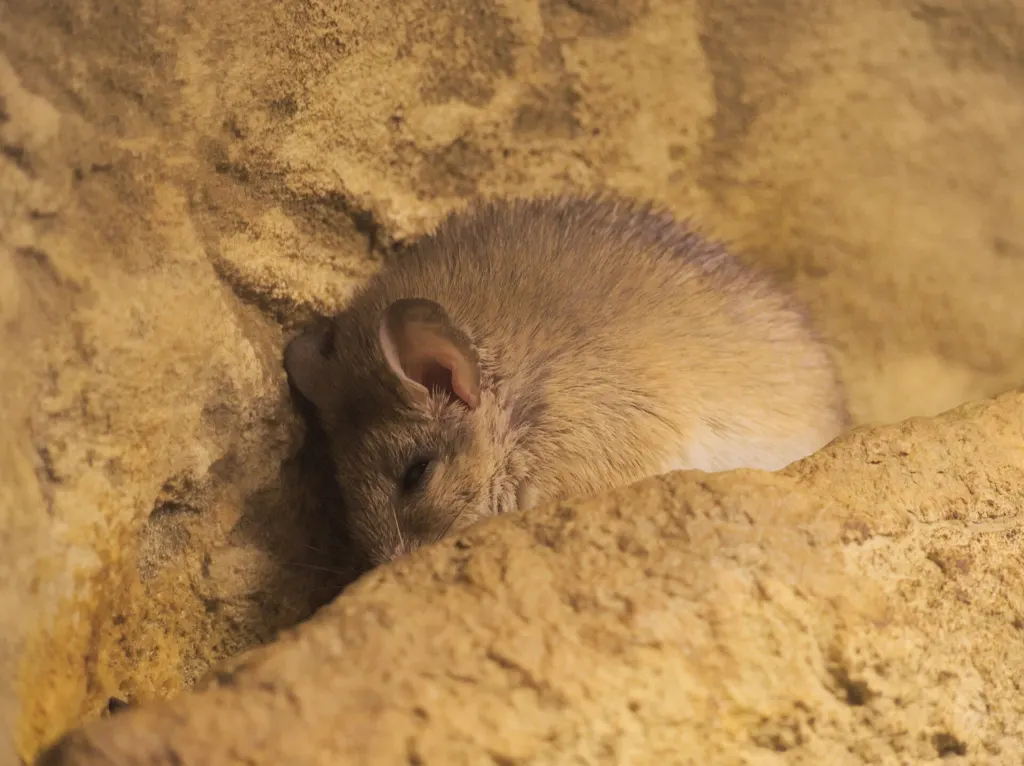
Hair follicles do not need a master plan to find their places. A University of Geneva team has shown that one simple rule, dermal cells crawling toward a chemical signal in the skin, can reproduce the follicle layouts of two very different mammals: the laboratory mouse and the spiny mouse, whose hairs line up in strikingly regular, oriented rows. The study appeared in July in the Proceedings of the National Academy of Sciences (PNAS).
The old explanation
Hairs, feathers and scales all start as placodes, tiny clusters of cells in the embryo’s skin. In laboratory mice, new follicles appear in waves, each one an even distance from those already there. For years that was described by an expansion-induction model: existing follicles block new ones nearby, and as the skin stretches, fresh follicles fill the widening gaps.
The model described the mouse well, but it did not fit newer data suggesting that skin appendages organize themselves through reaction, diffusion and chemotaxis, meaning cells moving along a chemical gradient. And it failed outright for the spiny mouse.
What the Geneva team did
Muhamet Ibrahimi, Ebrahim Jahanbakhsh, Athanasia Tzika and Michel Milinkovitch built a mathematical model of mobile dermal cells drifting toward a chemical attractant made by the skin’s outer layer, set on a flat sheet that grows like embryonic skin. They then compared simulations and mathematical analysis with real developmental data.
Two results stood out. First, the chemotaxis model naturally produced the same even-spacing rule seen in laboratory mice, so the old geometric rule turns out to be a side effect of cell movement rather than its cause. Second, when the team let cells move more easily in one direction and fed in the uneven skin growth measured in real spiny mouse embryos, the model recreated that species’ long-range order and fixed orientation, something expansion-induction could not do.
Two models side by side
- Expansion-induction: each follicle sends a stop signal to its neighbors; new ones appear in the gaps as skin grows. Fits lab mice, fails for spiny mice.
- Chemotaxis: cells cluster where a chemical cue is strongest, and clusters reshape the cue around them. Fits both species once direction-dependent movement and growth are added.
The authors suggest that small differences in the chemotaxis step may explain why hair patterns vary so much between species. The Milinkovitch-Tzika lab describes it as simple cellular interactions generating diverse tissue layouts across mammals.
Limits
This is modeling checked against embryo data, not a direct experiment that tracks the chemical. The study refers to a generic epidermal chemoattractant without naming the molecule, and it covers two rodent species, not humans. It explains where follicles form and how the pattern is oriented in the spiny mouse; it does not address hair growth or loss in people.
Animal coats have a habit of hiding neat biology, from why calico cats are almost always female to the extra-long outer hair of Highland cattle. The PNAS paper, volume 123, issue 27, was funded by the Swiss National Science Foundation and is open access.
Image: C messier, CC BY-SA 4.0 via Wikimedia Commons
This article was produced with AI assistance and reviewed by our Editorial Desk. How we work.