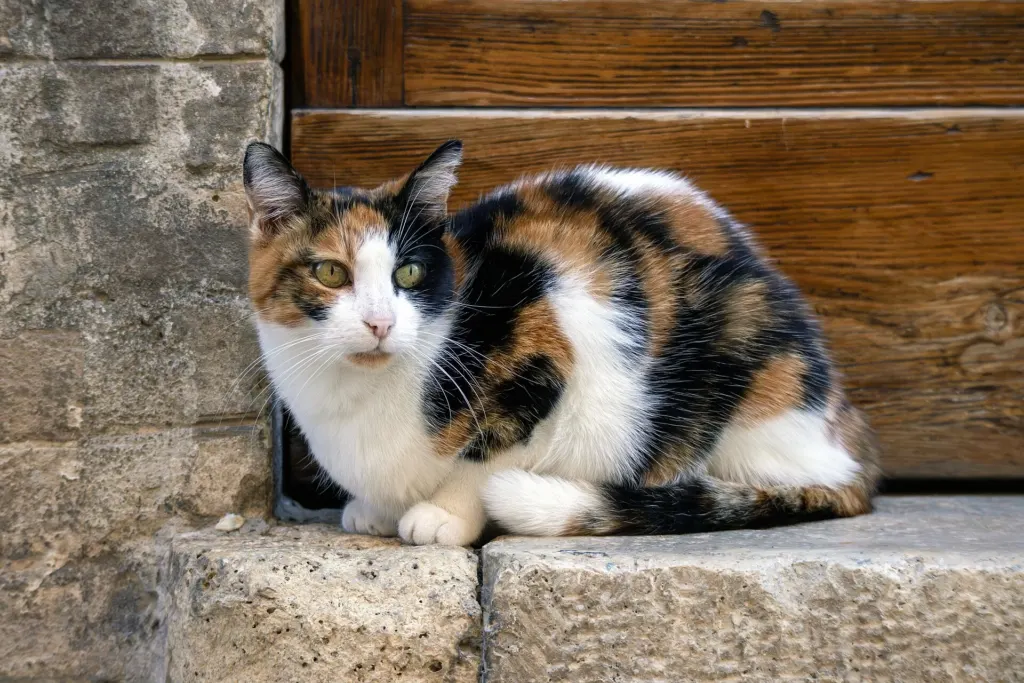
Almost every calico cat you meet is female, and the reason sits on a single chromosome. The gene that decides whether a patch of fur turns orange or black lives on the X chromosome, so a cat needs two X chromosomes to show both colors at once. Most males have only one.
That rule took researchers more than a decade to pin down, and cats were part of the story from the start.
What makes a calico a calico
“Calico” names a coat pattern, not a breed. The reference entry on calico cats defines it as any domestic cat with black-based and red-based patches plus white; outside North America the same look is usually called tortoiseshell and white. A tortoiseshell, or tortie, mixes black and orange with no white at all. The word itself was borrowed from printed calico cloth, which first came from Calicut in southwestern India.
The white is set by a separate piebald spotting gene on another chromosome. As a rough guide, the more white a cat carries, the bigger and fewer its orange and black patches, while a tortie without white often looks finely speckled.
How the X chromosome paints the coat
A female inherits one X from each parent. If one X carries the orange version of the color gene and the other carries black, she has both. Early in the embryo, each cell shuts down one of its two X chromosomes at random, and every cell descended from it keeps that choice. Skin built from one line of cells grows orange fur; skin from the other grows black. No two calicos end up with the same map.
A typical tomcat is XY. His Y chromosome has no copy of the color gene, so he carries a single version and comes out ginger or not ginger, never a blend of the two.
A timeline written in cat cells
- 1948: Murray Barr and his graduate student E. G. Bertram notice small, dark, drumstick-shaped masses in the nerve-cell nuclei of female cats but not males. They become known as Barr bodies.
- 1959: Japanese cell biologist Susumu Ohno identifies Barr bodies as X chromosomes.
- 1961: Mary Lyon proposes X-inactivation, the idea that one of a female mammal’s two X chromosomes switches off, after studying coat colors in mice.
Put together, the three findings explain a calico’s coat in one line: two X chromosomes, one silenced at random in each patch of cells.
The rare male calico
Male calicos do turn up, but only through a genetic slip. The usual route is an extra X chromosome left over from faulty cell division, giving the cat an XXY set, the feline counterpart of Klinefelter syndrome. Chimerism, where one animal carries cells from two embryos, is another. These males are nearly always sterile: only about one in ten thousand of them is an exception, and most cat registries will not accept a male calico as a show cat even then.
Chance in the coat also defeats copying. CC, short for Copy Cat, was cloned from a calico domestic longhair named Rainbow, yet the clone’s patches did not match the donor’s.
Badiyaa covered the same genetics through one fluffy example in our story on a tortoiseshell Maine Coon kitten whose coat won fans online. For more on reading cats, see how a raised tail signals a friendly approach and why cats meow more when a person can fix the problem.
Lucky cats and a state symbol
Folklore in many places treats the pattern as a charm. German speakers call a calico a Glückskatze, or lucky cat; some Americans say money cat; and Japan’s beckoning maneki-neko figures are often painted in calico colors. Japanese sailors kept calicos aboard as ship’s cats to ward off bad luck at sea.
Maryland made the calico its official state cat on October 1, 2001, picking it because white, black and orange match the state bird, the Baltimore oriole, and the state insect, the Baltimore checkerspot butterfly.
Further reading
Image: Terragio67, CC BY-SA 4.0 via Wikimedia Commons
This article was produced with AI assistance and reviewed by our Editorial Desk. How we work.