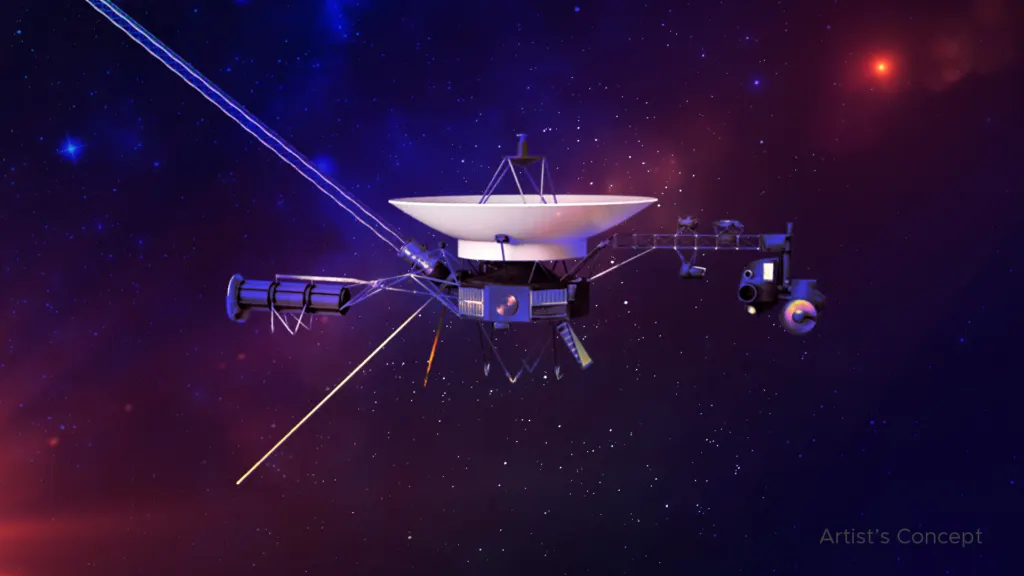
On Wednesday, November 18, 2026, at 5:16:07 a.m. EST, Voyager 1 will sit 25,902,068,356 kilometers (16,094,799,096 miles) from Earth, the distance light covers in exactly 24 hours. From that moment, a “hello” sent from a NASA dish needs a full day to reach the probe, and its answer needs another full day to come back.
That is the figure NASA gives on its light-day explainer page, and no other human-made object has been this far away. We covered the date and the agency’s flashlight celebration in our story on NASA’s V-G-R Morse code invitation. This piece does the arithmetic behind the milestone.
The math of a light-day
Light moves at 299,792 kilometers per second. Multiply by the 86,400 seconds in a day and you get roughly 25.9 billion kilometers, which matches NASA’s figure to the kilometer once you use the exact speed of light.
Voyager 1, by comparison, is cruising at about 61,000 kilometers per hour, or nearly 38,000 mph, according to NASA. Over one day that adds about 1.46 million kilometers. Divide that by the speed of light and the signal delay grows by about 4.9 seconds every day.
Scale it up and the delay climbs by roughly half an hour a year. Published mission figures for Voyager 1 put its yearly travel at about 523 million kilometers; at the speed of light, that distance takes about 29 minutes to cross.
NASA says the trip to one light-day will have taken 49 years, two months and 11 days since launch on September 5, 1977. That is close to 18,000 days of flying to match a single day of light travel.
When will it reach two light-days?
Here is where the numbers turn sobering. At about 523 million kilometers a year, Voyager 1 needs roughly another 49 to 50 years to add a second light-day, which puts two light-days somewhere in the mid-2070s.
The spacecraft will not be talking to us by then. Its three plutonium power units have been losing output for decades. Power is expected to run out for even one science instrument at some point between 2027 and 2036, and after 2036 both Voyagers are expected to be out of range of NASA’s Deep Space Network. Only two instruments, the magnetometer and the plasma wave subsystem, were still on as of 2026, after the team shut off the cosmic ray subsystem in February 2025 and the low-energy charged particle instrument in April 2026.
If Voyager 1 keeps transmitting until 2036, our estimate puts it at about 31 billion kilometers out, or roughly 28 light-hours. Its last words, whenever they come, will take more than a day to arrive.
One caveat on the clock
The “distance from Earth” figure is a moving target in a second way. Earth itself loops around our star on an orbit about 300 million kilometers across, which is about 16 light-minutes. Depending on where our planet sits in its orbit, the gap to Voyager 1 is a few light-minutes longer or shorter than its distance from the solar center. That is why NASA gives an exact crossing time to the second, calculated for one point on Earth’s path.
How it compares
- The Moon: about 1.3 light-seconds away.
- Our own star: about 8 minutes and 20 seconds.
- Neptune: about four light-hours and 10 light-minutes on average.
- Proxima Centauri, the nearest star system: about 4.24 light-years.
Voyager 1 is drifting toward a dim star called Gliese 445 in Ursa Minor and should come no closer than about 1.7 light-years to it, some 40,000 years from now. For a sense of just how distant the outer solar system already is, see our story on the dwarf planet Sedna’s 11,400-year orbit, or our look back at Voyager 1’s Saturn flyby in 1980.
Its twin, Voyager 2, launched first in 1977 and took a slower route past Uranus and Neptune. NASA expects it to reach one light-day from Earth in November 2035.
Further reading
Image: NASA/JPL-Caltech, Public domain via Wikimedia Commons
This article was produced with AI assistance and reviewed by our Editorial Desk. How we work.