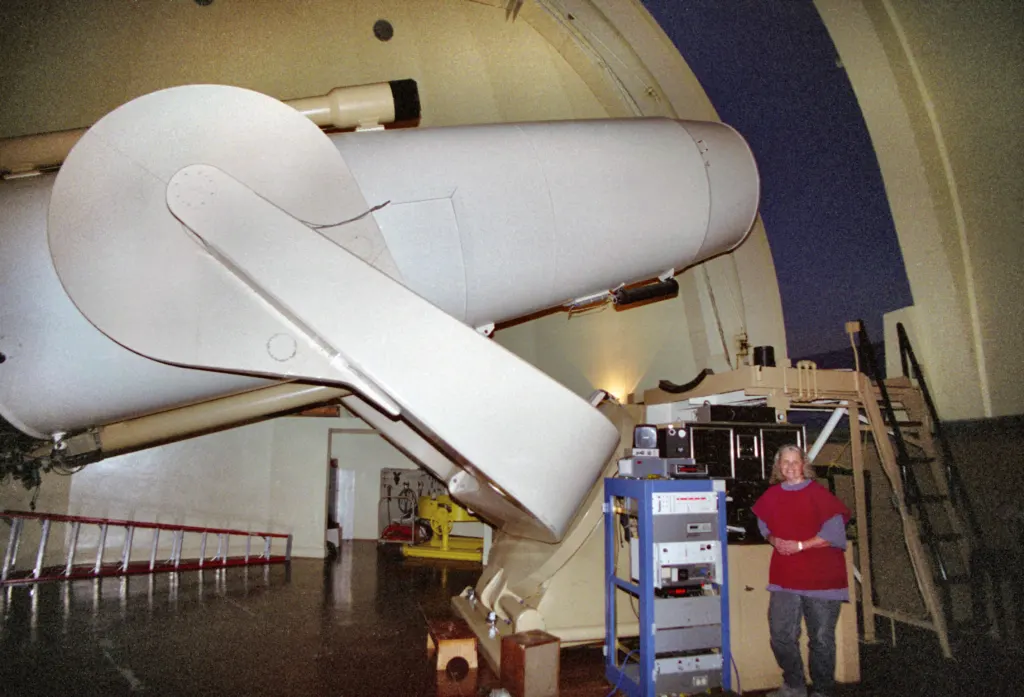
On November 14, 2003, a faint dot crept 4.6 arcseconds across the sky in 3.1 hours on images from the Samuel Oschin telescope at Palomar Observatory in Southern California. That sluggish drift told Michael Brown of Caltech, Chad Trujillo of Gemini Observatory and David Rabinowitz of Yale that the object sat roughly 100 times farther out than Earth. They had found Sedna, and 23 years later it is still one of the strangest bodies circling our star.
The find came out of a sky survey the trio started in 2001, using Yale’s 160-megapixel Palomar Quest camera. Follow-up work through November and December 2003 drew in telescopes in Chile, Arizona and Hawaii, and older frames from August 2003, plus 2001 and 2002 data from a near-Earth asteroid program, pinned down its path. Archive searches later turned up Sedna on plates from September 25, 1990.
A ghost ship, then a sea goddess
Because the dot moved so slowly that it had hidden in plain sight, Brown first called it “The Flying Dutchman,” or simply “Dutch,” after the phantom ship of sailors’ legend. The permanent name came from Sedna, the Inuit goddess of the sea and its animals, who in tradition lives at the bottom of the Arctic Ocean, a fitting home for something so cold and remote. The team announced the name before the object had received its official number, which annoyed some amateur astronomers and drew a protocol complaint from the head of the Minor Planet Center. The naming committee of the International Astronomical Union approved it anyway in September 2004.
An orbit that breaks the pattern
Sedna is about 1,000 kilometers (620 miles) across and one of the reddest objects known in the solar system, almost as red as Mars, a color linked to organic sludge called tholins on its icy surface. Its orbit is the real puzzle. One full orbit takes roughly 11,400 years. At its closest it comes within 76 astronomical units (AU, the Earth–Sun distance); at its farthest it swings out to about 937 AU, some 19 times Pluto’s greatest distance.
Here is the scale in plain arithmetic. Sunlight needs about 8.3 minutes to cross 1 AU, so at 937 AU it would need 937 x 8.3, or about 7,780 minutes. That works out to roughly 5.4 days for a ray of sunlight to reach Sedna at the far end of its loop.
Neptune cannot have flung it there, because Sedna never comes close enough for the giant planet’s gravity to matter. Brown’s team proposed a passing star, a sibling star from the cluster where our star was born or an unseen planet. That last idea grew into the Planet Nine hypothesis, which Konstantin Batygin and Brown put forward to explain the clustered orbits of a group of distant objects, Sedna included. “I call Sedna a fossil record of the earliest Solar System,” Brown said in 2006.
Sedna also helped force the 2006 rewrite of what counts as a planet. Early headlines in March 2004 called it a tenth planet; most astronomers now treat it as a dwarf planet, though the IAU’s own short list has not grown since 2006. Fresh candidates keep arriving, including the Rubin Observatory’s first dwarf planet candidate beyond Pluto. For a sense of how slowly anything travels that far, Voyager 1 is only now reaching one light-day from Earth after almost half a century of flight, and Sedna’s far point sits several times farther out still.
The 2076 window
Sedna is now heading inward and will reach perihelion around July 2076. Planners have sketched flyby routes using a Jupiter gravity assist, with possible launches on May 6, 2033 or June 23, 2046 and arrival near the end of 2057 or 2070. Miss that pass, and the next close approach falls more than 11 millennia away.
Further reading
Image: Michael Vergara, CC BY-SA 3.0 via Wikimedia Commons
This article was produced with AI assistance and reviewed by our Editorial Desk. How we work.