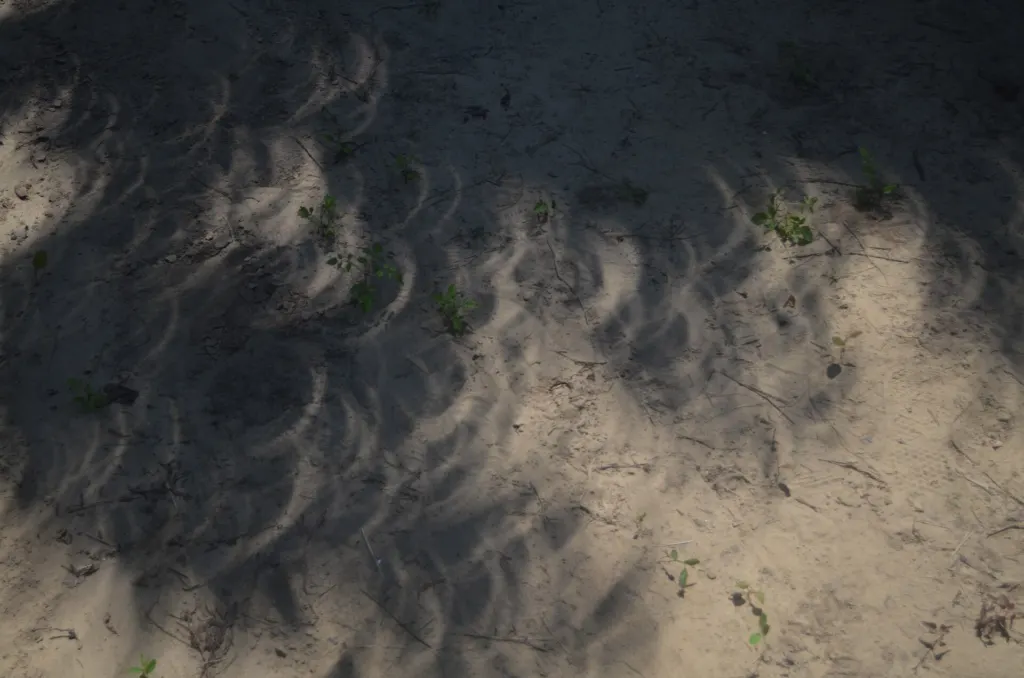
During a partial solar eclipse, the dappled light under a leafy tree turns into dozens of tiny crescents, each one a small picture of the eclipsed sun. Nothing about the tree changes. Every small gap between overlapping leaves is working as a pinhole camera, as the physics of pinhole images explains.
On an ordinary day those same gaps throw round blobs of light onto the ground. People rarely notice that the blobs are round because the solar disk is round, not because the holes are.
How a gap in the leaves makes a picture
A pinhole camera is a dark box with one tiny opening. Light from each point of a bright object travels in a straight line through the hole and lands on a matching point on the far wall, so the whole scene appears there, upside down. Thinkers described the effect in the Chinese Mozi writings around 500 BCE, and Ibn al-Haytham studied it in the eleventh century. For centuries, people used darkened rooms with a small hole in a shutter to watch eclipses without staring straight at it.
A tree canopy does the same job with no box at all. The shade is the dark room, the sidewalk is the screen, and the leaves supply hundreds of openings. When the Moon bites a notch out of the solar disk, every projected spot loses the same notch. A 1999 NASA Astronomy Picture of the Day showed exactly this on the campus of Northwestern University in Evanston, Illinois, where a tall tree projected dozens of crescents from a 1994 eclipse onto the pavement, as the picture’s explanation notes.
During an annular eclipse, when the Moon looks slightly too small to cover the whole sun, the spots become thin bright rings instead.
How big will the crescents be?
The size depends on one thing: how far the light travels from the gap to the ground. Seen from Earth, the solar disk spans between 31 arcminutes 27 seconds and 32 arcminutes 32 seconds, roughly half a degree, according to tables of angular diameter. Half a degree works out to a ratio of about 1 to 108.
- A gap 3 meters (about 10 feet) above the ground gives crescents roughly 2.8 centimeters, a little over an inch, across.
- A gap 10 meters (about 33 feet) up gives crescents of about 9 centimeters, near 3.5 inches.
- A pinhole in a cereal box 1 meter long gives an image under a centimeter wide.
That is why tall trees make the most striking displays: their projections are bigger, though fainter. Smaller gaps give sharper edges, but past a point the image grows dim. Optimally, a pinhole is no wider than about one hundredth of its distance from the screen.
Why the Moon fits so neatly
The Moon’s apparent size ranges from 29 arcminutes 20 seconds to 34 arcminutes 6 seconds, which brackets the solar disk’s. When the Moon sits near the large end, it can cover the solar disk completely; near the small end, a ring of sunlight survives. Those same two outcomes show up on the ground beneath trees as crescents or rings.
Try it without a tree
NASA lists a pinhole projector as an indirect way to watch our star when eclipse glasses are not at hand, since it throws an image onto a nearby surface instead of into anyone’s eyes. A colander, a cracker with holes, or two hands with crossed fingers will also throw a grid of little suns onto paper.
Badiyaa’s Science page covers more sky events, including the Taurid fireballs and their November peaks and the Orionid meteors from Halley’s Comet.
The next total solar eclipse visible from the contiguous United States arrives on August 23, 2044, according to NASA.
Further reading
Image: B137, CC0 via Wikimedia Commons
This article was produced with AI assistance and reviewed by our Editorial Desk. How we work.