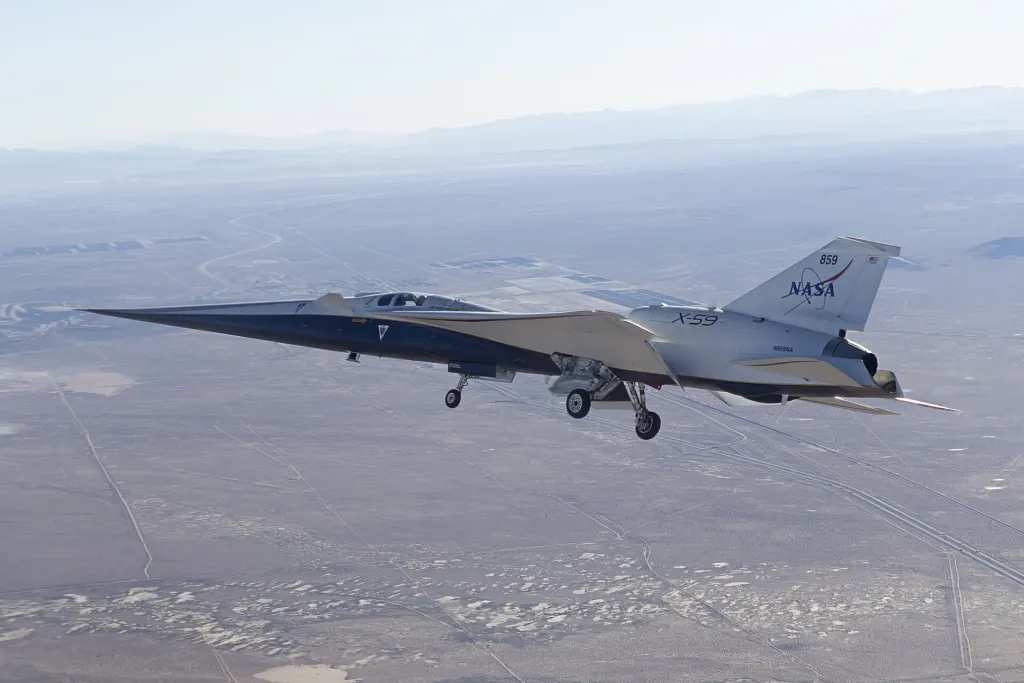
NASA’s X-59, the one-of-a-kind jet built to fly faster than sound without a loud sonic boom, has made its first trip across the United States, hopping from California through El Paso and Fort Worth, Texas, to the Kennedy Space Center in Florida. The ferry flight began on October 28, 2026, exactly one year after the aircraft first left the ground, and by that anniversary it had logged 41 flights in total.
The X-59 is a research tool, not a prototype airliner. Each sortie widens what engineers call the flight envelope, the range of speeds and altitudes the jet is cleared to fly. NASA’s one-year progress report says the plane has now climbed past 56,000 feet (about 17,070 meters) and reached Mach 1.53, roughly 1.5 times the speed of sound.
Why Fort Worth keeps showing up in the X-59 story
The Texas stop was not the jet’s first visit to Fort Worth. Lockheed Martin’s Skunk Works assembled the X-59 in Palmdale, California, but in late 2021 the half-finished airframe was trucked to the company’s Fort Worth plant, where the F-16 fighter was built for decades. There, according to NASA, engineers loaded its structure 25 percent beyond anything it should meet in flight.
“Everything is passing with flying colors, and nothing is bending in a way we didn’t expect,” Lockheed engineer Mike Buonanno said in early 2022. This autumn it passed back through the city under its own power.
Palmdale has its own film-history quirk: one of its giant hangars hid the airport set for a Tom Hanks comedy, as Badiyaa explained in its story on how The Terminal was shot inside an Air Force bomber hangar.
A first year in numbers
- October 28, 2025: first flight from Air Force Plant 42 in Palmdale, a subsonic systems check of about an hour.
- April 3, 2026: first flight with the landing gear retracted, at about 20,000 feet.
- June 5, 2026: first supersonic run, near Mach 1.1, followed a week later by Mach 1.4.
- Late September 2026: six flights in a single week, a program record.
- October 28, 2026: 41 flights, a 56,000-foot ceiling and Mach 1.53.
Those dates come from the X-59’s Wikipedia entry and NASA’s mission blog. Read side by side, they show a program that spent most of a decade on the ground and then moved quickly once it flew.
What the trip to Florida was for
The destination was MAX POWER, an aerospace expo and air show held on and near Kennedy Space Center from November 6 to 8. In its media advisory, NASA listed the X-59 among its displays and scheduled a briefing with test pilot Jim “Clue” Less, Aeronautics Division director Laurie Grindle and Quesst mission manager Peter Coen. The same weekend NASA also gave an update on its lunar Moon Base, the program behind the $10 billion ceiling for Moon Base cargo landers.
The limits: the hard part has not started
So far the X-59 has proved it can fly. It has not yet proved the thing it was built for. The jet’s long, narrow shape is meant to stop shock waves from merging, so that at its planned cruise of Mach 1.4 and 55,000 feet people below hear a soft thump rather than a boom. NASA compares that sound to a car door closing about 20 feet (6 meters) away.
That claim rests on design work and wind-tunnel models, not on recordings from the real aircraft. The next phase, which NASA calls acoustic validation, will measure the sound on the ground. After that, the plan is to fly over US communities and ask residents what they heard. Wikipedia’s account says results were slated to reach the Federal Aviation Administration and the International Civil Aviation Organization in 2027, which could feed a decision on supersonic flight over land around 2028.
The current US ban is based on speed, not noise, so good thump data could let regulators write a noise limit instead. NASA has long used odd flight profiles for research, from the KC-135 Vomit Comet dives behind Apollo 13’s weightless scenes to this jet; for the X-59, the first ground recordings of a real overflight are the next milestone.
Further reading
Image: NASA Armstrong Flight Research Center / NASA/Lori Losey, Public domain via Wikimedia Commons
This article was produced with AI assistance and reviewed by our Editorial Desk. How we work.