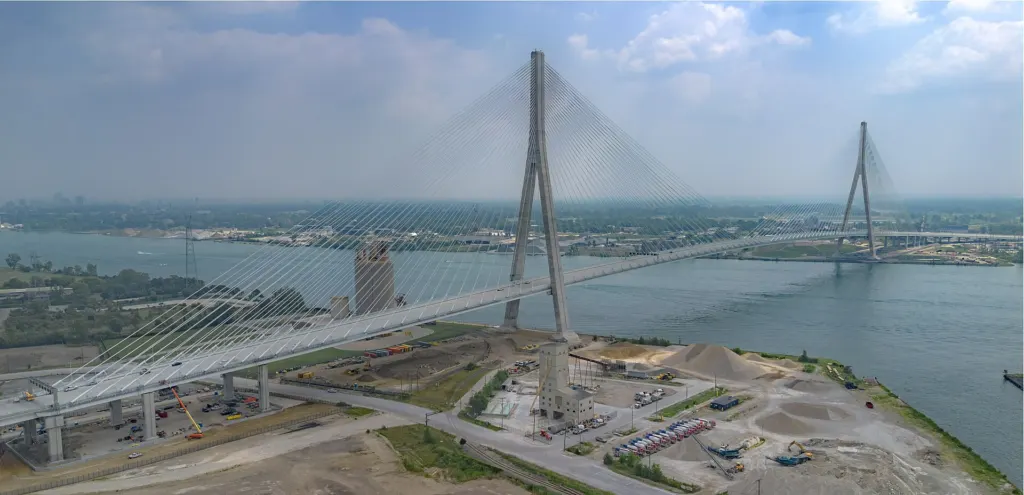
The Gordie Howe International Bridge, the first new crossing between Ontario and Michigan in more than 60 years, carries traffic over the Detroit River on a main span of 853 meters (about 2,800 feet). No other cable-stayed bridge in North America has a longer main span, and since July 27, 2026, cars and trucks have been driving across it between Detroit and Windsor.
For readers outside the region: the Detroit River is the border between the United States and Canada at this point, and the corridor is one of the busiest trade routes on the continent. The Windsor-Detroit Bridge Authority, the Canadian federal Crown corporation that runs the bridge, puts trade between Michigan and Ontario along it at $300 billion a year.
How the bridge is built
A cable-stayed bridge hangs its road deck straight from tall towers on fans of steel cables, rather than from two big main cables draped between towers as on a suspension bridge. Here, two A-shaped towers rise 220 meters (722 feet), one on each bank, and 216 cable stays hold up the deck. Because the towers stand on land, there are no piers in the water.
The towers were drawn by AECOM’s chief bridge architect, Erik Behrens, to suggest hockey sticks swung back for a slapshot, a nod to the man the bridge is named for. The full bridge runs 2.5 kilometers (1.6 miles), with six traffic lanes and clearance of 46 meters above the river at its highest point.
The design also fixes an old annoyance. The 1929 Ambassador Bridge nearby lands on city streets on the Canadian side. The new bridge links Ontario’s Highway 401 straight to Interstate 75 in Michigan, so drivers can stay on freeways from one country to the other.
The numbers behind it
- 16 toll lanes and 60 Canadian and US inspection lanes, at ports of entry the authority calls the largest on the Canada-US border.
- More than 15,800 people worked over 20.1 million hours on the project since construction began in 2018.
- A $6.4 billion project contract (Canadian dollars), which includes 30 years of operation and maintenance by the Bridging North America consortium.
- Car tolls of US$5.75 or CA$8 one way, with the walking and cycling path free.
Divide those hours by the workforce and each person averaged roughly 1,270 hours on site, about 32 standard 40-hour weeks.
Who was Gordie Howe
Gordie Howe was a Canadian ice hockey player who spent 25 seasons with the Detroit Red Wings, which made him a fitting symbol for a bridge joining a Canadian city to a US one. The name was announced in 2015. Howe died in 2016, two years before construction began; his family attended the July 24 ribbon-cutting and said in a statement that they were “humbled by the magnificence and magnitude of this moment.”
On foot and by bike
The multi-use path opened on August 5, 2026, with its own customs areas at each end. It is the first international border crossing to join the Trans Canada Trail, the cross-country trail network, and links to trails on both banks. At night, the bridge glows with an architectural lighting design called Shimmer by Canadian artist Douglas Coupland.
Badiyaa has looked at other engineering fixes for moving people and goods, from the steel-mat runway kits of World War II to a 1990 Wisconsin test road built over shredded tires.
Further reading
Image: WMrapids, CC0 via Wikimedia Commons
This article was produced with AI assistance and reviewed by our Editorial Desk. How we work.