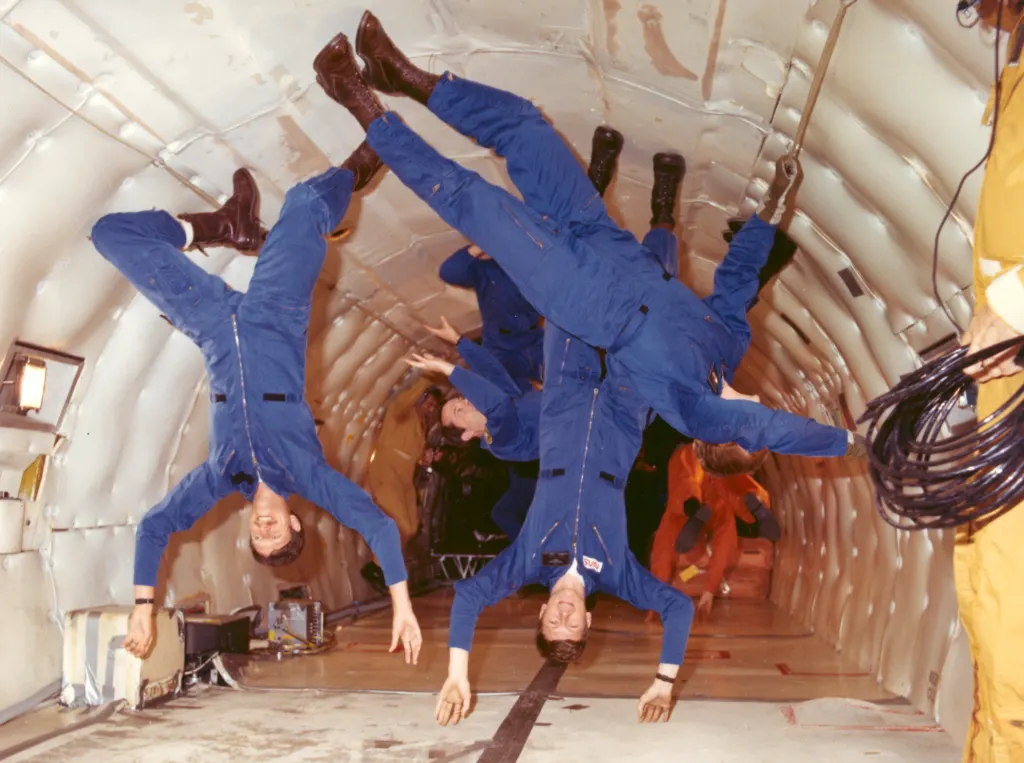
The floating astronauts in Apollo 13 were not hanging from wires. Ron Howard’s cast really was weightless, in roughly 23-second bursts, aboard a NASA jet that dove toward the ground hundreds of times so the camera could roll. The production logged 612 zero-g maneuvers to collect three hours and 54 minutes of usable filming time.
The aircraft was a KC-135, a military tanker that NASA used as a reduced-gravity trainer, and the nickname it earned among passengers is the one most people remember: the “Vomit Comet.”
How a plane switches gravity off
The trick is a flight path called a parabola, the same arc a thrown ball follows. The jet climbs steeply, at a nose-up angle of about 45 degrees. The pilots then cut thrust to the point where the engines only cancel out air drag and push the nose over, so the plane falls along the same curve a free-falling object would.
For those seconds the cabin floor no longer pushes up on anything inside it. People, cameras and props all fall at the same rate as the aircraft, so relative to the cabin they float. Weightlessness actually starts while the plane is still climbing and lasts over the top and into the dive, until the nose points down at roughly 30 degrees. Then the pilots pull up hard, and everyone feels close to twice their normal weight before the next climb.
A NASA photo caption from a later shuttle crew’s training session describes the same routine plainly: astronauts floated “as the plane flies a series of climbs and dives – called ‘parabolas’ – over the Gulf of Mexico.”
The numbers behind Apollo 13’s floating scenes
Each parabola gives about 25 seconds of weightlessness out of roughly 65 seconds of flight, and a typical training sortie runs 40 to 60 of them. Run the film’s figures and they line up:
- Filming time: 3 hours 54 minutes is 14,040 seconds.
- Per maneuver: 14,040 divided by 612 is about 22.9 seconds of floating each time.
- Total flying in parabolas: 612 times 65 seconds is about 39,800 seconds, or roughly 11 hours of climbing and diving.
- Sorties: at 40 to 60 parabolas a flight, that is somewhere between about 10 and 15 flights.
Steven Spielberg suggested the approach when Howard worried about faking weightlessness convincingly. Building the spacecraft interiors to fit inside the plane, the production used modified command and lunar module sets, while Tom Hanks, Kevin Bacon and Bill Paxton flew from Johnson Space Center in Houston. The engines were so loud that all the dialogue recorded in flight was unusable, and the three actors re-recorded their lines later in a studio.
Hanks has said that floating for real, rather than spending days in painful harnesses, made the shoot “completely glorious.” The cast reported bumps and bruises, mostly from unpadded fittings, and only a few people got motion sickness.
Why it is called the Vomit Comet
About two-thirds of passengers on parabolic flights get airsick. John Yaniec, a former director of NASA’s Reduced Gravity Research Program, put it more bluntly, estimating that “one third [become] violently ill, the next third moderately ill, and the final third not at all.”
The idea is older than the space program. German brothers Fritz and Heinz Haber proposed parabolic flight as a way to simulate weightlessness in 1950, and Project Mercury astronauts trained on a C-131 Samaritan in 1959.
Where the Apollo 13 jet is now
NASA flew two KC-135s. The one used by the film crew, registered N931NA, made its last flight on October 29, 2004, and is stored at the Pima Air & Space Museum in Tucson, Arizona. NASA ended its own Reduced Gravity Research Program in July 2014 and now buys flights from private operators, while Europe flies an Airbus A310 called Zero-G from Bordeaux, the same aircraft type Tom Cruise used for weightless scenes in The Mummy in 2017.
For more on how astronauts cope once they are actually in orbit, see how ISS astronauts are weighed by a spring-loaded arm, and how China’s Tiangong space station chilled atoms to 9.7 picokelvin in microgravity.
Further reading
Image: NASA, Public domain via Wikimedia Commons
This article was produced with AI assistance and reviewed by our Editorial Desk. How we work.