Physicists working with a laser trap aboard China’s Tiangong space station have pushed about 20,000 rubidium atoms to an equivalent temperature of 9.7 trillionths of a kelvin above absolute zero, according to their paper in the journal Science. The team calls it a record, and the old mark was almost four times warmer at 38 picokelvin.
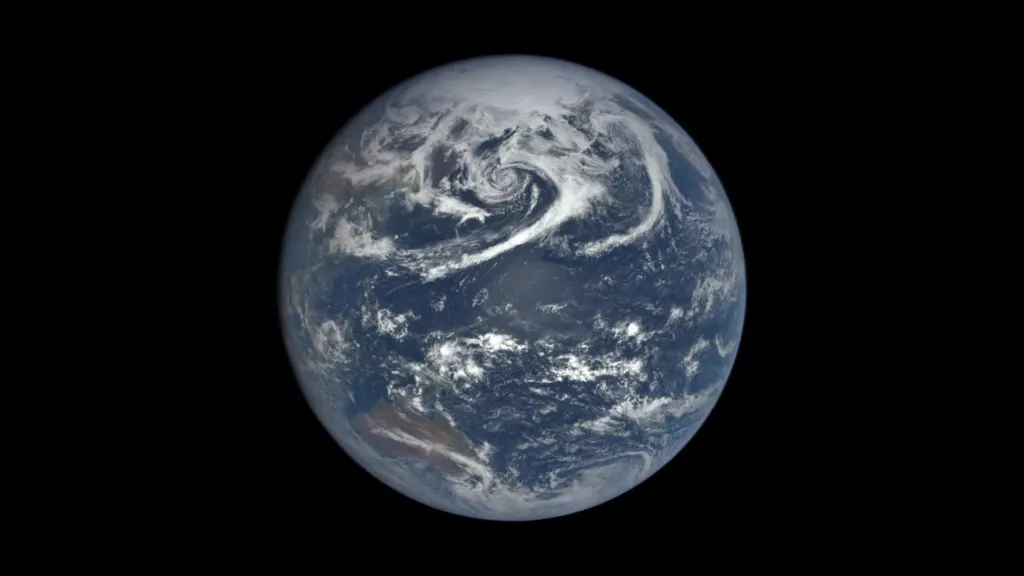
Deep space sits near 2.7 kelvin, the faint afterglow of the Big Bang. Divide 2.7 by 0.0000000000097 and you get roughly 280 billion, which is where the eye-catching comparison comes from.
The cloud also lingered. Released from its trap, it spread so slowly that the researchers could follow it for 7.0 seconds, against 2 seconds in the previous record run.
How do you cool something in orbit
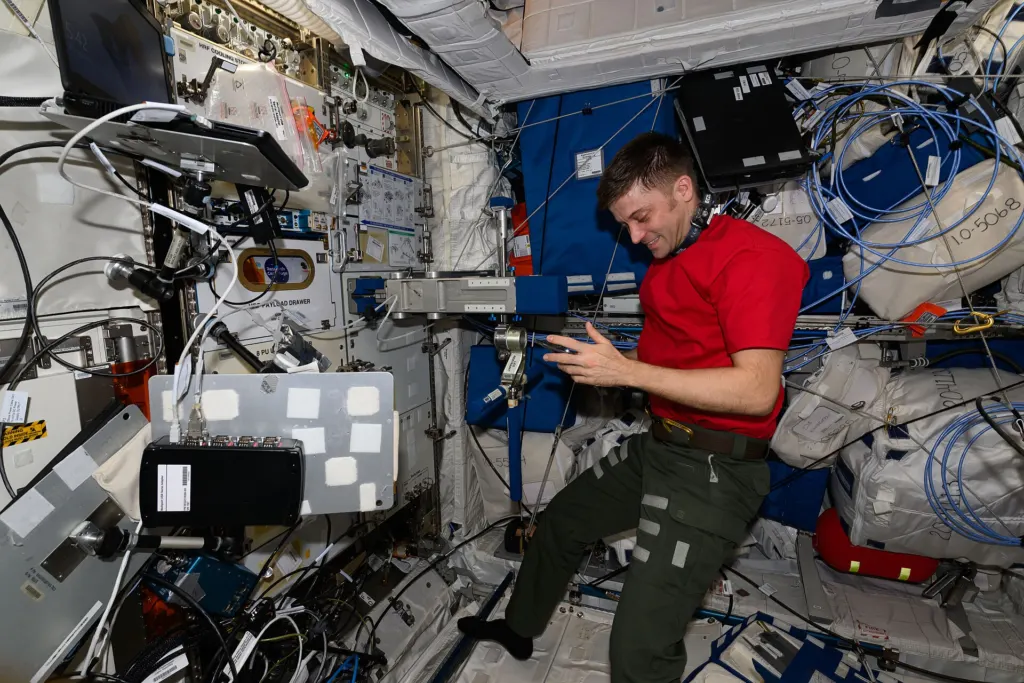
The apparatus is the Cold Atom Physics Rack in the station’s Mengtian module, which reached orbit in 2022. Its developers say they squeezed a ground setup of about 20 cubic meters and 10 tons into a cabinet of 0.7 cubic meters and roughly half a ton.
Lasers grabbed the rubidium-87 and held it in what physicists call an optical dipole trap. Next came evaporative cooling, the same trick that chills a mug of coffee: let the most energetic particles escape, and the ones left behind carry less energy on average.
Orbit created an awkward snag here. On the ground, gravity helps drag those fast atoms out of the trap. Without it, evaporation in a laser trap loses efficiency, so the team added a magnetic gradient that stood in for the missing pull. That produced a Bose-Einstein condensate, a state in which the atoms act together as a single quantum object.
A final stage relaxed the trap and let the condensate swell before release, draining away still more of its motion. The temperature itself came from watching how fast the freed cloud grew.
Why seven seconds beats a colder number
Gravity is the reason this had to leave Earth. A dropped object falls about 240 meters in seven seconds (half of 9.8 meters per second squared, times seven squared), so a ground lab would need a vacuum chamber taller than most skyscrapers to watch this cloud for that long.
According to the research team, ground experiments have offered roughly 0.05 seconds of observation, and the International Space Station about one second. Time is what instruments called atom interferometers feed on, because they use the wave nature of atoms to sense tiny accelerations, and they grow more sensitive the longer the atoms drift. The Chinese Academy of Sciences lists navigation, mapping of Earth’s gravity and tracking of glaciers and ocean currents among possible long-term uses.
The laser approach is the other novelty. Earlier microgravity records relied on magnetic traps built on atom chips, and the paper says optical traps had never before produced a degenerate quantum gas in microgravity. Light can hold atoms that magnetic fields cannot grip, which widens the menu of future experiments. In the authors’ words: “This record-low temperature could stimulate a new generation of ODT-based experiments in quantum simulation and precision measurements in space.”
For scale, the first gaseous condensate, made in Colorado in June 1995, sat at 170 billionths of a kelvin. The Tiangong cloud is about 17,500 times colder than that landmark, a gap closed in 31 years.
The limits of the record
“Equivalent temperature” is doing real work in this story. The number describes how slowly the atoms expand once they are set free. It does not mean the rack, the module or anything else on the station got that cold, and it is not a measure of ordinary thermal equilibrium.
The result also carries error bars. The paper gives 9.7 picokelvin with an uncertainty of plus 3.2 and minus 2.7, a range of 7.0 to 12.9. Run that range through the deep-space division and the comparison spans about 210 billion to 390 billion, so 280 billion is the midpoint of a wide band. Even the top of the range sits well under the old 38-picokelvin mark.
A sample of 20,000 atoms is tiny, and a separate group has yet to reproduce the experiment. The interferometers and navigation tools remain plans. Absolute zero itself stays out of reach: the third law of thermodynamics rules out arriving there in a finite number of steps.
The next test is in orbit. The paper’s data set is public on Zenodo, and the chief designer of China’s space application system has invited researchers abroad to propose work on the same rack.
Further reading
Image: Shujianyang, CC BY-SA 4.0 via Wikimedia Commons
This article was produced with AI assistance and reviewed by our Editorial Desk. How we work.