The New York airport where Tom Hanks spends nine months stranded in Steven Spielberg’s The Terminal never existed. The bustling concourse, with its shops, food court and departure gates, was a full working set built inside an aircraft hangar in the California desert, on a site where the US Air Force has assembled bombers.
The 2004 comedy-drama stars Hanks as Viktor Navorski, a traveler from the fictional country of Krakozhia who lands at John F. Kennedy International Airport just as a coup back home leaves his passport worthless. Unable to enter the United States or fly home, he makes a life inside the terminal. Catherine Zeta-Jones, Stanley Tucci, Diego Luna, Chi McBride and Zoe Saldaña fill out the airport around him.
No airport would host the shoot
Spielberg searched around the world for a real airport that would let him film for an entire production schedule, and none agreed. So the production built its own. The set went up in a massive hangar at the LA/Palmdale Regional Airport, part of the US Air Force Plant 42 complex, where Rockwell International had built the B-1B bomber.
Plant 42 is no ordinary film location. It sits in the Antelope Valley, about 60 miles from downtown Los Angeles, and covers more than 5,800 acres of Mojave Desert. Every Space Shuttle orbiter was assembled there, and contractors still work on aircraft such as the B-2 Spirit. In other words, Hanks spent his days in a pretend airport parked inside a real aerospace factory.
Built like a real building
The set was not a cardboard shell. It was built to full earthquake construction codes and modeled on Düsseldorf Airport in Germany. Seen from the side, both the real terminal and the replica take the shape of a cross-section of an aircraft wing.
That curved roofline caused a camera problem, and the fix made film history. The Terminal was one of the first movies to use the Spidercam, a cable-suspended camera best known from televised sports. Strung above the set, it let Spielberg glide across the concourse in long, sweeping shots that a crane could not manage. The look of the space owed a large debt to Jacques Tati’s 1967 comedy PlayTime, a film famous for its own giant modernist set.
Not everything was faked in Palmdale. The customs hall, offices and most of the exterior shots were filmed at Montreal-Mirabel International Airport in Canada.
How the illusion adds up
The film cost $60 million and grossed $219 million worldwide, with $77.9 million from North America and $141.2 million from other territories. That works out to roughly 3.65 times its budget, a solid return for a gentle comedy that takes place almost entirely in one room. Building rather than borrowing an airport also meant Spielberg could control every light, every crowd and every camera move without delaying a single real flight.
Hanks has form with this kind of movie trickery. His 1995 film Apollo 13 famously filmed its weightless scenes during 612 dives aboard NASA’s KC-135 “Vomit Comet”. Zeta-Jones, who played flight attendant Amelia Warren, is now back with a dangerous marriage counselor role in Tate Taylor’s Cupid, and Spielberg’s name still turns up in projects like the Robopocalypse series Ron Howard and Akiva Goldsman are making from his abandoned film.
The man behind the idea
The premise may trace back to Mehran Karimi Nasseri, an Iranian refugee known as Sir Alfred, who lived in Terminal 1 of Paris Charles de Gaulle Airport from 1988 until 2006. Spielberg bought the rights to his life story, but none of the studio’s publicity named Nasseri as an inspiration, and Viktor’s plot bears little resemblance to his experiences.
Hanks built Viktor’s accent and languages on his father-in-law, Allan Wilson, a Bulgarian immigrant, and Viktor speaks mostly Bulgarian on screen. The film opened in North America on June 18, 2004, and took $19.1 million in its first weekend.
Further reading
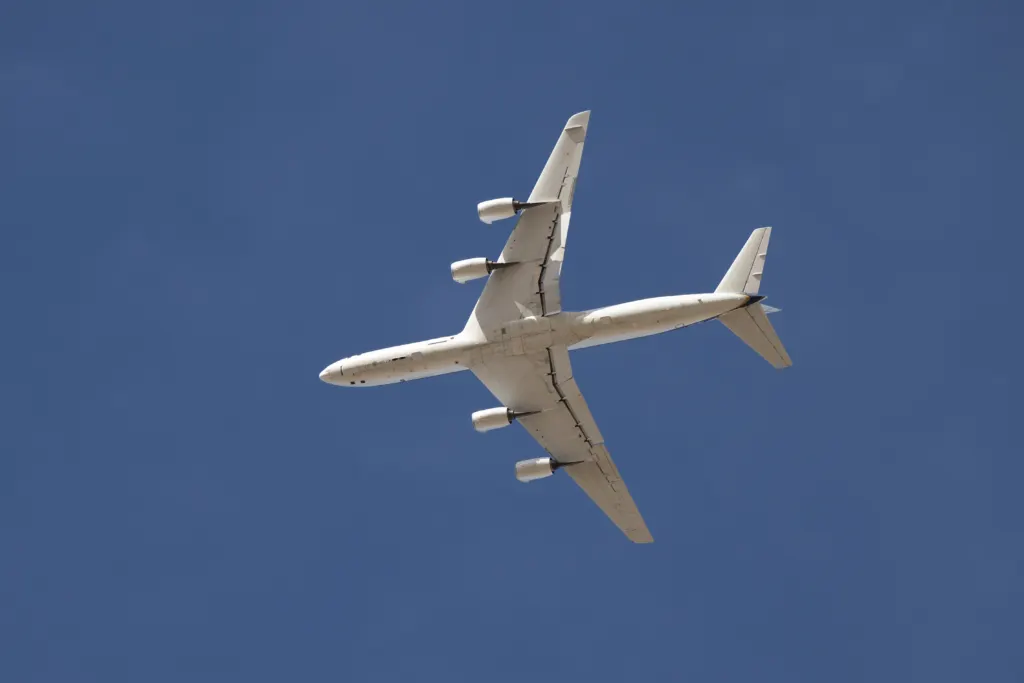
Image: NASA/Carla Thomas, Public domain via Wikimedia Commons
This article was produced with AI assistance and reviewed by our Editorial Desk. How we work.