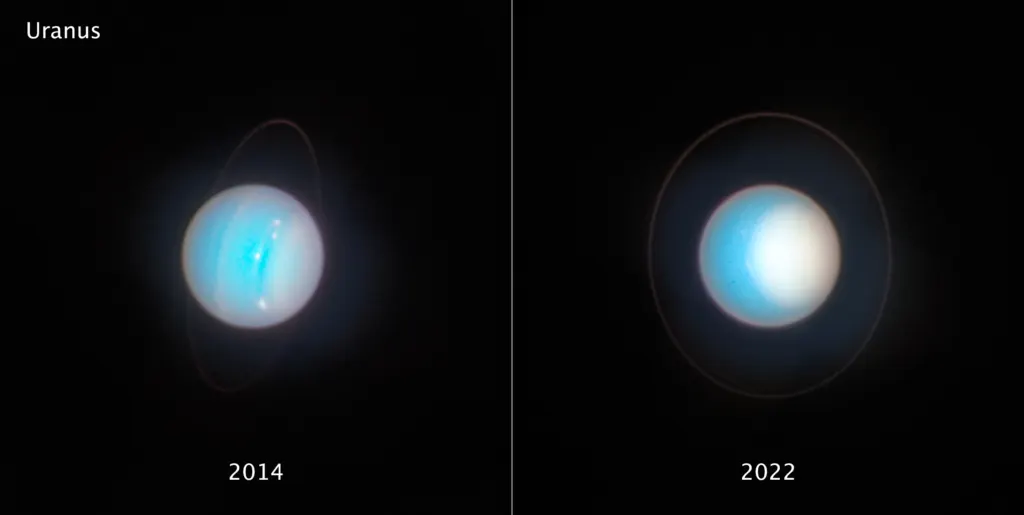
Uranus is tipped so far over that NASA lists its tilt at 97.77 degrees, and the result is a 21-year stretch of darkness over much of the planet each time winter comes around.
No other planet in the solar system comes close to this posture. NASA says the planet travels around the Sun “like a rolling ball,” with its equator nearly at a right angle to its orbit. The usual explanation is violent: something very large hit young Uranus and knocked it sideways. A competing idea says no giant hit was needed at all.
What 98 degrees does to a year
Tilt is what makes seasons, and Uranus has the most extreme set anywhere around the Sun, according to NASA. One orbit takes about 84 Earth years, while a single rotation lasts roughly 17 hours. Those two numbers set the whole calendar.
On Earth, the Sun climbs and falls in the sky but never parks over a pole. On Uranus, it does. Near solstice, one pole points almost straight at the Sun and the other faces deep space, with the planet’s day-night spin doing little to change that for anyone near the poles.
The math is simple. Divide the 84-year orbit by four and each season runs about 21 years. Published solstice and equinox dates fit that pattern almost exactly:
- 1986: southern summer solstice, the height of the season when Voyager 2 flew past
- 2007: equinox, with the Sun over the equator
- 2028: northern summer solstice
- 2050: the next equinox
That timeline carries a strange consequence. The only spacecraft ever to visit arrived during peak southern summer and could not observe the northern hemisphere at all. Everything since has come from telescopes watching the planet slowly turn its other side toward us.
The figure also needs a footnote. Astronomers can quote the tilt as 82.23 degrees or 97.77 degrees, depending on which pole they call north. Add the two together and you get 180, because they describe the same axis from opposite ends. The larger number follows the right-hand rule tied to the direction of spin.
The collision case
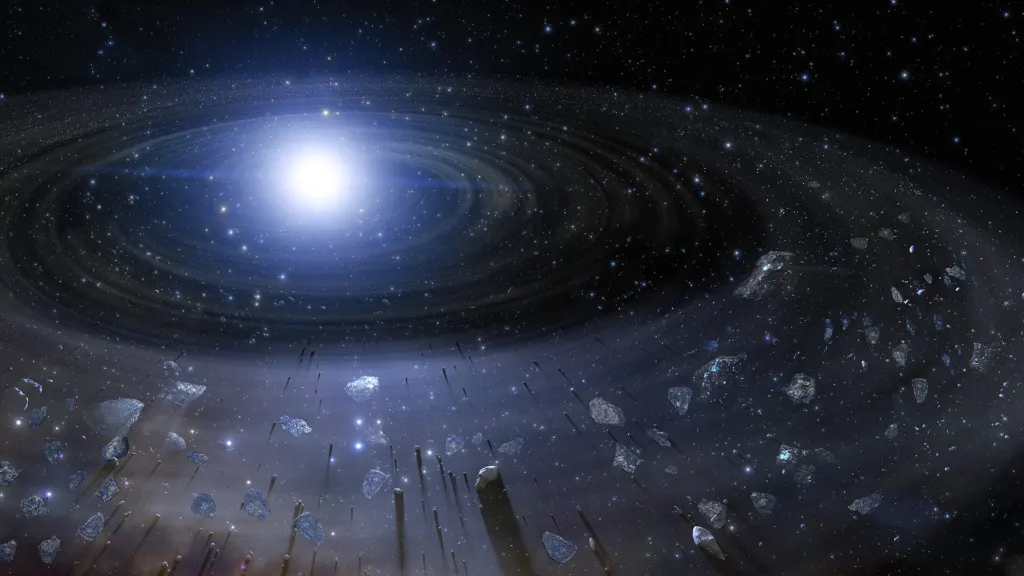
NASA’s fact page floats an ancient crash with something about Earth’s size. The most detailed modern test went bigger. In a 2018 paper in The Astrophysical Journal, Jacob Kegerreis and colleagues ran smoothed particle hydrodynamics simulations of a giant impact on the young planet, tracking where the material went.
Their results confirmed earlier, lower-resolution work: an impactor of at least two Earth masses can leave Uranus spinning fast enough. At least 90% of the atmosphere stayed gravitationally bound afterward. Much of the intruder’s ice and energy settled into a hot shell at around three Earth radii, a structure the authors say could explain why so little heat escapes the planet’s interior and could bear on its lopsided magnetic field. Rocky lumps embedded in the ice layer offer a second possible link to that field.
A sideways hit raises an obvious objection. Why do the moons of Uranus orbit neatly over its tilted equator? A 2012 analysis led by Alessandro Morbidelli offers an answer: a disk of debris around the planet would have been scrambled by the impact and then collapsed into a thin equatorial sheet, where the moons later formed. That scenario needs Uranus to have been somewhat tilted already before the final blow.
Limits: nobody has proved the crash
All of this is modeling. The impact is an inference from a planet’s present state, and the simulations show that a collision can work, which falls short of showing that one happened.
Rival physics exists too. A 2022 study led by Melaine Saillenfest argues the giant-impact picture has weaknesses and tests a gentler route: a single large ancient moon, migrating over billions of years, could drag the planet’s axis past 80 degrees through a gravitational resonance. The moon then destabilizes and crashes into the planet, freezing the tilt. Their simulations reach spin states like today’s with probabilities as high as 80%, favoring a bigger moon, and the authors say the basic scenario still has room to improve.
Both camps agree on the destination and disagree on the journey. The next milestone on that long calendar is close: northern summer solstice falls in 2028.
Further reading
Image: NASA, ESA, STScI, Amy Simon (NASA-GSFC), Michael H. Wong (UC Berkeley), Joseph DePasquale (STScI), Public domain via Wikimedia Commons
This article was produced with AI assistance and reviewed by our Editorial Desk. How we work.