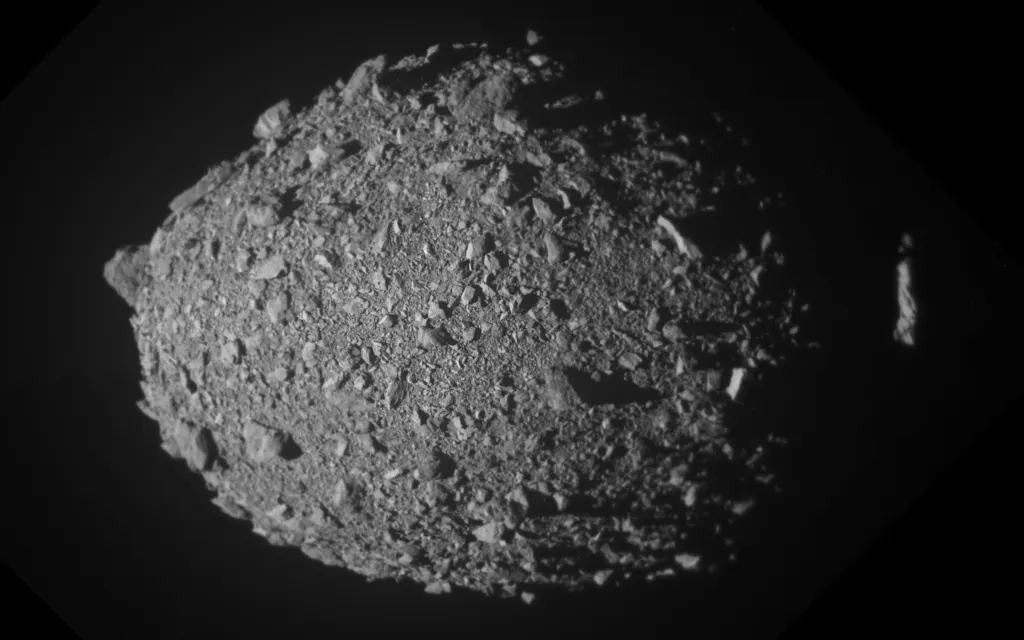
Four years after NASA rammed a spacecraft into a 151-meter asteroid on purpose, Europe has a probe parked beside the scene. The European Space Agency’s Hera spacecraft began its first close survey of the Didymos asteroid pair on November 11, 2026, opening a six-week phase meant to pin down the shape, mass and gravity of both rocks, including Dimorphos, the small moon that DART struck in 2022.
The target is unique. ESA calls Dimorphos the only object in the solar system whose orbit has been measurably shifted by people.
How Hera got there
Hera lifted off on a Falcon 9 from Cape Canaveral on October 7, 2024. It swung past Mars in March 2025, using the planet’s gravity to bend its path toward the asteroids, and grabbed pictures of the Martian moon Deimos on the way.
In October 2025, ESA said the spacecraft’s propulsion had behaved so well that controllers could brake “later and harder” on approach, bringing arrival forward by a month. “Hera is proving to be a flexible and dynamic spacecraft,” said Sylvain Lodiot, who heads ESA’s outer solar system and planetary defence mission operations.
The final run-in, as recorded in the mission’s public timeline, went like this:
- October 7, 2026: two years to the day after launch, Hera spots Didymos as a single pixel from about 236,500 km.
- October 15: a 93-minute braking burn starts slowing the probe.
- October 18: from roughly 1,280 km, the camera separates the system into two distinct bodies for the first time.
- November 5: ESA shows a detailed view of Didymos taken from 60 km.
- November 11: Hera settles into a boxy “rectangular” path around the pair and early characterization begins.
Why a second look matters
DART proved a spacecraft can nudge an asteroid. It did not explain how much of the push came from the hit itself and how much from the spray of debris it blasted off. ESA’s own mission page asks why Dimorphos moved further than earlier simulations had predicted, and whether the moon was left with a giant crater, set tumbling or reshaped entirely.
Answering that requires the moon’s mass, which nobody has measured directly. Hera will estimate it by tracking tiny shifts in its own radio signal, then map the whole of Dimorphos to a few meters and the impact zone down to about 10 centimeters. Those numbers turn a one-off stunt into a technique engineers could plan around if a dangerous asteroid were ever found.
For scale: Dimorphos is about 151 meters across, roughly one and a half US football fields, and it circles a parent about 780 meters wide. DART’s 2022 hit trimmed 33 minutes off an orbit that had taken about 11 hours and 55 minutes, a cut of roughly 4.6%.
The limits
This first phase is about global shape and gravity, not close-ups of the crater. The two suitcase-sized CubeSats riding along, Milani and Juventas, are only released after it ends, and the low, tight passes over Dimorphos come weeks later. The CubeSats face their own hazard: in such weak gravity, even the gentle pressure of sunlight can push them off course.
Hera is one of a busy run of small-body missions; see our coverage of Japan’s MMX probe heading for the Martian moon Phobos and NASA’s twin ESCAPADE probes slinging past Earth toward Mars. ESA has said the first detailed Dimorphos images are due on November 25.
Further reading
Image: NASA/Johns Hopkins APL, Public domain via Wikimedia Commons
This article was produced with AI assistance and reviewed by our Editorial Desk. How we work.