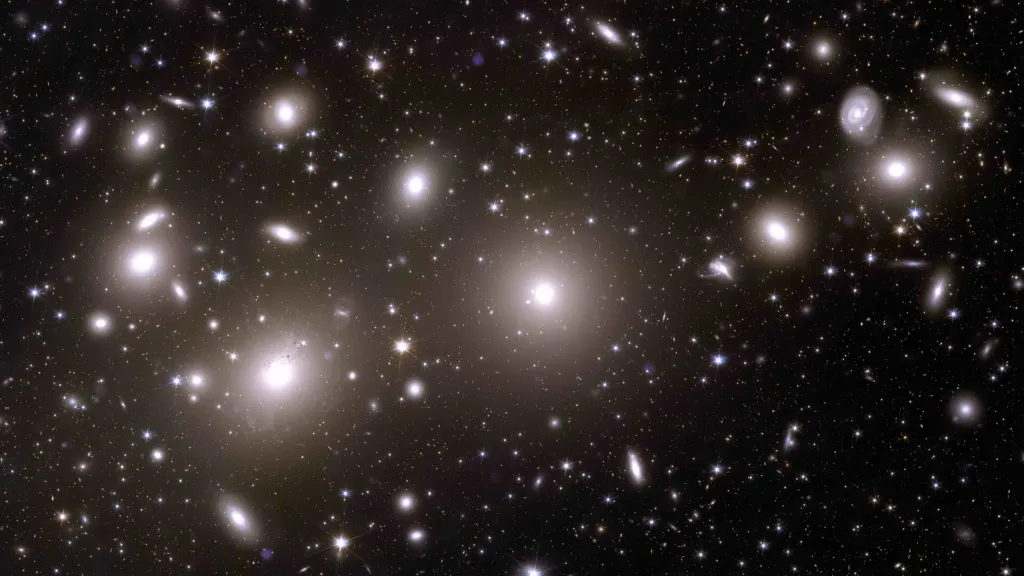
One frame, 1,000 galaxies in the Perseus Cluster, and more than 100,000 fainter ones scattered behind them, some so far off that their light left them 10 billion years ago. That was the opening shot of the European Space Agency’s Euclid telescope, released in ESA’s first-image announcement on November 7, 2023, and it is still the clearest way to grasp what the mission is for.
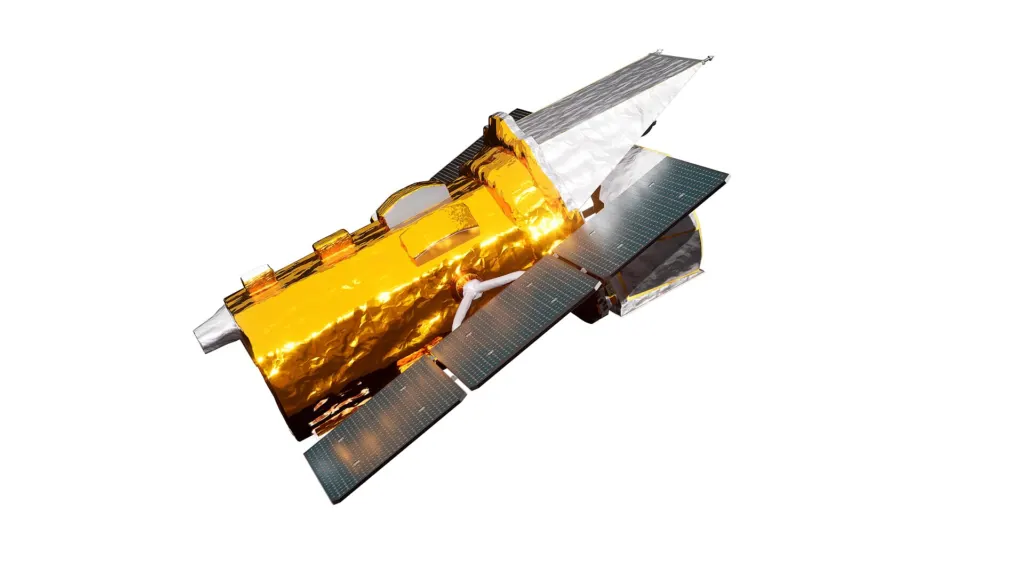
Three years on, the five pictures from that day work as a kind of field guide to Euclid’s job: measuring the parts of the cosmos nobody can see directly.
A detective for the 95%
According to ESA, roughly 95% of the universe appears to consist of dark matter and dark energy. Neither shines, so astronomers infer them from tiny effects on things that do: the shapes of distant galaxies, how they cluster and how fast they move.
“Dark matter pulls galaxies together and causes them to spin more rapidly than visible matter alone can account for; dark energy is driving the accelerated expansion of the Universe,” ESA Director of Science Carole Mundell said at the release. Euclid, she added, would let cosmologists study “these competing dark mysteries together.”
The plan ESA laid out is a six-year survey covering a third of the sky, tracking billions of galaxies out to 10 billion light-years and stitching them into the largest 3D map of the cosmos yet attempted.
The five first targets
Each opening image tested a different skill:
- Perseus Cluster, about 240 million light-years away, one of the most massive structures known. Clusters this heavy are thought to need dark matter to hold together.
- IC 342, the “Hidden Galaxy,” a spiral that resembles the Milky Way and sits behind our own galaxy’s dust; Euclid’s infrared eye cut through it.
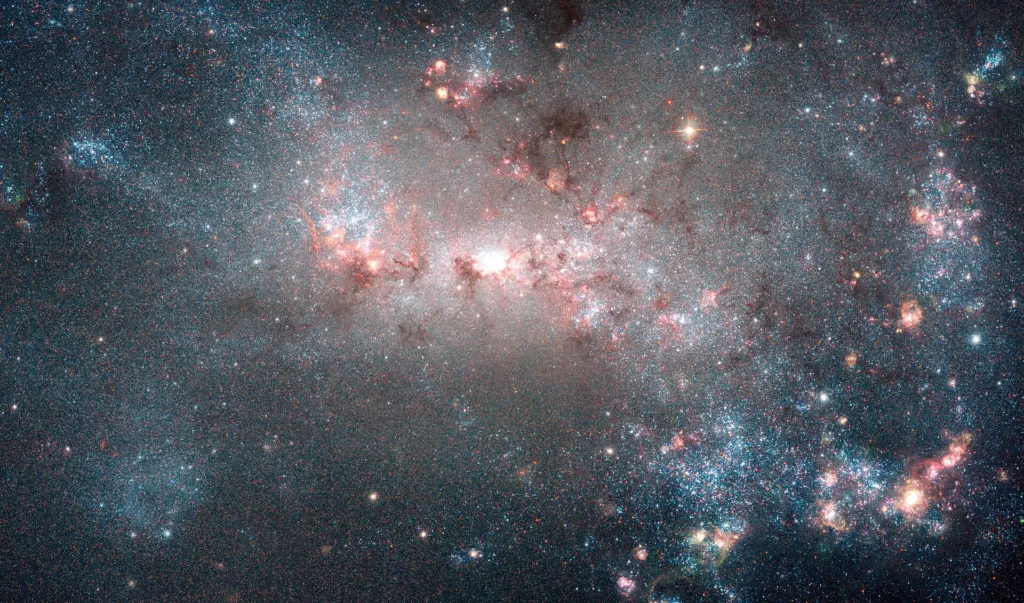
- NGC 6822, an irregular dwarf galaxy 1.6 million light-years out, a nearby stand-in for the small, messy galaxies of the early universe.
- NGC 6397, the second-closest globular cluster at about 7,800 light-years, captured whole in a single pointing, which ESA said no other telescope could manage.
- The Horsehead Nebula in Orion, where the team hoped to spot young brown dwarfs and free-floating planets with roughly the mass of Jupiter.
“We have never seen astronomical images like this before, containing so much detail,” said René Laureijs, ESA’s Euclid project scientist at the time.
Why the wide view matters
Euclid’s trick is width plus sharpness. Telescopes such as Hubble see fine detail in a small patch; survey instruments cover wide areas with blurrier results. Euclid combines both in one sitting, in visible and infrared light. For a dark-matter census that matters, because the signal is a faint, statistical stretching of background galaxy shapes, and it only emerges when you measure enormous numbers of them with the same crisp optics.
A quick sum shows the scale. If one Perseus frame held about 101,000 galaxies, Euclid needs on the order of 10,000 frames of that richness to reach a billion galaxies, which is why the survey runs for years rather than months.
The limits
The first images were a demonstration, not a result. They proved the optics and pointing worked; they did not measure dark energy. ESA said routine survey observations would start in early 2024 and that data would be released about once a year through its archive in Spain. Europe built and runs the spacecraft, with NASA supplying the detectors for the near-infrared instrument, NISP, and a consortium of more than 2,000 scientists from 300 institutes handling the science.
For more on how astronomers model the unseen early cosmos, see our story on the Lumina simulation of the universe’s first 2 billion years, and on how pulsars hint at supermassive black hole pairs merging after all. Euclid launched on July 1, 2023, aboard a Falcon 9 rocket, bound for the second Lagrange point, 1.5 million kilometers from Earth.
Further reading
Image: ESA/Euclid/Euclid Consortium/NASA, image processing by J.-C. Cuillandre (CEA Paris-Saclay) and G. Anselmi, CC BY-SA 3.0 IGO via Wikimedia Commons
This article was produced with AI assistance and reviewed by our Editorial Desk. How we work.