Small galaxies in our cosmic neighborhood are holding on to an average of just 11% of the oxygen their own stars have forged, a team led by astronomer Kristen B. W. McQuinn of Rutgers University and the Space Telescope Science Institute reports. Across 37 dwarf galaxies studied with NASA’s Hubble Space Telescope, the share each one kept ran from 4% to 25%.
Turn that average around and the scale is plain. Subtract 11% from 100% and 89% of the oxygen is no longer in the galaxies, or roughly eight of every nine atoms. Even the best keeper in the sample has lost three-quarters of what it made.
The paper, GLOW. II. A Census of Oxygen in Low-mass Galaxies, appeared in The Astrophysical Journal on November 2, 2026. GLOW is short for Galaxies Losing Oxygen via Winds, a project that NASA says it funds jointly with the National Science Foundation.
How the team counted oxygen in 37 galaxies
Every galaxy on the list sits within about 19.6 million light-years (6 megaparsecs) of Earth. That cutoff is practical: inside it, Hubble can pick out single stars, something NASA notes cannot be done for most known dwarf galaxies because they are too distant.
Single stars are what make the method work. From archived Hubble images, the researchers rebuilt the record of when each galaxy formed its stars. From that record they calculated how much oxygen those stars must have produced by nucleosynthesis, the fusion that builds heavier elements inside stars.
The measured total came from adding up oxygen in three places: stars, the gas between them, and dust. Besides Hubble, the team used NASA’s retired Spitzer Space Telescope and two radio arrays, the Very Large Array and the Australia Telescope Compact Array. Almost all of the oxygen that remained turned up in gas, which means the stars and dust of these galaxies hold very little of it.
The 37 galaxies hold between about 3 million and 3 billion solar masses of stars. That band is where theory expects exploding stars to shove out a growing share of a galaxy’s material, because small galaxies have weak gravity to pull it back.
Oxygen was picked as the marker because, after hydrogen and helium, it is the most abundant element and is fairly easy to measure. “So, it’s really for practical reasons that we’ve chosen oxygen,” McQuinn said in NASA’s announcement.
Why 11% is lower than simulations predict
Astronomers have long suspected that winds driven by supernovae, the explosions of massive stars, strip heavy elements from small galaxies. What the census adds is a figure, and the figure is lower than the models. Hydrodynamical simulations, computer models that follow gas as galaxies grow, correctly reproduce the mass-metallicity relation, the pattern in which heavier galaxies have gas richer in oxygen. Yet the authors write that those same simulations predict much higher retention than the 4% to 25% they measured.
“We know that the oxygen had to be inside of the galaxies at some point in the past, so the oxygen must have been ejected,” said co-investigator Grace Telford, an assistant professor at the University of Utah.
Location changed the result. Galaxies in denser surroundings, or within about 3.3 million light-years (1 megaparsec) of a massive neighbor, scattered toward higher retention. The authors read that as a sign that surroundings affect how much oxygen a galaxy keeps, recycles or pulls back in.
One expectation failed outright: how much oxygen a galaxy kept did not line up with where it falls on the mass-metallicity relation.
A simple model in the paper points to two properties of the winds: how much gas they carry off compared with the stars being formed, and how oxygen-rich that outflow is. It also suggests these galaxies take in less ordinary matter than the cosmic average would give them.
What a census of 37 galaxies cannot say
This is one study of 37 objects, all gas-rich and all close by; the authors lean on earlier published results to stretch the comparison to lighter and heavier galaxies.
The census also measures what is left, not where the other 89% went. Ionized oxygen has been detected in the circumgalactic medium, the thin halo of gas around a galaxy, but the paper says it is still unclear whether most of the missing oxygen sits there or has been pushed out for good.
The amount produced is also a calculation, not a direct count; it depends on each galaxy’s reconstructed star-formation record. A 2014 study cited by NASA asked the same question of galaxies like the Milky Way and found that they had also lost a large share, some of it lodged in their halos.
Next targets: fainter galaxies for Roman, Hubble and Webb
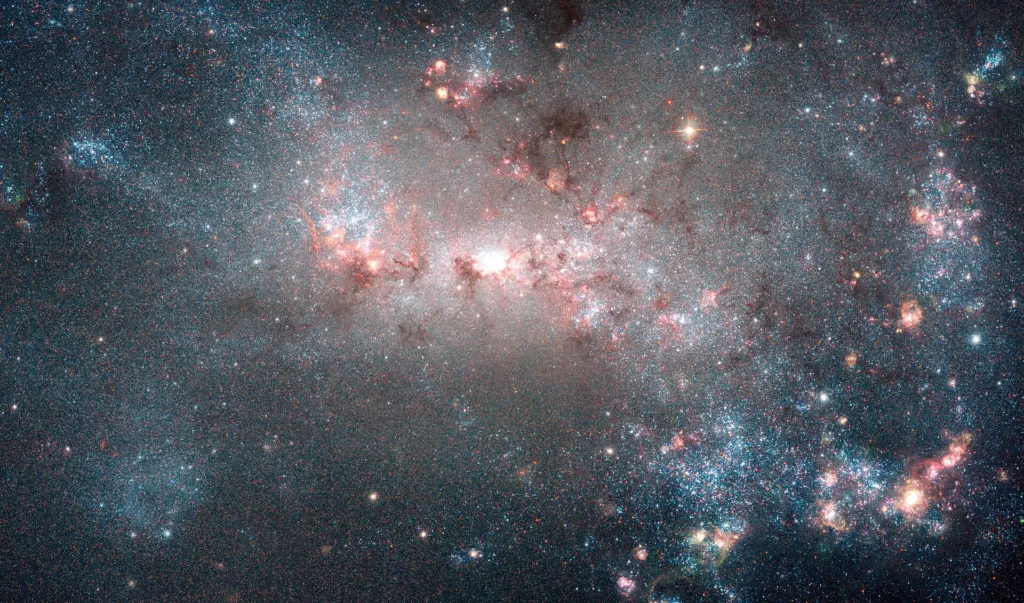
NASA illustrated the result with NGC 4449, one of the 37. It lies about 13 million light-years away in the constellation Canes Venatici, was discovered by William Herschel on April 27, 1788, and forms stars at twice the rate of the Large Magellanic Cloud.
McQuinn has an approved program on NASA’s newly launched Nancy Grace Roman Space Telescope to hunt for even lower-mass galaxies across a wide strip of sky, then plans deeper looks at their stars with Hubble and the James Webb Space Telescope. Telford is using Hubble to study individual massive stars, the ones that make the oxygen and blow it out, in several of the nearby GLOW galaxies.
Further reading
- The Astrophysical Journal: GLOW. II. A Census of Oxygen in Low-mass Galaxies
- NASA: Hubble Uncovers Case of Missing Oxygen in Nearby Dwarf Galaxies
- Wikipedia: NGC 4449
Image: NASA, ESA, A. Aloisi (ESA/STScI) and The Hubble Heritage (STScI/AURA)-ESA/Hubble Collaboration, CC BY 4.0 via Wikimedia Commons
This article was produced with AI assistance and reviewed by our Editorial Desk. How we work.