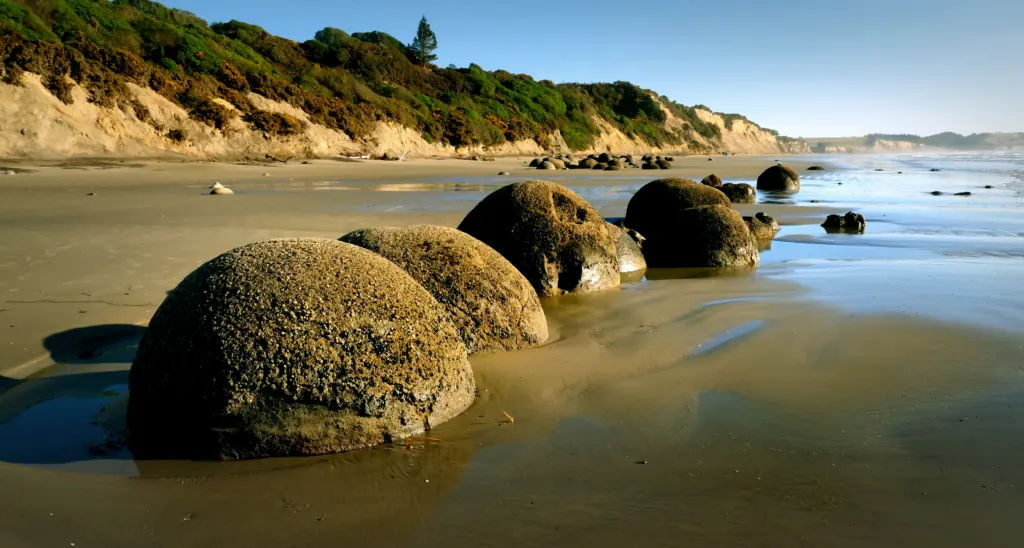
The largest of the Moeraki Boulders, near-perfect stone spheres scattered across a beach on New Zealand’s South Island, are about 2 meters (6.6 feet) across, and by current estimates each needed between 4 million and 5.5 million years to reach that size. They formed inside the mud of an ancient seafloor and have spent the last stretch of their lives being freed by the waves.
The boulders sit on Koekohe Beach on the Otago coast, between the fishing village of Moeraki and the town of Hampden. Their official name is Moeraki Boulders / Kaihinaki, and the stretch of sand they occupy is protected as a reserve. New Zealand’s Department of Conservation describes them as geological marvels uncovered as the mudstone around them, laid down roughly 60 million years ago, wore away.
How a stone ball grows
Each boulder is a concretion: a lump of ordinary seabed mud, silt and clay glued together by calcite. According to the encyclopedia entry on the boulders, they began forming near the surface of the seafloor during the Paleocene epoch, the slice of time just after the dinosaurs vanished.
Calcium-rich mineral crept through the mud by diffusion, spreading outward evenly in every direction rather than being pushed along by flowing water. That even spread is why the boulders came out round. While they grew, another 10 to 50 meters (33 to 164 feet) of mud piled up on the seafloor above them.
Put the growth rate in human terms. A 2-meter boulder has a radius of about 1,000 millimeters. Spread over 4 to 5.5 million years, that works out to roughly one millimeter of new stone every 4,000 to 5,500 years, slower than any fingernail and slower than most coral reefs.
The cracks inside
Many boulders carry a web of raised lines on their surface that look like turtle shell. Those are septaria, cracks that radiate outward from a hollow center. After the concretions formed, a drop in sea level let fresh groundwater flow through the surrounding mudstone, and it filled the cracks in stages: first brown calcite, then yellow calcite crystals, and in a few boulders a thin final coat of dolomite and quartz. Why the cracks opened in the first place is still unresolved; geologists have proposed several explanations without settling on one.
Break one open, as the sea has done to several, and the hollow core is lined with sharp calcite crystals. The outer rim is the hardest part, with calcite making up as much as 10% to 20% of the rock, which helps explain why the shells survive the surf.
Two sizes, not one
- About one-third of the boulders measure 0.5 to 1 meter (1.6 to 3.3 feet) across.
- The other two-thirds measure 1.5 to 2.2 meters (4.9 to 7.2 feet).
- Most are spheres or close to it; a few are slightly stretched along the layers of the mudstone that held them.
Not the only ones
Similar giants turn up elsewhere. The Koutu Boulders on the shore of Hokianga Harbour in New Zealand’s North Island reach 3 meters (10 feet), and the Katiki Boulders at Shag Point, about 19 kilometers (12 miles) to the south, include some that hold the bones of mosasaurs and plesiosaurs. Septarian concretions also appear in England’s Kimmeridge Clay and Oxford Clay.
In local Māori tradition, the great sailing canoe Āraiteuru was wrecked nearby, and the boulders are the eel baskets, gourds and kūmara (sweet potatoes) its cargo spilled onto the shore. In 1848, Walter Mantell sketched the beach when there were more boulders than there are today.
For more of Earth’s slow-motion geology, Badiyaa has covered a Patagonian forest of 160-million-year-old stone trunks and noctilucent clouds that form about 50 miles up.
Visitors reach the beach from a signposted turnoff on State Highway 1, about 3 kilometers south of Hampden; the Department of Conservation warns that the coast is exposed to rogue waves and tide changes.
Further reading
Image: Bernard Spragg, CC0 via Wikimedia Commons
This article was produced with AI assistance and reviewed by our Editorial Desk. How we work.