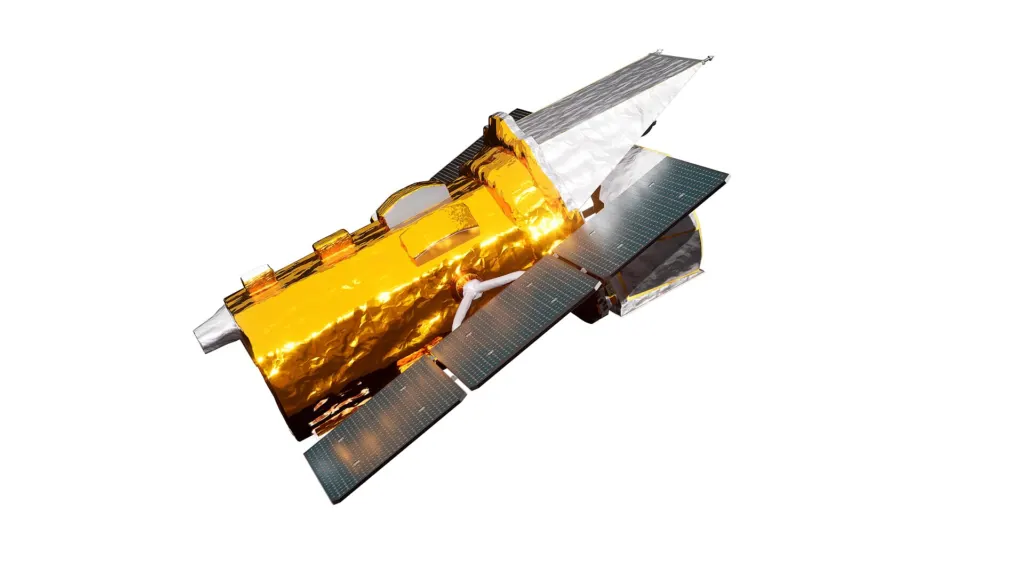
NASA’s Neil Gehrels Swift Observatory, a gamma-ray burst hunter that caught more than 2,000 of the universe’s biggest explosions, burned into the sky over Indonesia at 7:39 a.m. EST on Wednesday, November 4. U.S. Space Force tracking put the plunge over North Sumatra, near 3.4 degrees north and 98.6 degrees east, according to NASA’s re-entry confirmation.
That ends a run of almost 22 years for a spacecraft built for two. Gamma-ray bursts matter because they flare for seconds to minutes and then vanish, so a telescope has to be fast to catch any of them, and Swift was the fastest of its era.
NASA expected most of the observatory, which weighed 3,240 pounds (1,470 kilograms) at launch, to burn up on the way down, while warning that some components may have survived. Before the fall, agency officials put the chance of surviving debris hurting anyone at 1 in 2,100. None of the reports we reviewed through Thursday mentioned damage or injuries. Videos posted online appear to show a fireball, but none has been independently verified.
How Swift reached 2,000 bursts at about a minute each
The method was speed in three steps. The Burst Alert Telescope scanned a wide patch of sky through a mask of 52,000 small lead tiles, fixed a rough position within 15 seconds and sent it to the ground. The spacecraft then swung its X-ray Telescope and Ultraviolet/Optical Telescope onto that spot to catch the fading afterglow. “This typically took Swift about a minute to do,” principal investigator S. Bradley Cenko of NASA’s Goddard Space Flight Center said in NASA’s end-of-mission review on October 23.
That minute opened up a whole class of events. In May 2005, Swift turned toward GRB 050509B, a burst lasting 0.03 seconds, quickly enough to collect 11 X-ray photons from its afterglow. It was the first short burst ever seen with an afterglow, and it backed the theory that short bursts come from merging neutron stars, the city-sized cores left behind when massive stars die.
The wider tally is just as large. NASA counts more than 1,400 supernovae studied and about 7,000 published papers built on Swift data. Its open archive holds roughly 12 terabytes, including over 1.5 million ultraviolet and optical images, so researchers will keep mining it long after the hardware has gone.
Swift’s 22 years, from first burst to final orbit
- November 20, 2004: launch on a Delta II rocket from Cape Canaveral into an orbit 364 to 375 miles (585 to 604 kilometers) up.
- May 9, 2005: GRB 050509B, the first short burst pinned down precisely.
- March 19, 2008: GRB 080319B, 7.5 billion light-years away and briefly visible to the naked eye, a distance record for that.
- April 23, 2009: GRB 090423, a blast from when the universe was only about 630 million years old.
- October 27, 2015: burst number 1,000, GRB 151027B.
- January 2018: renamed for Neil Gehrels, its first principal investigator, who died in 2017.
- October 9, 2022: GRB 221009A, the brightest burst ever recorded, caught together with NASA’s Fermi telescope.
- 2024 to January 2025: a stormy solar maximum puffs up the upper atmosphere; nearly every NASA forecast now has Swift down by summer 2026.
- September 2025 to August 19, 2026: NASA hires Katalyst Space for $30 million to boost Swift; the LINK robot launches July 3, but attitude-control trouble cancels the capture.
- October 20, 2026: last observation at 171 miles (275 kilometers); re-entry follows 15 days later.
The lesser-known chapter is how hard the Penn State operations team fought the drag. Swift carried no thrusters. Starting in December 2025, controllers swapped about 25% of science targets for sky positions that kept the spacecraft in its most streamlined attitude. By February 2026 the X-ray and ultraviolet telescopes had stopped observing altogether, and in April the burst telescope was paused too, saving power so the solar panels could be angled to cut drag further. Those moves, logged on NASA’s boost-mission timeline, held Swift above the 185-mile (300-kilometer) line, below which a boost gets much harder, into fall 2026.
Once NASA and Katalyst called off the capture, Swift went back to science and logged hundreds more targets. Every new pointing raised drag again, so the final drop came fast.
What the 1-in-2,100 figure does and does not tell us
The evidence is uneven. The time and location of re-entry come from Space Force tracking relayed by NASA, which is as solid as orbital data gets. The casualty odds were a forecast made before the fall, not a measurement, and NASA has not said which parts reached the ground or sea. One aerospace engineer said before the fall that only a handful of small, scorched pieces, such as reaction wheels and mirror fragments, were likely to survive. Until someone documents a recovered piece, any debris claim is unconfirmed.
There is also no one-for-one replacement. Astrophysics Division director Shawn Domagal-Goldman said Swift stayed “productive for more than 10 times as long” as planned, and that NASA will cover rapid response by stretching “NASA’s fleet of existing space telescopes,” plus commercial and new missions. Fermi, in orbit since 2008, still watches for bursts. The Space Variable Objects Monitor, or SVOM, in orbit since 2024, is listed as Swift’s successor in the observatory’s encyclopedia entry.
For now, the 12-terabyte archive at nasa.gov/swift stays public, and NASA expects it to feed new discoveries “for decades more.”
Further reading
- NASA: Swift Observatory re-entered atmosphere
- NASA: Swift boost mission timeline
- Wikipedia: Neil Gehrels Swift Observatory
Image: NASA's Goddard Space Flight Center Conceptual Image Lab / Scientific Visualization Studio, Public domain via Wikimedia Commons
This article was produced with AI assistance and reviewed by our Editorial Desk. How we work.