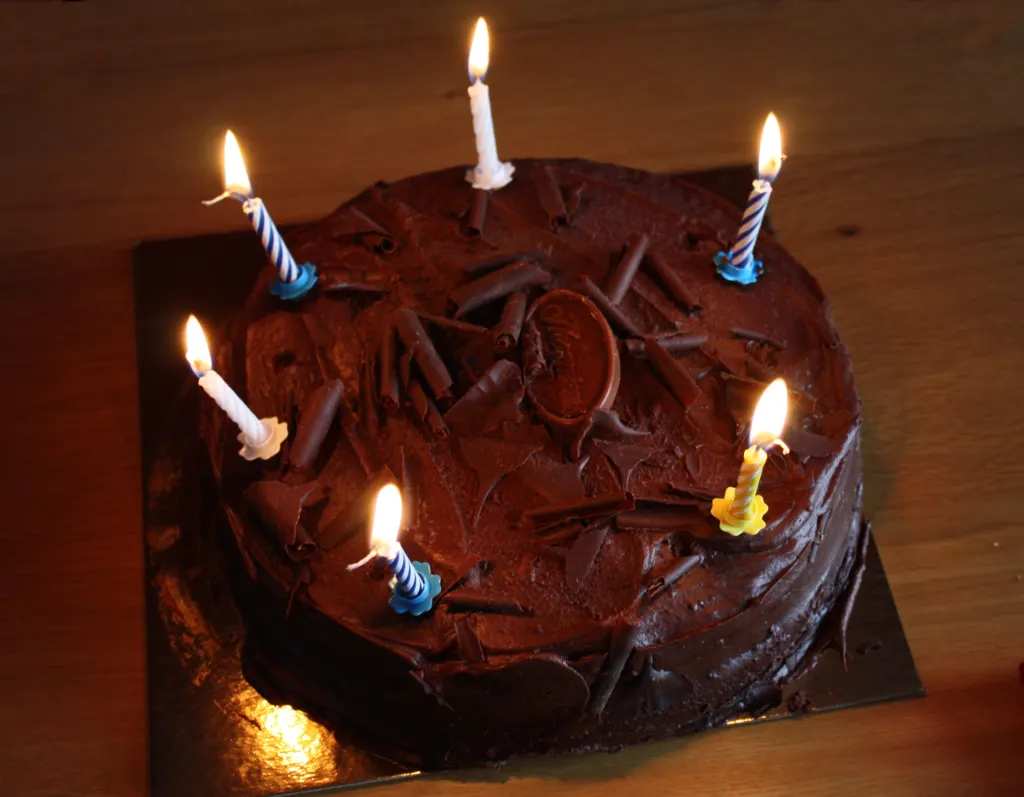
Blowing out birthday candles leaves a measurable cloud of mouth bacteria on the frosting. In a 2017 experiment at Clemson University in South Carolina, icing that had been blown on carried 1,400 percent more bacteria than icing nobody had breathed over, according to the paper published in the Journal of Food Research.
The study, “Bacterial Transfer Associated with Blowing Out Candles on a Birthday Cake,” was led by food scientist Paul Dawson with Inyee Han, Danielle Lynn, Jenevieve Lackey, Johnson Baker and Rose Martinez-Dawson. It ran in volume 6, issue 4 of the open-access journal.
How the Clemson team built a fake cake from foil and foam
The researchers started small. In preliminary tests, volunteers simply blew onto plates of nutrient agar, the jelly microbiologists use to grow colonies, to see whether breath alone carried bacteria. It did: tiny droplets and particles from the mouth, which scientists call bioaerosols, were enough to seed the plates.
For the main test they needed something that behaved like a cake but could be sampled cleanly. They spread icing evenly over aluminum foil, then pushed birthday candles through the foil into a block of foam underneath. That setup kept the candles upright and kept the icing layer uniform from trial to trial.
To make the scene closer to a real party, test subjects ate pizza first. Then they blew out the candles. The team scraped icing samples off under sterile conditions, spread them on growth plates and counted what grew, comparing the blown-on icing with icing that had not been breathed on.
What 1,400 percent more bacteria actually means
Percentages like this are easy to misread. “1,400 percent more” means the blown-on icing held the original amount plus 14 times that amount on top, so roughly 15 times as many bacteria as the untouched icing. If a control sample grew 100 colonies, a blown-on sample at that average would grow about 1,500.
The Wikipedia article on birthday cakes, summarizing the work, describes the average rise as 14 times and notes that some people deposited far more bacteria than others. In other words, the spread between blowers was wide; a few people did most of the seeding.
The authors concluded that it is likely bacteria and other microorganisms from the airways of the person blowing out candles reach the food that other guests then eat.
What the frosting experiment did not test
This was a single laboratory study with a modest design. It counted bacteria; it did not identify which species were present, and it did not follow anyone who ate the icing. One of the researchers described the result as not a big health concern, according to the same encyclopedia summary. Most bacteria that live in a healthy mouth are harmless, and the experiment says nothing about whether any of them could make someone ill.
It also used icing on foil rather than a baked cake, a single round of blowing, and test subjects who had just eaten pizza, which may change what is in the mouth. A thicker, sugary frosting at room temperature could behave differently, and the paper did not measure how numbers changed over time after the candles went out.
Dawson’s lab had a track record of turning everyday food habits into small experiments, which explains the pizza-then-candles setup. The work also sits in a long line of agar-plate science; Badiyaa has told how Fanny Hesse suggested kitchen agar for growing bacteria in 1881, the same basic tool the Clemson team used. More food and microbe curiosities are collected in the Badiyaa Science section.
A ritual older than germ theory
Candles on cake predate the science by centuries. A 1746 birthday festival for Count Ludwig von Zinzendorf at Marienborn, in what is now Germany, featured a cake with a candle pushed into a hole for every year of his age and one in the middle. A note on blowing candles out one by one was recorded in Switzerland in 1881, 136 years before Clemson’s foil-and-foam cake put a number on what that breath leaves behind.
Further reading
- Journal of Food Research: Bacterial Transfer Associated with Blowing Out Candles on a Birthday Cake
- Wikipedia: Birthday cake
Image: Ardfern, edited by Rlevente, CC BY-SA 4.0 via Wikimedia Commons
This article was produced with AI assistance and reviewed by our Editorial Desk. How we work.