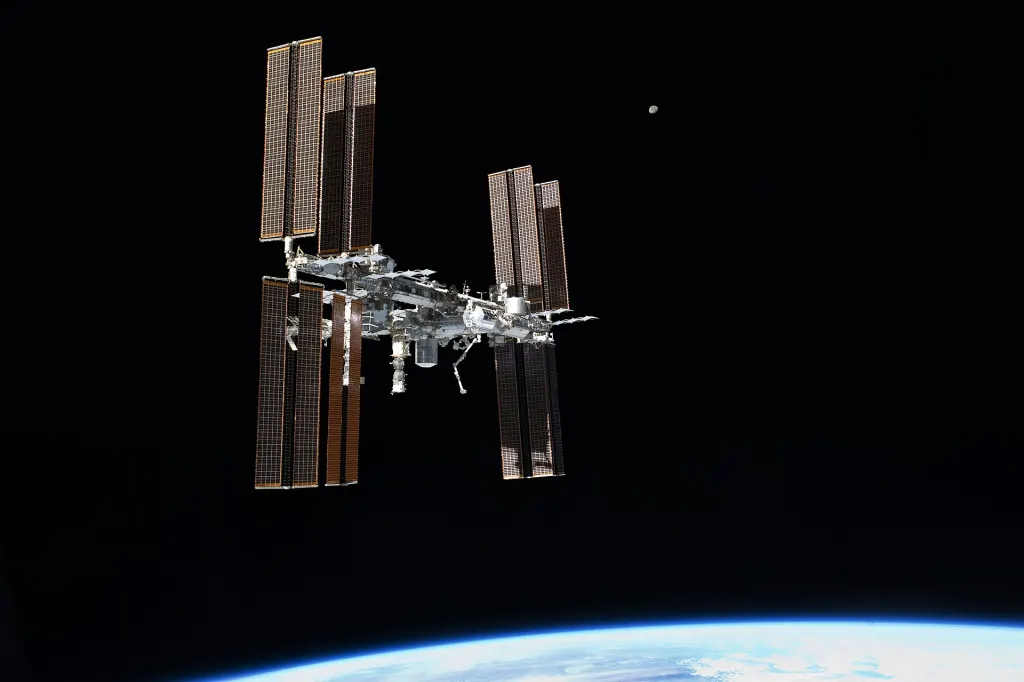
A metal object about 11 feet (3.4 meters) across, which the Stevens County Sheriff’s Office in west-central Minnesota calls “presumably a space object,” was confirmed by deputies in a Scott Township cornfield on the afternoon of Wednesday, October 14. No one was hurt. The sheriff’s office says the object poses no danger to the public, and in its statements so far it has not said what the object is, who launched it or when it came down.
The first report reached deputies at about 3:30 p.m., from a caller who had spotted debris among the corn. Deputies found what the office described as a “large, metallic object,” alerted the Minnesota Duty Officer, and federal agencies then came out to the site. The office has not named those agencies. Its stated plan is to identify the object with state and federal help, reach whoever owns it, and arrange to get it out of the field.
That is the full extent of what officials have confirmed. No statement from NASA, the US Space Force or any spacecraft or rocket maker appeared in the material we reviewed, so this article does not guess at a source. What can be explained is how hardware from orbit ends up on farmland at all, and what usually happens next.
About 50,000 large objects circle Earth, and some fall every week
NASA’s Orbital Debris Program Office estimates that roughly 50,000 large, trackable objects orbit Earth. The US Space Surveillance Network had cataloged more than 34,000 of them by August 2026, from working satellites to spent rocket bodies, and it routinely follows pieces bigger than about 4 inches (10 centimeters). Altitude sets their lifetime: below 373 miles (600 kilometers), debris typically drops back within several years, while above 621 miles (1,000 kilometers) it can stay up for a millennium or more.
The European Space Agency’s space debris office puts the return rate in plain numbers. Objects of 1 meter (3.3 feet) or more re-enter about once a week, and on average two smaller tracked fragments come back every day. About 75% of all the larger objects ever launched have already fallen back.
Why most debris burns up, and some does not
Shortly before re-entry, at roughly 75 miles (120 kilometers) up, a spacecraft is typically moving at about 28,000 km/h, according to ESA. Converted, that is around 17,400 mph: 28,000 divided by 3,600 gives about 7.8 kilometers per second, or nearly 4.8 miles every second. From about 68 miles (110 kilometers) down, in the final 10 minutes or so, the air becomes thick enough to heat the object and slow it sharply, and in most cases that destroys it completely.
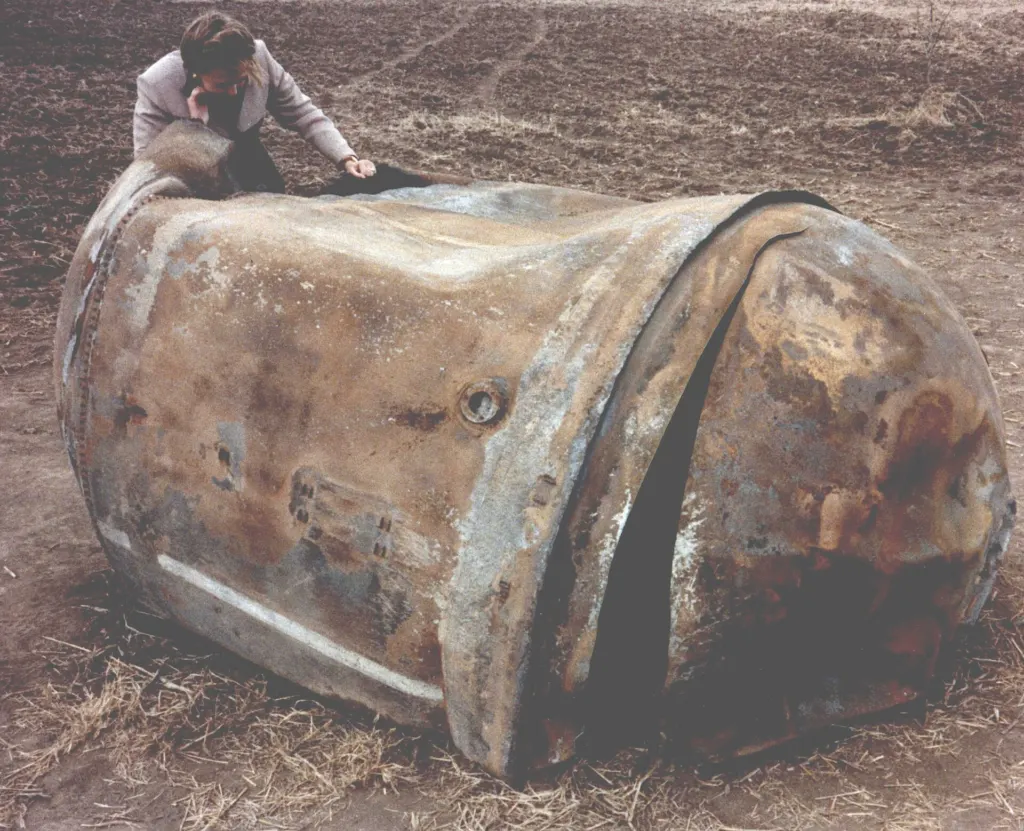
Survival depends on build. ESA says large, very compact or dense spacecraft can drop fragments to the ground, especially when they contain plenty of high-melting-point metals such as stainless steel or titanium. In the heaviest uncontrolled re-entries, such as the 74-tonne Skylab station in July 1979, 20 to 40% of the mass may reach the surface. One well-documented example is pictured with this story: a roughly 250-kilogram (550-pound) stainless steel propellant tank from the second stage of a Delta 2 rocket that landed near Georgetown, Texas, on January 22, 1997, largely intact.
The last time US officials traced a fallen piece
The closest recent precedent is a 2024 case in Florida. In March 2021, NASA ground teams let go of a pallet of old nickel hydride batteries from the International Space Station using the station’s robotic arm, about 5,800 pounds of hardware that was expected to burn up completely when it came down on March 8, 2024. One piece did not, and it struck a home in Naples, Florida. NASA collected it with the homeowner’s cooperation and examined it at Kennedy Space Center, then reported on April 15 that it was a stanchion from the battery mounting equipment, made of the alloy Inconel, 4 inches tall and weighing 1.6 pounds. The agency said its re-entry models are revised whenever debris turns up on the ground.
The Minnesota find is in another size class entirely: at 11 feet across, it is more than 30 times the height of that Florida stanchion (11 feet is 132 inches; 132 divided by 4 is 33).
Who answers for a fallen space object
Ownership matters because international law attaches responsibility to the launch. Under the 1972 Space Liability Convention, a country is liable for damage caused by space objects launched from its territory or facilities, or launches it arranged. Claims run only between governments, so an injured person would have to ask their own country to file. Only one claim has ever been brought under the treaty, after the nuclear-powered Soviet satellite Kosmos 954 crashed in Canada in 1978. As of January 1, 2021, 98 countries had ratified it.
For perspective on risk, ESA says it knows of no injuries caused by re-entering space debris, and it puts the chance of being struck by lightning at 60,000 times higher than the risk any one person faces from falling hardware. NASA adds that pieces which survive will most likely land in an ocean or a sparsely populated area, which describes a cornfield in rural Stevens County well.
How long identification takes in Minnesota is not yet known. In the Florida case, NASA published its finding 38 days after the debris fell, counting from March 8 to April 15, 2024.
Further reading
- NASA Orbital Debris Program Office: Frequently asked questions
- NASA: NASA Completes Analysis of Recovered Space Object (2024)
- Wikipedia: Space Liability Convention
Image: NASA, Public domain via Wikimedia Commons
This article was produced with AI assistance and reviewed by our Editorial Desk. How we work.