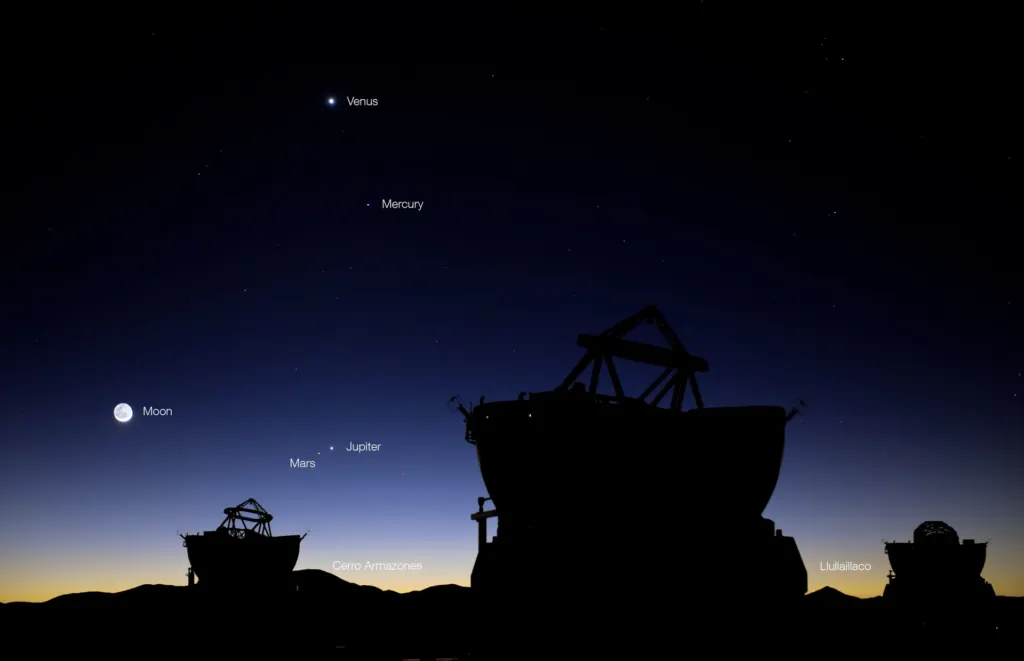
Mars and Jupiter will sit just 1.2 degrees apart in the southeast before sunrise on Sunday, November 15, and Monday, November 16, with bright Venus hanging low near the horizon below them. It is the tightest planet pairing of the month, and no telescope is needed.
NASA’s What’s Up skywatching guide for November 2026 describes the gap as a little more than two full Moons placed side by side. Jupiter is the brighter of the two; Mars is the fainter, reddish point next to it.
Where and when to look
NASA’s sky chart for the pairing is drawn for about 5 a.m. local time on November 15, facing southeast. At that hour Mars and Jupiter stand fairly high, while Venus is much lower, between east and southeast. Three bright stars help you get your bearings: Arcturus, Procyon and Sirius are all marked on the chart.
- Best mornings: November 15 and 16, before dawn.
- Direction: southeast for Mars and Jupiter; low east-southeast for Venus.
- Brightest: Venus, then Jupiter, then Mars.
- Gear: eyes only; binoculars will show both planets in one view.
To judge the spacing yourself, use the Moon as a ruler. A full Moon spans about half a degree, so 1.2 degrees works out to roughly 2.4 Moon-widths, which matches NASA’s “a little more than” two. Held at arm’s length, the tip of your little finger covers about one degree, so the pair should almost hide behind a single fingertip.
NASA suggests going out on several mornings in a row. The two planets close in, reach their tightest spacing and then slide apart again. They are not actually near each other: the alignment is a line-of-sight effect, and the planets remain far apart in space.
A dark sky helps this week
The Moon will not get in the way. NASA’s phase table lists the new Moon on November 8 and first quarter on November 17, so in mid-month the Moon is a thin evening crescent that has set long before the planets climb in the morning. That also helps the Leonid meteor shower, which NASA says is best in the early hours of November 17 and 18, after moonset, with up to around 15 meteors an hour under ideal conditions. On NASA’s Leonid chart, the shower’s radiant sits high in the east near Jupiter and Mars, so one pre-dawn session can cover both. Our guide to the Leonid meteor shower peak on November 17 has more on the comet behind it, and the Northern Taurid fireballs still crossing the sky this week could add a bonus streak.
For the best view, NASA’s general advice is to get away from streetlights, wait roughly 30 minutes for night vision to build and keep a wide stretch of horizon in view. Planets are bright enough to see from a city, but the meteors are not.
Limits
Exact rise times and heights depend on your latitude, and NASA’s chart is drawn for mid-northern skies. Observers far south will see the scene tilted, and anyone with a hill or buildings to the east may lose Venus, since it sits close to the horizon. Clouds are the other risk.
If you miss the planets, the next sky date on NASA’s list is November 24, when the full Moon rises at sunset as a supermoon, the first of three in a row through January.
Further reading
Image: G. Hüdepohl (atacamaphoto.com)/ESO, CC BY 4.0 via Wikimedia Commons
This article was produced with AI assistance and reviewed by our Editorial Desk. How we work.