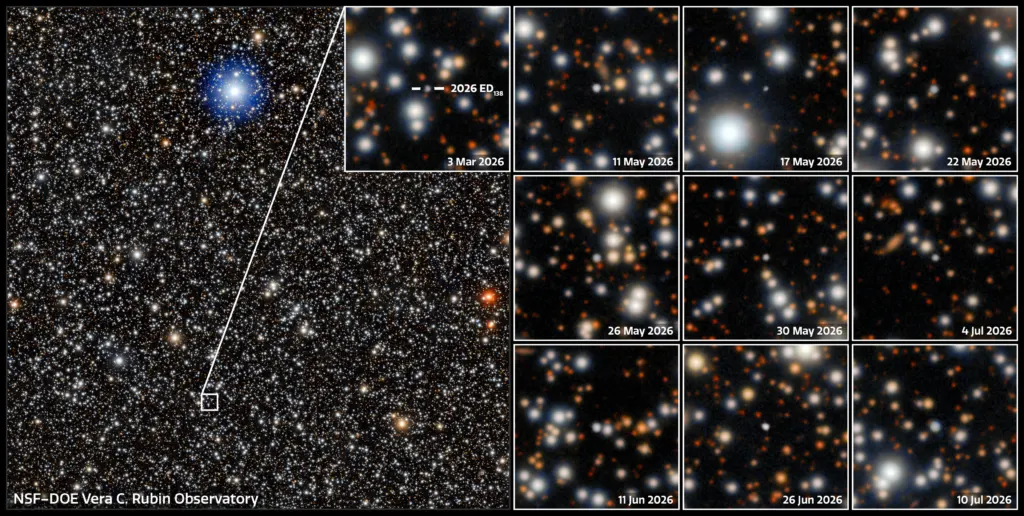
The icy world that could become the solar system’s sixth recognized dwarf planet was hiding in plain sight on photographic plates for 89 years. Within three days of its October 27 announcement, archive searches had pushed the first known image of 2026 ED138 back to 1937, a frame shot at Boyden Observatory in South Africa. Its tracked path now covers 88.53 years, about 31% of one trip around our star.
That is the longest observation record of any object beyond Neptune except Pluto, according to the reference entry for 2026 ED138, which compiles the Minor Planet Center’s follow-up reports.
From 10 years of data to 88 in a week
When the NSF–DOE Vera C. Rubin Observatory team revealed the object, the record ran from 2016 to 2026. Our first report on Rubin’s dwarf planet candidate 2026 ED138 worked out that those 10.37 years covered only about 3.7% of its 282.68-year orbit. Then the hunt through old archives began.
- October 28: the Minor Planet Center added frames from Chile’s VISTA telescope taken in 2010 and 2011, and sightings turned up in data from NASA’s TESS satellite spanning 2019 to 2026.
- October 29: the center reported positions measured on Digitized Sky Survey plates from 1937 to 2000.
- Since then, a paper by Mróz and colleagues reports 102 reliable detections in images from the OGLE survey taken between 2011 and 2024.
The working is simple: 88.53 divided by 282.68 is 0.313, so astronomers have now watched almost a third of one orbit instead of a sliver. A longer arc pins down an orbit far more tightly than a few months of fresh data. The 1937 plate also caught the object only about 11 years after its last closest approach to our star, in April 1926.
What the new studies say about its surface
Size is still the open question. Estimates run from about 600 to 1,500 km (400 to 900 miles), because nobody knows how dark its surface is. If it reflects 10% of sunlight, a value seen on several large bodies out there, it would be about 980 km wide, bigger than Ceres. The likely range is narrower, roughly 610 to 970 km.
Color measurements in a study led by Joseph Murtagh sort it as an intermediate blue-red object, and the spectral slope argues against water ice on its surface. That matters for its family tree. Its orbit sits close to those of the Haumea family, fragments from an ancient collision, but those pieces have bright gray, icy surfaces. ED138 is red, which suggests it is an unrelated interloper. Mario Jurić, Rubin’s solar system lead, put it this way: “it’s quite red, which points to an icy surface darkened by organic material.”
Light-curve data hint that it spins once every 10.4 or 20.7 hours, and the OGLE team reports a tentative period of about 1.18 days, though a weak signal leaves that uncertain. At those temperatures, around 42 to 46 kelvin, it is also too small and warm to hold an atmosphere of methane, carbon monoxide or nitrogen.
Limits: why it is not the sixth dwarf planet yet
The National Science Foundation’s announcement called the analysis preliminary. If confirmed, ED138 would join the five recognized dwarf planets: Pluto, Ceres, Eris, Haumea and Makemake. Confirmation needs a measured size, which infrared observations or a stellar occultation (the object briefly blocking a star) could give. Images from a telescope such as James Webb could reveal a moon, whose orbit would yield its mass.
Recognition is slow even for strong cases; Quaoar and Gonggong are widely treated as dwarf planets in research but still sit outside the official list. For ED138, the next formal step is a permanent catalog number, a test its orbit has already passed, followed by a creation-myth name chosen under International Astronomical Union rules. Find more space and science stories on Badiyaa.
Further reading
Image: NSF–DOE Vera C. Rubin Observatory/NOIRLab/SLAC/AURA, image processing M. Jurić, D. de Martin and M. Zamani, CC BY 4.0 via Wikimedia Commons
This article was produced with AI assistance and reviewed by our Editorial Desk. How we work.