On November 14, 1680, a calendar-maker in the German town of Coburg turned a telescope on the sky and found something no one had ever discovered that way before: a comet. Gottfried Kirch’s find, now catalogued as C/1680 V1, grew into one of the brightest comets of the 17th century, reputedly visible even in daylight, and it went on to help Isaac Newton test the laws of planetary motion.
The almanac man with a telescope
Kirch was born in Guben in 1639, the son of a shoemaker, and started out as a schoolmaster. He learned astronomy under Erhard Weigel in Jena and the famous observer Johannes Hevelius in Danzig, built his own telescopes and, in 1679, invented a screw micrometer for measuring small angles in the sky. For years he could not find a salaried post, so he paid the bills by writing almanacs, at one point up to 13 a year, some under pseudonyms. His second wife, Maria Margaretha Winkelmann, and their children helped with the calculations.
Comets had been seen with the naked eye for thousands of years. What changed in 1680 was the instrument. Kirch spotted this one in a telescope first, which is why the Great Comet of 1680 is listed as the first comet discovered by telescope and is still called Kirch’s Comet.
A dive through the solar furnace
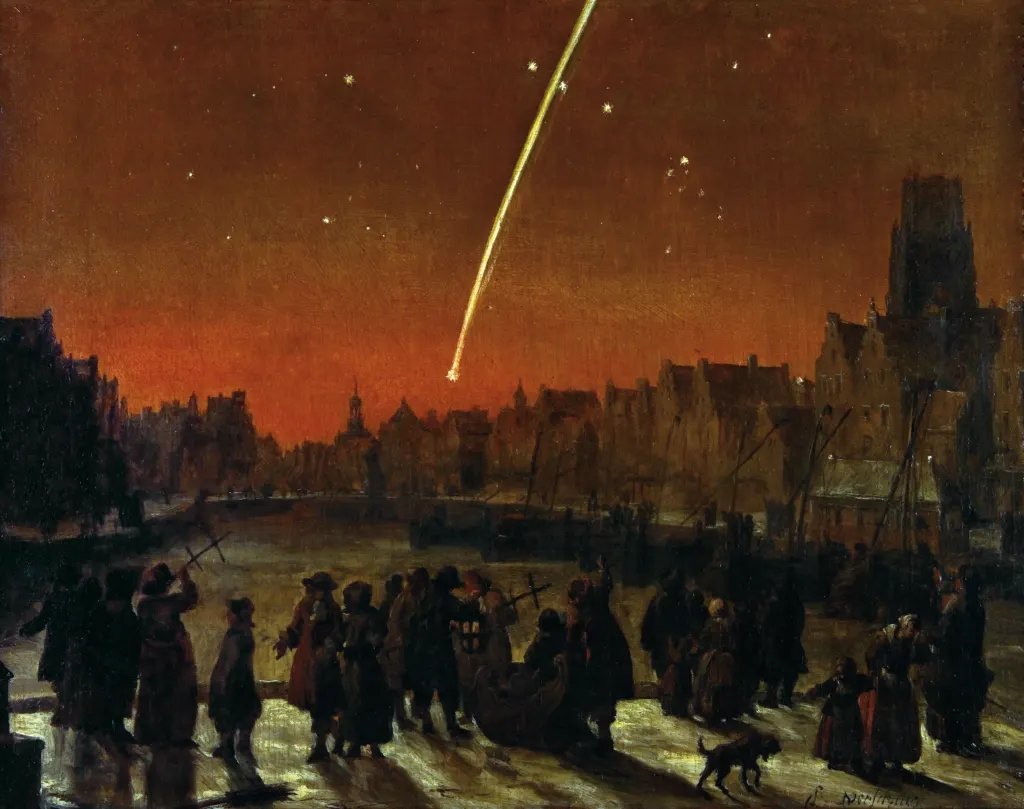
The comet passed 0.42 astronomical units from Earth on November 30, 1680, then plunged toward its closest point to our star on December 18. It skimmed just 1.34 solar radii from the center, roughly 235,000 kilometers (146,000 miles) above the glowing surface. It was brightest on December 29, on the way back out, and its long tail drew artists across Europe; the Dutch painter Lieve Verschuier showed it hanging over Rotterdam.
To picture how close that is, compare it with the Moon, which orbits about 384,400 kilometers from Earth. Divide 235,000 by 384,400 and you get about 0.61, so the comet came nearer to the solar surface than three-fifths of the distance between Earth and the Moon.
It was seen far beyond Europe. Basil Ringrose, sailing with the buccaneer Bartholomew Sharpe off Chile, logged it on November 19, 1680, writing that “its tail extended itself 18 or 20 degrees in length.” The Jesuit priest Eusebio Kino charted its course from Cádiz and later published his account in Mexico City in 1681, among the earliest scientific treatises a European published in the Americas.
One comet, not two
Observers at first thought they had seen two comets, one heading in and one heading out. John Flamsteed, the English Astronomer Royal, was the first to argue they were the same object. Newton disagreed, then changed his mind and, with Edmond Halley’s help, used some of Flamsteed’s data without credit to confirm it. The orbit of the 1680 comet, fit to a parabola, appears in Newton’s Principia, which is why the object is also known as Newton’s Comet.
It was last seen on March 19, 1681. Kirch kept going: he discovered the Wild Duck Cluster, M11, in 1681, and in 1700 became the first astronomer of the new Berlin academy. A lunar crater and asteroid 6841 Gottfriedkirch carry his name.
Comets still put on shows; the debris of one feeds the Leonid meteor shower that peaks on November 17, and Halley’s Comet drives the October Orionids. Kirch’s comet will not be back for a long time. Its orbit takes roughly 10,400 years, and as of 2026 it is about 260 astronomical units, or 39 billion kilometers, from our star.
Further reading
Image: Lieve Verschuier, Public domain via Wikimedia Commons
This article was produced with AI assistance and reviewed by our Editorial Desk. How we work.