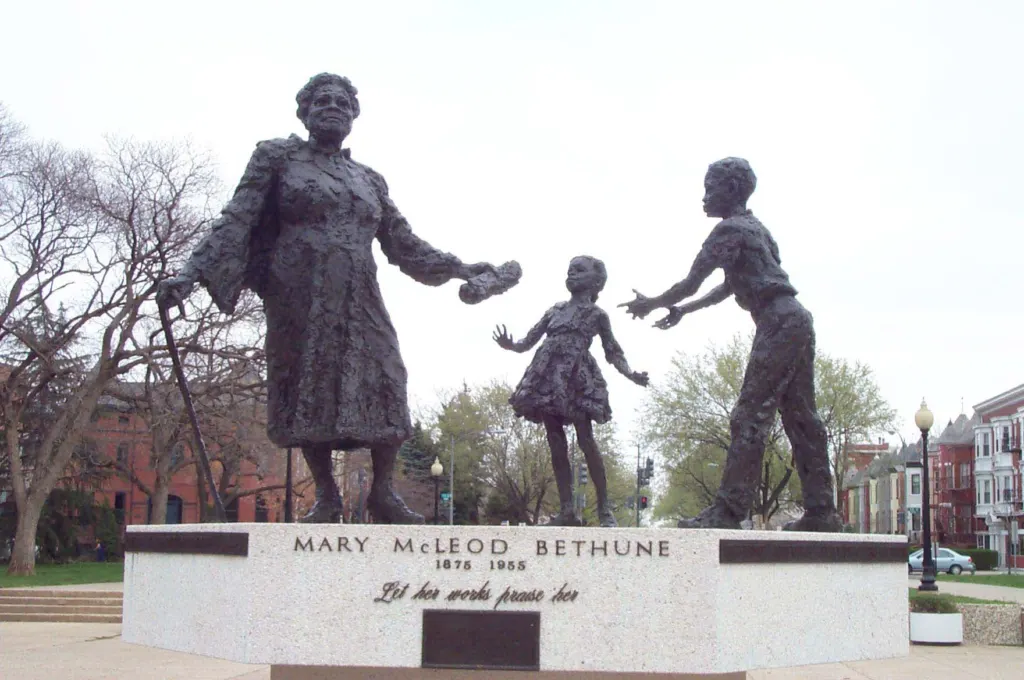
“I leave you love.” The line most often quoted from Mary McLeod Bethune is the first of nine short bequests in what she called her Last Will and Testament, and the most reliable place to read it is not a book or a poster but a bronze band wrapped around a statue in Lincoln Park, Washington, D.C.
The National Park Service, which looks after the site, describes the testament as Bethune’s last literary pronouncement. It was not a legal will. It handed out values rather than property, and its tenets were later chosen for the base of the Mary McLeod Bethune Memorial, unveiled on July 10, 1974, which would have been her 99th birthday.
The nine bequests, as the Park Service lists them
The Bethune Council House National Historic Site gives the “Legacy” in this order: “I leave you Love. I leave you Hope. I leave you the Challenge of Developing Confidence in One Another. I leave you a Thirst for Education. I leave you a Respect for the Use of Power. I leave you Faith. I leave you Racial Dignity. I leave you a Desire to Live Harmoniously with Your Fellow Men. I leave you, finally, a Responsibility to Our Young People.”
That is the version to quote. Small variations circulate, and three of them are easy to spot once you line the sources up side by side:
- The opening words. The Park Service reads “I leave you Love” and “I leave you Hope.” A transcription on Wikipedia gives “I leave you to love” and “I leave you to hope,” which changes a gift into an instruction.
- Power. The Park Service says “a Respect for the Use of Power”; the same Wikipedia passage has “uses of power.”
- The bronze band itself. The Park Service’s own record of the inscription runs the bequests in a slightly different order, adds “also” (“I Leave You also a Desire to Live Harmoniously”), and ends that line on “Fellow Man,” singular, where the printed list says “Fellow Men.”
None of these changes the meaning much. They show how a text drifts once it is carved, transcribed and shared, and why it is worth checking which version you are copying.
Who was leaving the legacy
Bethune was born on July 10, 1875, near Mayesville, South Carolina, the 15th of 17 children of Sam and Patsy McLeod, both formerly enslaved. In October 1904 she rented a small house in Daytona, Florida, for $11 a month and opened a school with six students: five girls and her son, Albert. Desks came from discarded crates. That school grew into Bethune-Cookman University.
She founded the National Council of Negro Women in 1935, led the Division of Negro Affairs at the National Youth Administration as the first Black woman to head a federal division, and in 1945 stood as the lone Black woman among those who founded the United Nations at San Francisco. When Booker T. Washington visited her school in 1912, he advised her on winning support from white donors; his own most famous line has its own origin story, told in our look at his 1895 “cast down your bucket” speech.
A statue of firsts
The National Council of Negro Women, led then by Dorothy Height, erected the Robert Berks sculpture, which shows Bethune handing a paper to two children. By the Park Service’s count, no African American had been honored with a memorial on the capital’s public land before it, and no American woman had a portrait statue on a public site there either. The front reads, in cursive, “Let her works praise her.”
Her birthday celebrations there drew figures including Shirley Chisholm, Cicely Tyson and Coretta Scott King. The Park Service still marks the date each year; the next one, her 152nd birthday, falls on July 10, 2027.
Further reading
- National Park Service: Mary McLeod Bethune Memorial
- National Park Service: Annual Bethune Birthday Celebration
- Wikipedia: Mary McLeod Bethune
Image: Rudi Williams, US Department of Defense, Public domain via Wikimedia Commons
This article was produced with AI assistance and reviewed by our Editorial Desk. How we work.