The most famous sentence ever credited to Voltaire was written 128 years after he died, by an Englishwoman. “I disapprove of what you say, but I will defend to the death your right to say it” first appears on page 199 of The Friends of Voltaire, a book published in London in 1906 by Evelyn Beatrice Hall under the pen name S. G. Tallentyre. Voltaire, the pen name of François-Marie Arouet, died in 1778.
Hall was born at Shooter’s Hill, Kent, in 1868, the daughter of a minor canon of St Paul’s Cathedral, and died at Wadhurst, East Sussex, in 1956, aged 87. Her Life of Voltaire came out in 1903. At least one major quotation reference gives her death as 1919, the year her last book appeared, which is wrong.
The page where it starts
The Friends of Voltaire is a set of ten portraits of men in Voltaire’s orbit, each with a tag: d’Alembert the Thinker, Diderot the Talker, Turgot the Statesman. Chapter 7 is “Helvétius: The Contradiction.” Its subject, the philosopher Claude-Adrien Helvétius, had published De l’esprit (“On the Mind”) in 1758, and Hall lists what followed almost day by day. The license to print it was withdrawn on August 10, 1758. The Pope condemned it in a letter of January 31, 1759; the Parliament of Paris followed on February 6; the hangman burned it in public on February 10, together with a poem of Voltaire’s on natural law; and the Sorbonne censured it on April 9.
Then comes the paragraph that went around the world. In the scanned 1906 edition it reads:
“‘What a fuss about an omelette!’ he had exclaimed when he heard of the burning. How abominably unjust to persecute a man for such an airy trifle as that! ‘I disapprove of what you say, but I will defend to the death your right to say it,’ was his attitude now.”
The grammar gives the game away. “Was his attitude now” is a biographer describing a frame of mind, not a witness recording speech. Hall wrapped her summary in quotation marks, and readers took the marks literally. The omelette remark is the line she presents as something Voltaire actually exclaimed; the famous sentence is her own gloss on how he felt.
How a summary turned into a quotation
The drift from Hall’s page to Voltaire’s mouth took about fourteen years, and the correction took more than thirty. A timeline built from the dated citations:
- 1758 to 1759: De l’esprit appears, is condemned and is burned in Paris.
- 1778: Voltaire dies. No text of his containing the sentence has ever been found.
- 1906: Hall’s paraphrase is printed in The Friends of Voltaire.
- 1919: In her translated selection Voltaire in His Letters, Hall reuses it with one added word, “I wholly disapprove,” and labels it “the essentially Voltairean principle,” inside her own commentary.
- 1920: Robert Dell’s book My Second Country (France) places the “wholly” wording in a supposed letter from Voltaire to Helvétius, and a newspaper in Aberdeen, South Dakota, prints it as Voltaire’s in June.
- May 9, 1939: Hall writes to the Columbia University scholar Burdette Kinne that the line is hers.
- 1943: Kinne publishes her letter in the journal Modern Language Notes under the title “Voltaire Never Said It!”
- 1963: A French “original,” addressed to an unnamed abbé, is printed in an anthology of French quotations, beside a citation to a February 6, 1770 letter that belongs to a different line.
Hall’s own correction
Her 1939 letter is unusually direct for an author caught out by her own punctuation. The phrase, she told Kinne, “is my own expression and should not have been put in inverted commas.” She apologized for having, “quite unintentionally,” led him to think she was quoting “a sentence used by Voltaire (or anyone else but myself).”
An earlier statement attributed to her, printed in May 1935, points the same way. In it she said she “did not mean to imply that Voltaire used these words verbatim,” and called them “rather a paraphrase” of a line from his essay on tolerance: “Think for yourselves and let others enjoy the privilege to do so too.”
That leaves the French version, “Monsieur l’abbé, je déteste ce que vous écrivez, mais je donnerais ma vie pour que vous puissiez continuer à écrire.” It turns up in 1950, in a speech by Ignazio Silone, president of the Italian P.E.N. center, which is very late for something Voltaire supposedly wrote. The reference to a 1770 letter to a M. le Riche that often travels with it is a misreading: in the 1963 anthology, that citation belonged to the neighboring entry, a remark about God being on the side of the big battalions.
None of this makes the sentiment un-Voltairean. Hall knew his letters well enough to translate a volume of them, and her line is a fair reading of a man who defended an author whose book he disliked. But the words are hers. Anyone who wants to see the source can open the 1906 scan to chapter 7, page 199, where the sentence opens the page, straight after the omelette remark at the foot of page 198.
Further reading
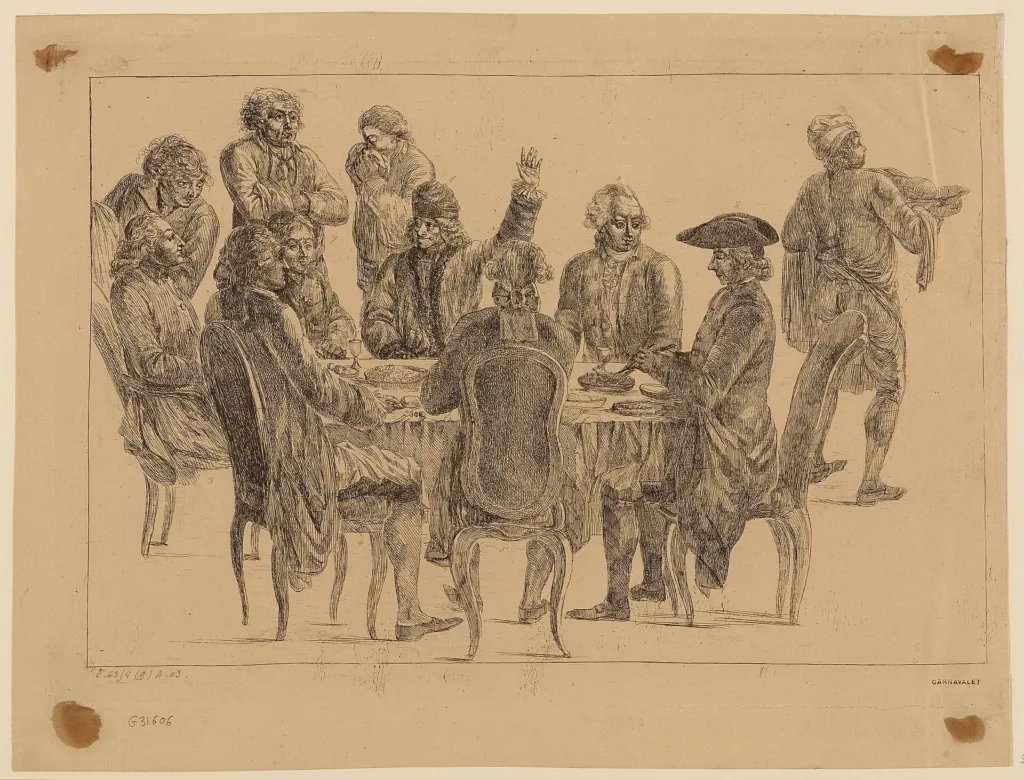
Image: Attributed to Jean Huber (1721-1786), CC0 via Wikimedia Commons
This article was produced with AI assistance and reviewed by our Editorial Desk. How we work.