No letter, interview, newspaper report or biography from Harriet Tubman’s lifetime contains the line “I freed a thousand slaves. I could have freed a thousand more if only they knew they were slaves.” The earliest printed version anyone has found sits on page 148 of My Soul Looks Back ‘Less I Forget, a 1993 anthology of quotations edited by Dorothy Winbush Riley. Riley dated it “c. 1865” and gave no citation. Tubman died 80 years before that book appeared.
Tubman specialists have been blunt about it. Biographer Kate Clifford Larson lists the saying among her fake quotes and says there is “no documentation, nor historical basis” for it. Historian Milton Sernett called it a twentieth-century fabrication, and the Tubman scholar Jean H. Humez also treats it as spurious.
What Tubman is actually recorded saying
Tubman could not read or write, so most of her words reach us through people who wrote them down. The closest of those is Sarah Hopkins Bradford of Geneva, New York, who took down her stories firsthand and published Scenes in the Life of Harriet Tubman in Auburn in 1869 to raise money for her. On page 21 Bradford records the creed Tubman said she carried north:
“Dere’s two things I’ve got a right to, and dese are, Death or Liberty–one or tother I mean to have. No one will take me back alive; I shall fight for my liberty, and when de time has come for me to go, de Lord will let dem kill me.”
Two pages earlier comes the moment of her own escape in 1849, after she crossed out of Maryland: “I looked at my hands to see if I was de same pusson. There was such a glory ober ebery ting; de sun came like gold through the trees, and ober the fields, and I felt like I was in Heaben.”
Bradford rewrote the book in 1886 as Harriet, the Moses of Her People, and the wording shifted. The creed became “there was one of two things I had a right to, liberty, or death; if I could not have one, I would have de oder; for no man should take me alive.” The hands passage gained four words: “to see if I was de same person now I was free.” Neither edition has anything about people who did not know they were enslaved. Readers comparing the two versions should treat the 1869 text as the earlier record; the 1886 phrasing is the one most quotation sites reproduce, often in modernized spelling.
A third line has a public setting. The National Park Service says that at a women’s suffrage convention in 1896 she told the audience: “I was the conductor of the Underground Railroad for eight years, and I can say what most conductors can’t say — I never ran my train off the track and I never lost a passenger.”
How the numbers grew
The fake quote fails on arithmetic before it fails on sourcing. Set the counts side by side, oldest first:
- 1859: the abolitionist Thomas Wentworth Higginson wrote to his mother that she had gone back eight times and “brought out in all sixty slaves.”
- 1869: Bradford reported nineteen trips south, by the reckoning of Tubman’s friends, eleven of them starting from Canada.
- 1886: Bradford’s preface spoke of “only three or four hundred slaves,” and the book settled on “somewhat over three hundred.”
- Today: the Park Service puts it at about 13 trips over roughly a decade, about 70 people led out, and instructions given to another 50 to 60 who escaped on their own.
- 1993 onward: “thousands” in the Riley anthology, later sharpened into “a thousand.”
So the invented line claims roughly 14 times the number the Park Service accepts, and it puts the boast in the mouth of a woman whose recorded statements are about her faith, her family and the people she brought out, not about anyone left behind.
How a 1990s line became Tubman’s
The saying moved fast once it was in print. A Pittsburgh newspaper column in February 1994 paraphrased it as something she “reportedly said.” By 1997 it was in a book on women’s sexuality and a magazine roundup of wise words from Black women; a 2001 business speech on networking used the “a thousand” version almost word for word. In 2008 the feminist writer Robin Morgan put a variant in an essay about the presidential primary, and scholars contacted at the time could not trace it to any primary source. It surged again in April 2016, when the Treasury announced plans to put Tubman on the front of the $20 bill.
Part of its staying power is that it sounds like a lesson about consent to oppression, which suits speeches and social posts. The documented Tubman is harder-edged and more personal. She was born Araminta Ross around 1822 on Maryland’s Eastern Shore, escaped alone in 1849, went back for her brothers and, in the summer of 1857, her elderly parents, then served the Union Army as a scout and nurse. She died on March 10, 1913.
The 1869 book that holds her own account of the escape is free to read online in the University of North Carolina’s Documenting the American South collection, transcribed from Duke University’s copy, call number 326.92 T885B; her line about death or liberty is on page 21.
Further reading
- Sarah H. Bradford, Scenes in the Life of Harriet Tubman (1869), Documenting the American South
- Sarah H. Bradford, Harriet, the Moses of Her People (1886), Documenting the American South
- National Park Service: Harriet Tubman and the Underground Railroad
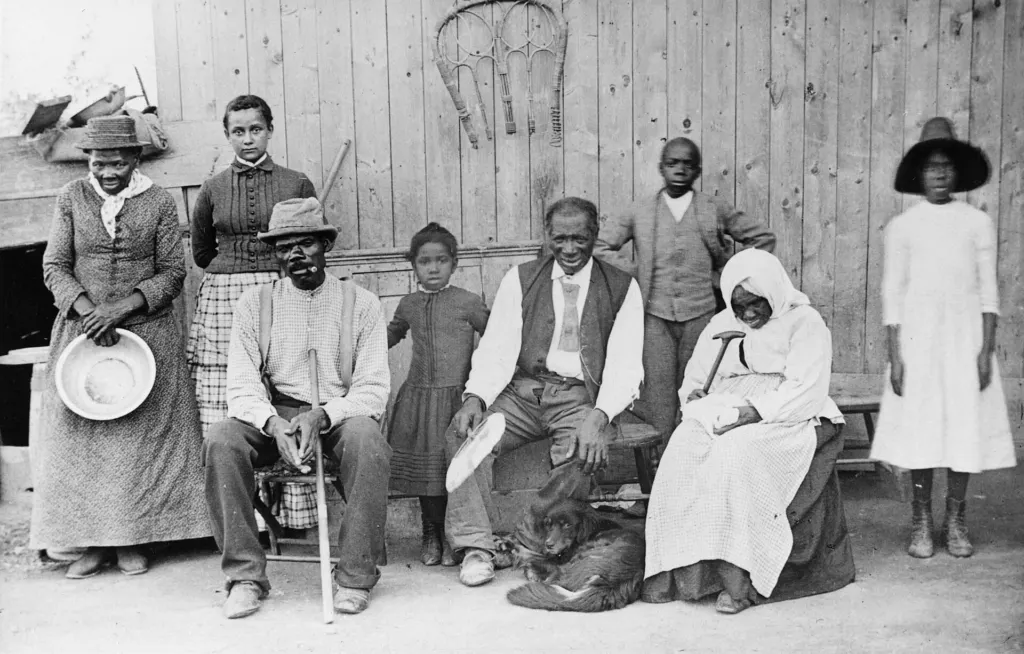
Image: William H. Cheney, Public domain via Wikimedia Commons
This article was produced with AI assistance and reviewed by our Editorial Desk. How we work.