The comforting ending that is supposed to rescue the proverb, “though oftentimes better than master of one,” turns up in none of the early printed versions that dictionary and phrase researchers have collected. The volunteer editors of the leading open dictionary describe that couplet as a rare 21st-century expansion. The matching open-encyclopedia article calls it “a relatively recent development,” though it flags that sentence as still needing a citation. The best that can honestly be said for the “full” proverb is that nobody has produced an old source for it.
The claim keeps circulating anyway. A 2024 post by a graduate student on a British university’s website is typical: “It turns out the full quote actually reads,” she wrote, before giving the couplet and asking who had cut “the rest of this beautiful quote.” The answer, on the evidence so far, is that there was no rest to cut.
Four centuries of a put-down
What the record does show is a saying that reads as a sneer in every dated example researchers have printed. In order:
- 1592: a pamphlet published as Robert Greene’s Groats-worth of Witte warns fellow playwrights about “an upstart Crow, beautified with our feathers,” who, “being an absolute Iohannes fac totum, is in his owne conceit the onely Shake-scene in a countrey.” The insult is in Latin, roughly “Johnny do-it-all.”
- 1618: Geffray Minshull’s Essayes and Characters of a Prison, drawn from his time jailed for debt, describes a prison porter as “some broken Citizen, who hath plaid Iack of all trades.” Encyclopedia editors, citing the Oxford English Dictionary, treat this as the earliest English use; one phrase researcher dates the book to 1612.
- About 1677: Martin Clifford, headmaster of Charterhouse School, tells John Dryden that his writings “are like a Jack of all Trades Shop,” with “nothing of value.”
- 1721: a Boston newspaper prints “Jack of all Trades; and it would seem, Good at none,” the first variation of the “master of none” kind the dictionary lists.
- 1732 and 1770: the verdict hardens into “of no trade” and then “seldom good at any.”
- 1785: the wording people now know, “a Jack of all trades, and in truth, master of none,” turns up in a pharmacy tract by Charles Lucas, the earliest example the researcher Gary Martin has found.
Read in that order, the history runs opposite to the internet version. Dictionary editors say the short form “jack of all trades” was originally sometimes a term of praise, and by the 19th century it often meant a capable handyman. Yet none of these records carries the extra line about masters of one, and the longer the saying got, the harsher it became.
The Shakespeare connection, and its limits
The 1592 jab is usually taken to be aimed at William Shakespeare, then an actor with the nerve to write plays. “Shake-scene” was a new coinage, and “Tygers hart wrapt in a Players hyde” echoes a line from his Henry VI, Part 3. Most scholars accept the identification, though some anti-Stratfordians have argued that the target was the actor Edward Alleyn.
Two cautions keep this from being a neat origin story. First, “Johannes factotum” was an existing Latin tag for someone spread too thin, so the pamphlet did not invent the idea. Second, it is not certain Greene wrote the passage. He died on September 3, 1592, and the pamphlet was registered 17 days later on the responsibility of Henry Chettle, who said he had copied out Greene’s illegible manuscript. A 1969 computer study pointed to Chettle as the author, a 2006 study argued for Greene, and the biographer Katherine Duncan-Jones considered Thomas Nashe “by far the stronger suspect.”
There is also a live disagreement over tone. Martin holds that the bare phrase “jack of all trades” carried no negative sense at first; encyclopedia editors answer that he offers no positive examples from before the 1800s. Minshull’s broken citizen turned porter does not read as a compliment.
Where to check it
The original-spelling text of the pamphlet, transcribed from the 1592 Wright edition, is in the Renascence Editions collection first published by the University of Oregon, and the passage sits near the end, in Greene’s address to three fellow playwrights. The couplet’s defenders have a simple test available: any dated printing of “better than master of one” from before the 2000s would change this story. Until one appears, the oldest verdict stands at 1785, and it reads “in truth, master of none.”
Further reading
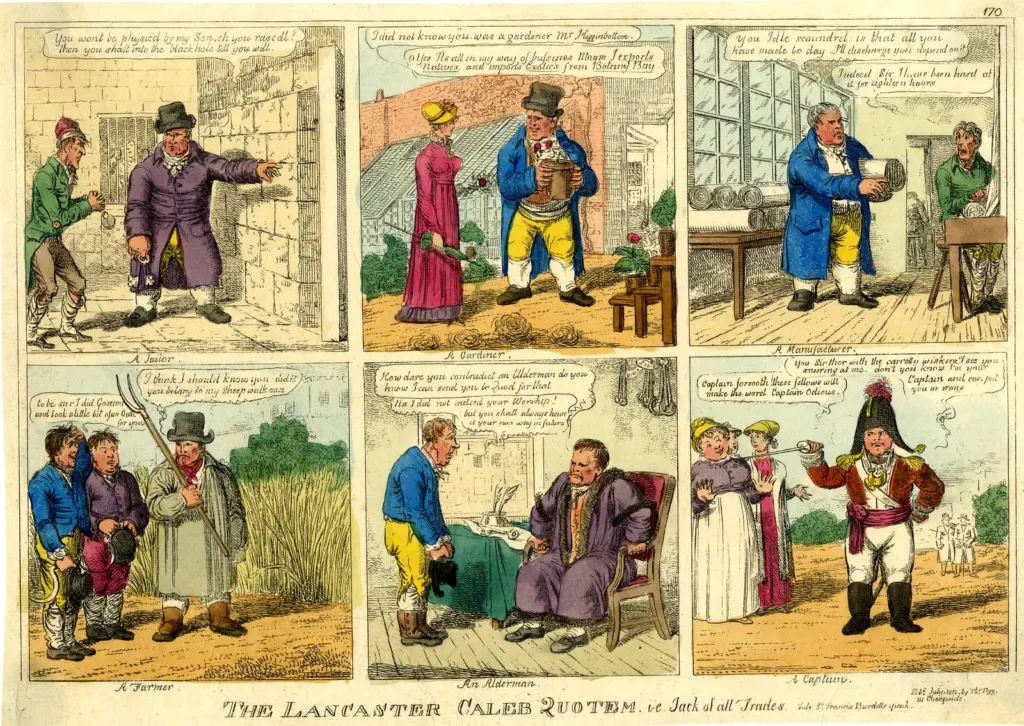
Image: Charles Williams, Public domain via Wikimedia Commons
This article was produced with AI assistance and reviewed by our Editorial Desk. How we work.
Spot an error? Help verify this story
The story in 5 slides