Clarice Phelps helped purify the rare isotope that led to element 117, and when Oak Ridge National Laboratory later cast a plaque honoring the discovery, her name was not on it.
It took her months to get it added. That fight now sits at the center of a strange double record: the world’s chemistry union calls her a historic first, while the lab’s own commemoration initially forgot her.
The story has been circulating again this week on Reddit, where a post carrying only her name reached the site’s popular feed.
What she actually did
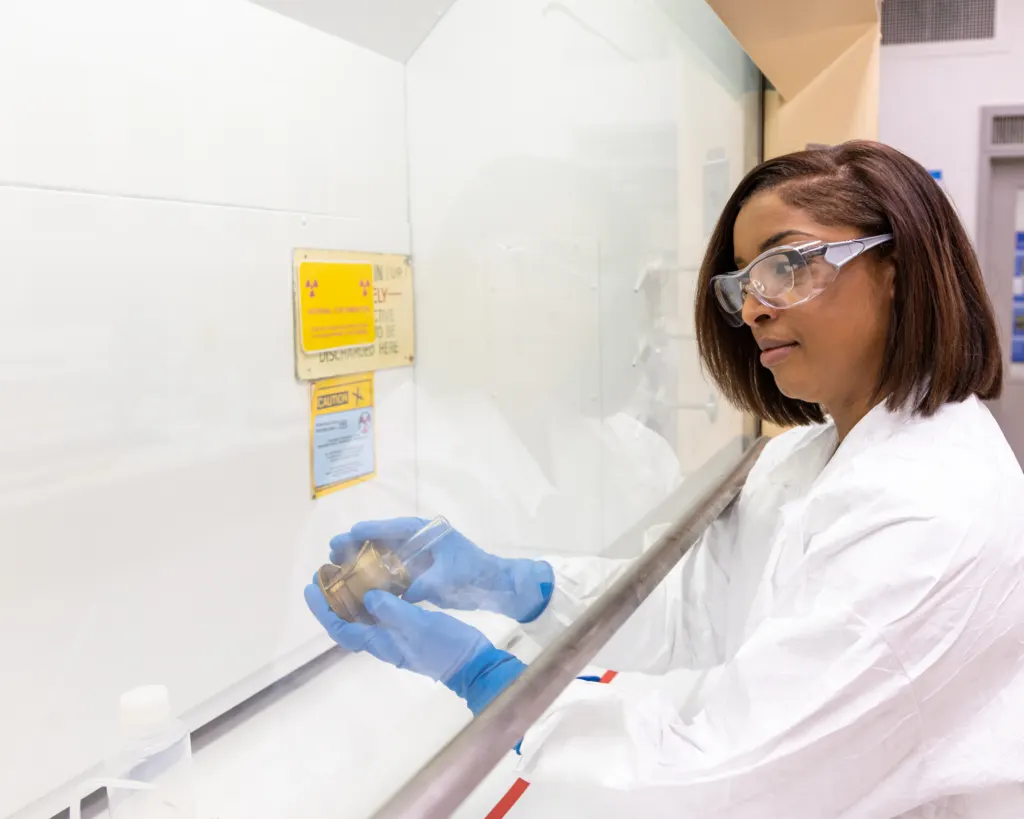
Phelps came to the Tennessee lab in 2009 as a nuclear operations technician, after four and a half years on the aircraft carrier USS Ronald Reagan running reactor chemistry for the Navy. Her staff biography says that from 2010 she worked with a team that “helped purify the isotope berkelium-249, which was used to confirm the discovery of element 117.”
The job ran three months and yielded 22 milligrams. That sliver of berkelium went to the Joint Institute for Nuclear Research, where it met calcium-48 in a fusion reaction. The product was tennessine, the second-heaviest element known.
When credit was assigned, Oak Ridge as an institution was named a principal co-discoverer, and 61 people at the lab were acknowledged, from researchers to operations and support staff. Phelps was one of them.
The gala and the plaque
By the published account of her career, the trouble started at a celebration for the team. Her name was missing from the list, and she arrived to find no seat for her among the other scientists. Then came the plaque, meant to hang at the lab permanently. It left her out as well.
She was told a line break in a spreadsheet had cut the name off. The lab later said the “error [was] quickly corrected”, a claim that sits awkwardly beside her several months of pushing before the change was made.
The second erasure
Then the internet did it again. In September 2018 the British physicist Jessica Wade wrote a Wikipedia biography of Phelps. Volunteer editors deleted it on February 11, 2019.
Their reasoning was procedural. Phelps had not been named in the papers announcing tennessine, according to a report in a chemistry trade publication that year, and most mentions of her work came from her employer, which the site does not accept as neutral proof of notability. The deletion was challenged repeatedly, and the article came back in January 2020.
In between, the recognition arrived anyway. In 2019 the International Union of Pure and Applied Chemistry placed her on its Periodic Table of Younger Chemists, assigning her einsteinium. The citation, as the lab published it, reads: “She is the first African American woman to be involved with the discovery of an element, tennessine.”
Read side by side, the two records show how fragile scientific credit becomes once a discovery needs dozens of hands. A paper’s author list, a plaque and an encyclopedia entry each apply a different test for who counts, and a technician-turned-researcher can fail all three while still doing the work.
Phelps has been blunt about why being visible matters. In 2019 she told an interviewer she chose nuclear chemistry partly because so few Black women worked in it: “They needed to see somebody like me sitting in the same spaces that they were at, and excelling in that same space.”
She gave her own version that December on a stage in Nashville, in a talk titled “How I Claimed a Seat at the Periodic Table.” In 2026 she completed a PhD in nuclear engineering at the University of Tennessee, and she now leads a project producing promethium-147 at the same lab.
Further reading
- Wikipedia: Clarice Phelps
- Oak Ridge National Laboratory: Two ORNL researchers featured on Periodic Table of Younger Chemists
- Wikipedia: Tennessine
Image: Oak Ridge National Laboratory, CC BY 2.0 via Wikimedia Commons
This article was produced with AI assistance and reviewed by our Editorial Desk. How we work.