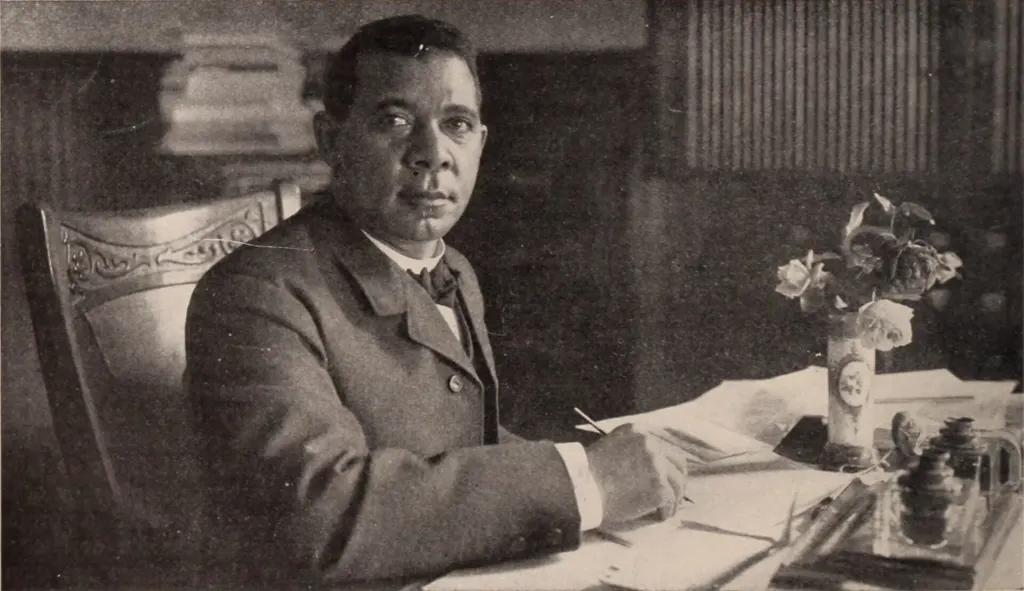
In August 1791 a free Black farmer in Maryland told the US Secretary of State, in writing, that he was “found guilty of that most criminal act, which you professedly detested in others.” The farmer was Benjamin Banneker, born on November 9, 1731. The man reading it was Thomas Jefferson.
We looked at how Jefferson answered and how he later turned on Banneker in an earlier piece. This one stays with Banneker’s own sentences, taken from the text printed in Philadelphia in 1792 and transcribed by the National Park Service.
The opening bow
The letter starts low. Banneker says he is “fully sensible of the greatness of that freedom, which I take with you,” a liberty that “seemed to me scarcely allowable” given the “almost general prejudice and prepossession” against people “of my complexion.”
That courtesy is doing tactical work. He uses the word “Sir” 11 times in roughly 1,400 words, and nearly every “Sir” comes just before he tightens the argument.
He grants that Jefferson is rumored to be “measurably friendly,” an adverb with teeth. Then he sets the terms: “one universal Father hath given being to us all,” and has “endowed us all with the same faculties.” Anyone who accepts that, he writes, has an “indispensible duty” to act on it.
He names his own position
Next comes the sentence no one in Jefferson’s office could have skimmed past. “Sir, I freely and cheerfully acknowledge, that I am of the African race, and in that color which is natural to them of the deepest dye.”
He adds that he is spared “that state of tyrannical thraldom, and inhuman captivity, to which too many of my brethren are doomed.” He was born free, so the plea is made for others.
The trap closes
Banneker then walks Jefferson back to the Revolution, asking him to remember when “the arms and tyranny of the British crown” were aimed at him. He copies out the Declaration of Independence line about all men being created equal, which Jefferson drafted, and calls it a “true and invaluable doctrine.”
The next paragraph is the blow. “Sir, how pitiable is it to reflect,” he writes, that a man so convinced of equal rights should be “detaining by fraud and violence so numerous a part of my brethren, under groaning captivity and cruel oppression.”
Fraud and violence are legal words in a moral sentence. Banneker offers no program for ending slavery, and says he will not “presume to prescribe methods.” He gives one instruction instead, borrowed from the Book of Job: “put your soul in their souls’ stead.”
And then, the almanac
Only near the end does he mention why he supposedly picked up his pen. The appeal, he claims, “was not originally my design,” and he was “unexpectedly and unavoidably led thereto” while sending a gift.
The gift was a handwritten almanac for 1792. He sent it in manuscript so that Jefferson “might also view it in my own hand writing,” which reads as the final argument. Jefferson had questioned Black intellect in print. Here was the answer, in ink, with the math done.
Jefferson replied within two weeks, thanking him and writing: “No body wishes more than I do, to see such proofs as you exhibit.” He did not directly answer the charge of fraud and violence.
Both letters were soon printed together. The 14-page pamphlet, sold by Daniel Lawrence at 33 North Fourth Street in Philadelphia, is held today by the Library of Congress.
Further reading
- National Park Service: The Letters of Benjamin Banneker and Thomas Jefferson
- Wikipedia: Benjamin Banneker
Illustrative image. Image: Missvain, CC BY 4.0 via Wikimedia Commons
This article was produced with AI assistance and reviewed by our Editorial Desk. How we work.