The phrase Americans quote is “separation of church and state.” The sentence Thomas Jefferson actually signed on January 1, 1802, says something slightly different: the First Amendment, he wrote, had the effect of “building a wall of separation between Church & State.”
That line comes from a short reply to a committee of the Danbury Baptist Association in Connecticut, a minority church in a state that still had an official, tax-supported church at the time. The full text of the letter on Wikisource, transcribed from the Library of Congress copy, is addressed to three men: Nehemiah Dodge, Ephraim Robbins and Stephen S. Nelson.
The sentence, word for word
Jefferson, then in his first year as president, opened with thanks for their “affectionate sentiments of esteem and approbation.” The key passage follows:
“Believing with you that religion is a matter which lies solely between Man & his God, that he owes account to none other for his faith or his worship, that the legitimate powers of government reach actions only, & not opinions, I contemplate with sovereign reverence that act of the whole American people which declared that their legislature should ‘make no law respecting an establishment of religion, or prohibiting the free exercise thereof,’ thus building a wall of separation between Church & State.”
He closed by returning the Baptists’ “kind prayers for the protection & blessing of the common father and creator of man,” and signed it “Th Jefferson Jan. 1. 1802.”
What the famous version changes
Set the slogan beside the original and three edits stand out. Jefferson wrote “between,” not “of.” He used an ampersand and capital letters, “Church & State,” as he did seven times across a letter of roughly 234 words. And the image he chose was physical: a wall, built by the amendment, rather than an abstract principle. The everyday version drops the wall entirely and keeps only the separation.
The wall itself was not new. Roger Williams, the Baptist dissenter who founded Providence, Rhode Island, had already written about “the hedge or wall of separation between the garden of the church and the wilderness of the world.” His wall protected the church from the world; Jefferson’s was framed around the powers of government, which in his words “reach actions only, & not opinions.”
How a private reply became a legal phrase
The letter was printed in a Massachusetts newspaper soon after it was sent, but its long life came later, through the courts. A timeline of the key citations:
- 1802: Jefferson signs the reply on New Year’s Day.
- 1879: In Reynolds v. United States, the Supreme Court says Jefferson’s words “may be accepted almost as an authoritative declaration of the scope and effect of the [First] Amendment.”
- 1947: In Everson v. Board of Education, Justice Hugo Black writes that “the clause against establishment of religion by law was intended to erect a wall of separation between church and state,” crediting Jefferson. Note the lowercase and the “and”: the slogan was already drifting from the manuscript.
- 1952: In Zorach v. Clauson, the court takes a more accommodating line, saying the nation’s “institutions presuppose a Supreme Being.”
So the shortening happened in stages. Jefferson’s ampersand became “and,” the capitals fell away, and the wall that Black still mentioned in 1947 disappeared from the everyday phrase.
Is the quote real?
Yes, with a caveat. “Separation of church and state” is a paraphrase of Jefferson, not his wording, and it appears nowhere in the Constitution. The closest the founding text comes is Article Six, which bars any “religious Test” as a qualification for federal office, and the First Amendment clause Jefferson himself quoted.
Badiyaa has traced other founding-era words back to the page, including Benjamin Banneker’s 1791 letter accusing Jefferson of “that most criminal act” and Patrick Henry’s “Give me liberty” speech, written down decades after he gave it.
The original Danbury letter is held in the Jefferson papers at the Library of Congress, and its full 234-word text can be read on Wikisource. It is dated New Year’s Day, so its 225th anniversary falls on January 1, 2027.
Further reading
- Wikisource: Letter to the Danbury Baptists
- Wikipedia: Separation of church and state in the United States
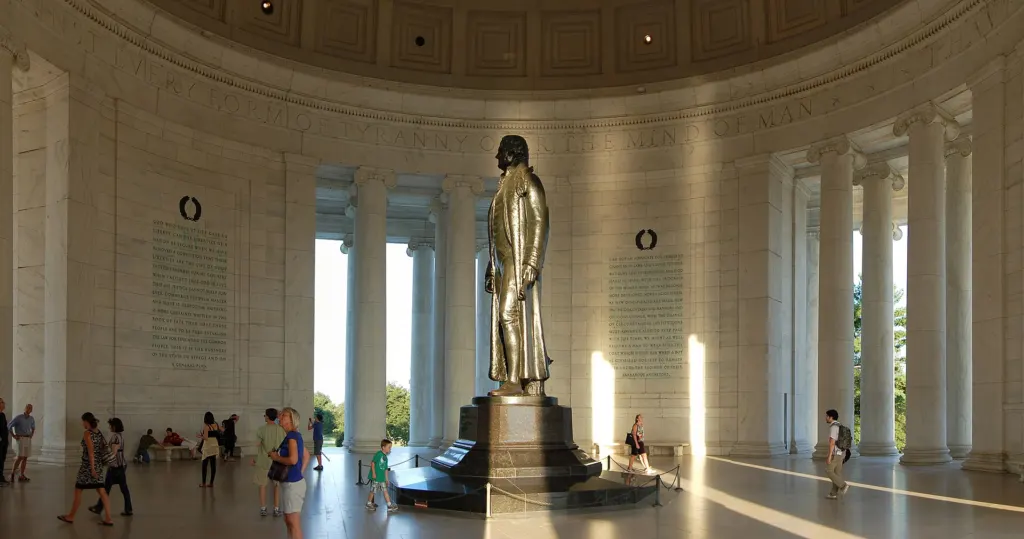
Illustrative image. Image: Michael Kranewitter, Public domain via Wikimedia Commons
This article was produced with AI assistance and reviewed by our Editorial Desk. How we work.