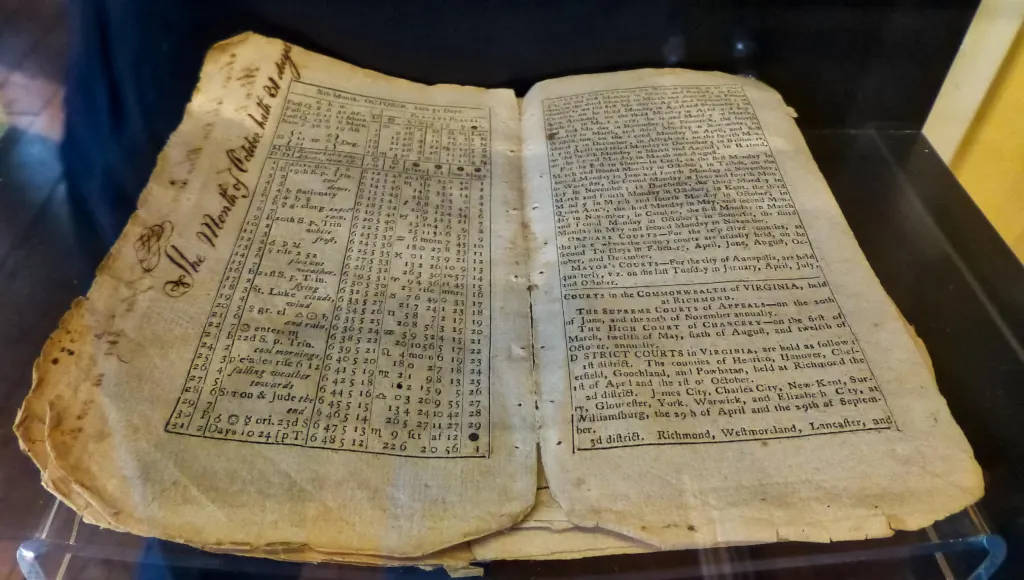
In August 1791, a free Black farmer from rural Maryland put a handwritten almanac in the mail to the US Secretary of State and accused him, in effect, of hypocrisy. The farmer was Benjamin Banneker, born 295 years ago this Monday. The Secretary of State was Thomas Jefferson, author of the Declaration of Independence and an enslaver.
Banneker quoted the Declaration’s own language back at him in a plea for justice for African Americans. To prove the point, he enclosed his calculations of the heavens for 1792.
Jefferson answered on August 30. He wrote that “no body wishes more than I do to see such proofs as you exhibit,” adding that nature had given “our black brethren, talents equal to those of the other colours of men.” Then he forwarded the almanac to the Marquis de Condorcet in Paris, describing its author as “a very respectable mathematician.”
A late start
Banneker was the son of a free Black woman and a formerly enslaved man from Guinea, and he had little or no schooling. He grew up on a 100-acre farm in the Patapsco Valley. His serious astronomy began only in 1788, when George Ellicott, a neighbor from a Quaker milling family, lent him books and instruments.
Do the subtraction. He was 56 or 57 when he opened those books and just shy of 60 when his first ephemeris went to the printers for the 1792 almanac. Three years, from borrowed equipment to tables good enough to sell.
Printers did not simply take his word for it. The astronomer David Rittenhouse vouched for the arithmetic, in a backhanded compliment typical of the age: “a very extraordinary performance, considering the Colour of the Author.” Abolition societies in Maryland and Pennsylvania pushed the book hard. At least 28 editions of the almanacs appeared in seven cities across five states, running from 1792 to 1797.
Record versus legend
Banneker turned into an American folk hero after his death, and the tall tales piled up fast. Here is how the common claims hold up against the surviving evidence:
- The wooden clock: he reportedly finished one around 1753, modeled on a borrowed pocket watch. The “reportedly” matters.
- The survey of Washington, DC: he did work on the boundary survey for Major Andrew Ellicott, starting in February 1791, but left in April. Exactly what he did is thinly documented.
- The portrait: the woodcut on his 1795 almanac may not show him at all. A biographer judged it more likely an idealized image of a Black youth.
- Parliament: an editor claimed his almanac was shown in the British House of Commons during the slave-trade debate, yet the official report of that debate does not mention him.
Jefferson changes his tune
Jefferson’s warmth did not last. In 1809, three years after Banneker’s death, he wrote to Joel Barlow that Banneker had “spherical trigonometry enough to make almanacs, but not without the suspicion of aid from Ellicot.” A long letter from Banneker, he now claimed, showed “a mind of very common stature indeed.”
That is 18 years between “very respectable mathematician” and “very common stature,” about the same man and the same evidence.
Most of the proof that might have settled the argument went up in smoke. On the day of Banneker’s funeral in 1806, fire destroyed his log cabin and nearly all his papers. One journal survived, recording his notes on the 17-year cicadas of 1749, 1766 and 1783. It went to the Maryland Historical Society in 1987.
Further reading
Image: F Delventhal, CC BY 2.0 via Wikimedia Commons
This article was produced with AI assistance and reviewed by our Editorial Desk. How we work.