No flight school in the United States would teach Bessie Coleman, so on November 20, 1920, the Chicago manicurist sailed for Paris instead. Seven months later she came back a licensed pilot, the first African American woman and the first Native American to hold a pilot's license, as her Wikipedia biography records.
The date on that license is June 15, 1921. The Smithsonian's National Air and Space Museum profile of Coleman notes she earned it from the Fédération Aéronautique Internationale more than 20 years before the Tuskegee Airmen flew in World War II.
From cotton fields to a Chicago barbershop
Her life began in Atlanta, Texas, on January 26, 1892. She was child number ten of 13, and her parents were sharecroppers. She grew up in Waxahachie, walking four miles each way to a one-room segregated school where she stood out at math, and stopping every harvest season to help bring in the cotton. Her savings bought one term at what is now Langston University in Oklahoma before the money ran out.
In 1915 she moved to Chicago and took a job as a manicurist at the White Sox Barber Shop. There she heard pilots home from World War I talk about flying. American schools of the day turned away both women and Black students. Robert S. Abbott, founder of a Chicago Black newspaper, urged her to train abroad, and banker Jesse Binga helped fund the trip. She took French lessons first.
A French biplane and an international license
In France she learned on a Nieuport 82 biplane steered by a stick and a rudder bar. Her license came from the Fédération Aéronautique Internationale, the Paris-founded world body for air sports, and she was the first American of any race or gender to receive it directly from the FAI rather than through the US national association.
Her own explanation of why she took the risk survives: "The air is the only place free from prejudices." She added that she "thought it my duty to risk my life to learn aviation."
Queen Bess on the air show circuit
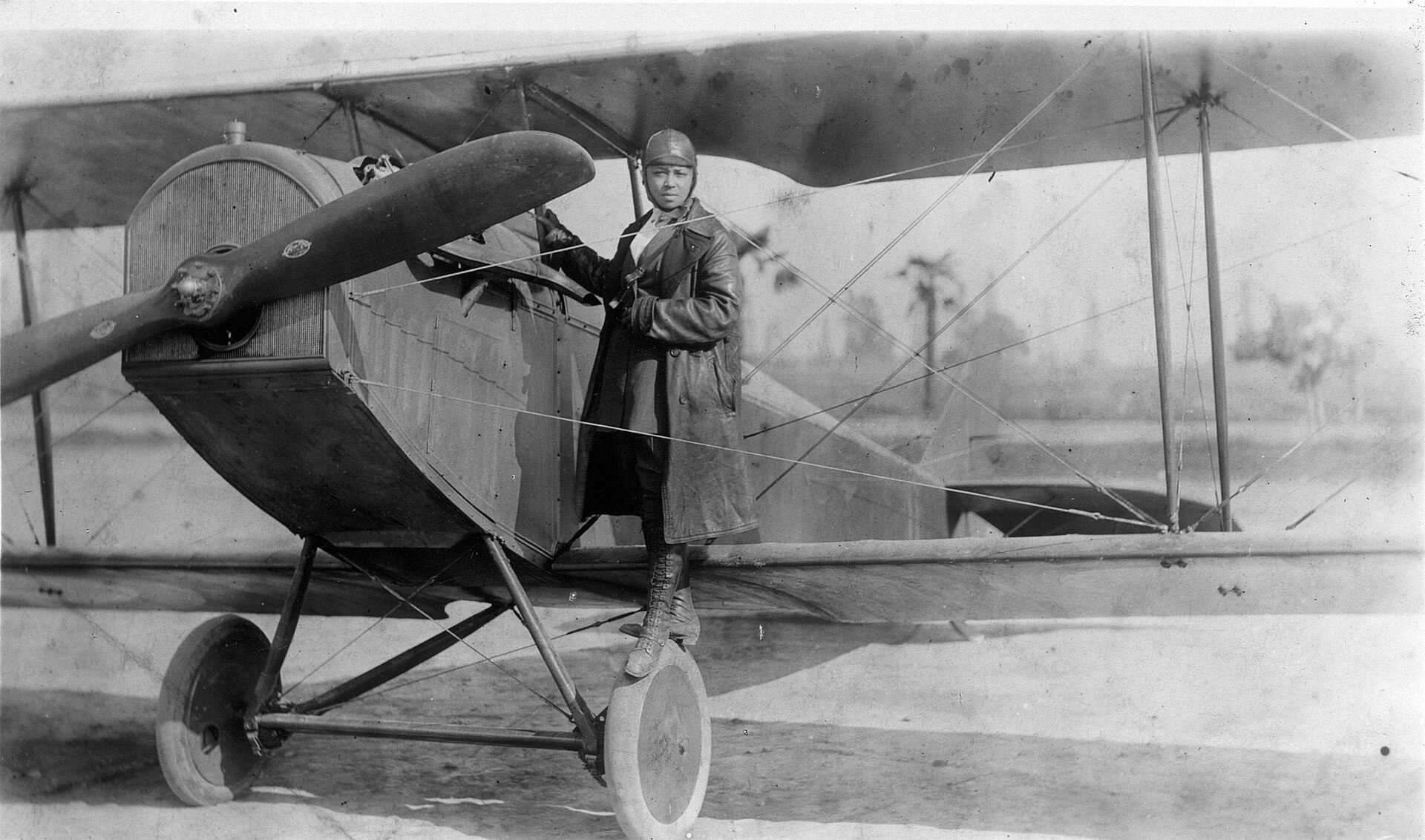
With airlines still years away, the only living for a civilian pilot was barnstorming. Coleman went back to Europe in 1922 for advanced training, including time with the Fokker company in Germany, and made her first US air show appearance on September 3, 1922, on Long Island. Crowds knew her as "Queen Bess" and "Brave Bessie." A 1922 photograph of Coleman beside her plane, held in UCLA's Miriam Matthews collection shows her standing with the aircraft.
She refused to perform at events that barred Black spectators, and the Smithsonian notes she flew only for desegregated crowds. Her goal was a flight school for African American students, and she opened a beauty shop in Orlando to save for it.
She never got there. Coleman was killed in a crash during a practice flight in Jacksonville, Florida, on April 30, 1926, aged 34.
A timeline of a short career
- November 1920: sails for France to train.
- June 15, 1921: receives her FAI pilot's license, aged 29.
- September 3, 1922: first American air show.
- April 30, 1926: dies in Jacksonville, less than four years into her flying career at home.
In other words, the whole public career that made her famous lasted about 44 months. Her influence ran much longer: William J. Powell founded the Bessie Coleman Aero Club in 1929, the US Postal Service issued a 32-cent stamp for her in 1995, and in 2021 a mountain on Pluto was named Coleman Mons.
Badiyaa's hidden history series has also covered Matthew Henson's 91-year wait for the Hubbard Medal, Mary Seacole's Crimean War British Hotel and the search for Amelia Earhart on Nikumaroro.
Sources
- Bessie Coleman, Wikipedia, 2026
- How Bessie Coleman Broke Barriers to Make History, Smithsonian National Air and Space Museum, 2021
- Fédération Aéronautique Internationale, Wikipedia, 2026
- Bessie Coleman and her plane (1922), Wikimedia Commons / UCLA Library, Miriam Matthews Photograph Collection, 1922
Image: Unknown photographer, Public domain via Wikimedia Commons
This article was produced with AI assistance and reviewed by our Editorial Desk. How we work.