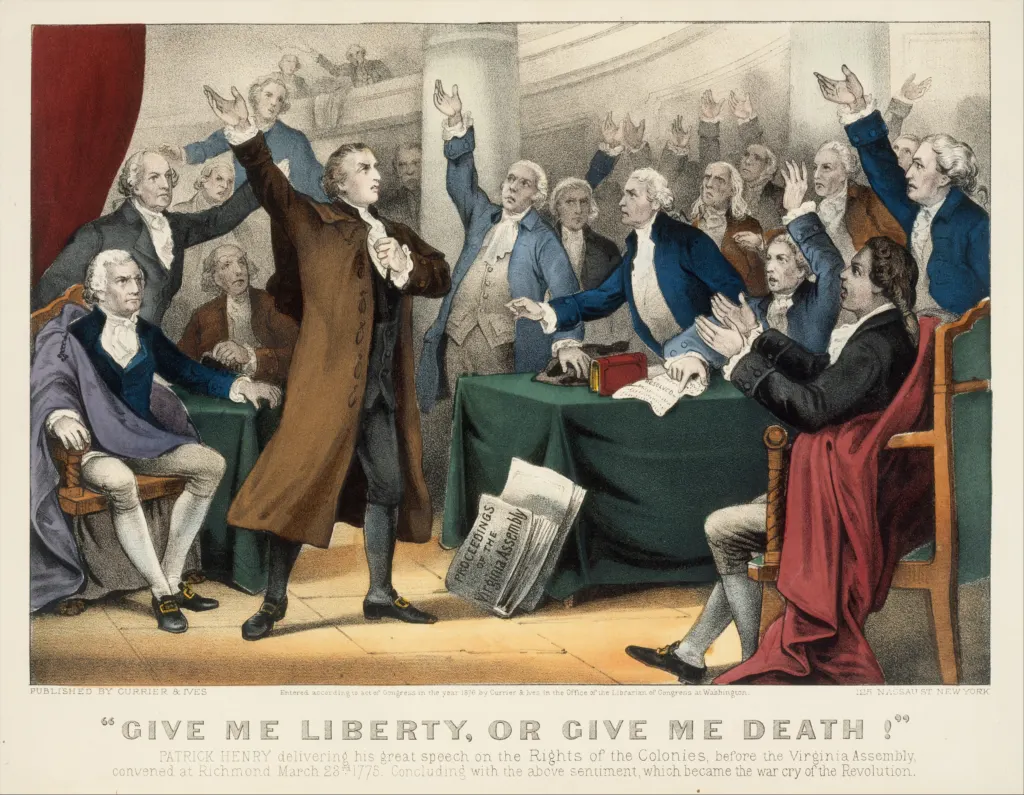
No one in the old wooden church at Richmond, Virginia, wrote down what Patrick Henry said on March 23, 1775. The speech that ends with “give me liberty, or give me death!” first reached print in 1816, as a preview of a biography by the Virginia lawyer William Wirt. The book itself appeared 42 years after the convention (1817 minus 1775) and 18 years after Henry died in 1799. Wirt had never met Henry and never heard him speak.
So did Henry say it? The fair answer is that nobody can prove he did, and the best surviving evidence suggests most of the famous text belongs to his biographer.
The convention and the motion
The Second Virginia Convention opened on Monday, March 20, 1775, in the church now known as St. John’s. Henry, a delegate from Hanover County, moved that the colony be “put into a state of defence” and raise a militia. Moderates such as Richard Bland, Benjamin Harrison and Edmund Pendleton objected that the motion was rash while a petition to the king was still pending. Henry answered them, and the resolutions passed. A committee that included George Washington and Thomas Jefferson was named to draw up the militia plan.
Those facts are solid. The words are not.
How Wirt built the speech
Wirt started his biography in 1805. Ten years in, he admitted in a letter to a friend that from 1763 to 1789 “not one of his speeches lives in print, writing or memory.” He wrote to elderly men who had been in Richmond, or who knew people who had. All agreed that the speech moved the room. Only one, the judge St. George Tucker, tried to set down actual sentences, and he warned Wirt: “In vain should I attempt to give any idea of his speech.” Tucker’s letter has since been lost.
Tucker’s recollection covered a single passage, the one that builds to “we must fight!” Wirt thanked him on August 16, 1815, writing, “I have taken almost entirely Mr. Henry’s speech in the Convention of ’75 from you.” He also borrowed one phrase from Edmund Randolph, another witness. By one modern count, more than 1,000 of the speech’s 1,217 words, including the closing paragraph, have no known source except Wirt.
Read Wirt’s own pages, not the classroom version, and the seams show. He opens the speech in reported speech: “No man,” he said, “thought more highly than he did, of the patriotism, as well as abilities, of the very worthy gentlemen who had just addressed the house.” Later editors turned that into first person. Even the climax arrives with a stage direction, as Henry speaks “with both his arms extended aloft, his brows knit.”
The only account from 1775
One listener did write about the speech within weeks. On April 6, 1775, the Scottish merchant James Parker, who was hostile to the patriots, told a correspondent in Britain that Henry “called the K—— a Tyrant, a fool, a puppet, and a tool to the ministry.” None of that name-calling appears in Wirt. Parker’s bias is obvious, but his letter is the nearest thing to a contemporary report, and it describes a rougher speech than the one American students memorize.
Historians accepted Wirt’s text for about 160 years. In the 1970s scholars began to test it, and most now doubt that it records Henry’s words. Henry may still have used the phrase. “Liberty or death” was already familiar: Joseph Addison’s 1713 play Cato, popular in the colonies, has the line “chains or conquest, liberty or death,” and the Culpeper Minutemen carried a 1775 flag with the slogan.
The paper trail, in order
- March 23, 1775: Henry speaks at the Richmond convention. No transcript is taken.
- April 6, 1775: James Parker’s letter describes Henry insulting the king.
- 1799: Henry dies.
- 1805: Wirt begins the biography.
- August 1815: Wirt thanks Tucker for the core passage.
- 1816: Wirt prints the speech as a preview in a Philadelphia literary magazine.
- 1817: Sketches of the Life and Character of Patrick Henry is published in Philadelphia.
For anyone quoting it today, the accurate wording is “give me liberty, or give me death!” as printed by William Wirt in 1817, credited to Henry. That keeps the line and tells readers where it really comes from. Wirt’s full chapter is on Wikisource.
Wirt’s book was a hit. It was reprinted 25 times over the next 50 years, which is how the reconstruction became the quotation.
Further reading
- Wikipedia: Give me liberty or give me death!
- Wikisource: Wirt, Sketches of the Life and Character of Patrick Henry, chapter 4
Image: Currier and Ives, CC0 via Wikimedia Commons
This article was produced with AI assistance and reviewed by our Editorial Desk. How we work.
Spot an error? Help verify this story
The story in 5 slides