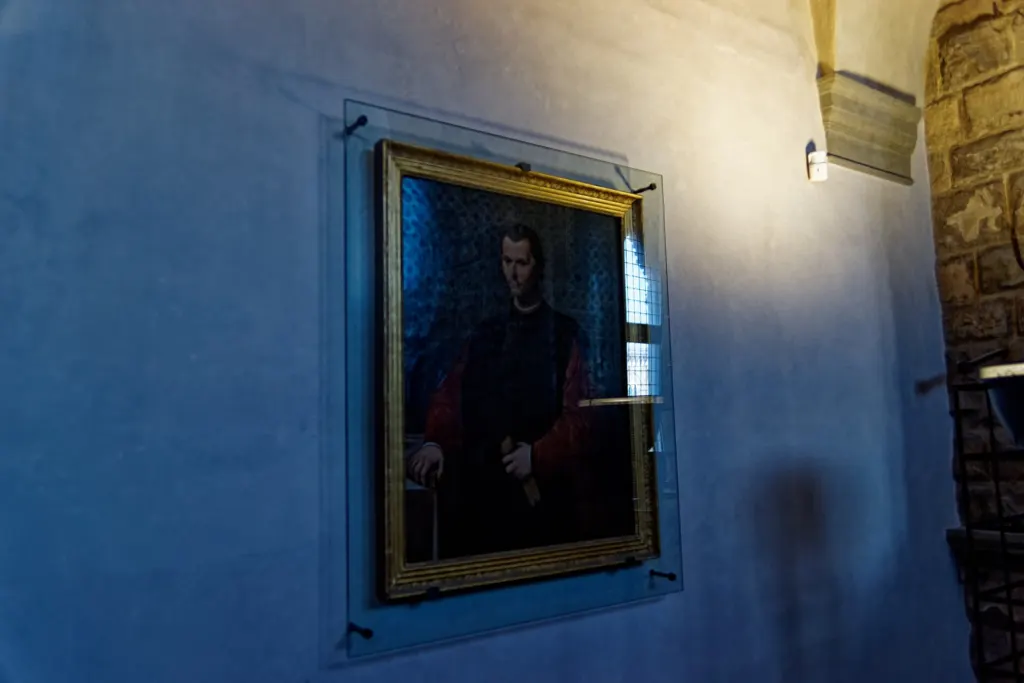
Search all 26 chapters of The Prince and the line everyone pins on Niccolò Machiavelli never turns up. “The end justifies the means” is not in the book, in English translation or in the Italian printed in 1532. It sits in the misattributed column of the standard quotation collections as the saying most often hung on him.
What he did write is shorter, colder and, read closely, a description of how crowds judge rulers rather than a license to do anything.
The sentence in chapter 18
The passage comes near the end of chapter 18, the chapter on whether princes should keep their word. In the Italian text, Machiavelli says that in the actions of all men, and above all princes, “dove non è giudizio a chi reclamare, si guarda al fine.” Where there is no court to appeal to, people look at the outcome.
William K. Marriott’s public-domain English translation renders the key clause as “one judges by the result,” and then gives the line that the famous slogan grew out of: “let a prince have the credit of conquering and holding his state, the means will always be considered honest, and he will be praised by everybody.”
Look at the grammar. The means “will always be considered” honest; in the Italian they will be “giudicati onorevoli,” judged honorable. Machiavelli is reporting a verdict handed down by onlookers. He explains why in the next breath: “the vulgar are always taken by what a thing seems to be and by what comes of it.” Success, in other words, launders reputation in the eyes of the public. That is a claim about perception, not a moral rule saying any method is fine if the goal is good.
He was not soft, either
None of this makes chapter 18 gentle. The same pages tell a ruler that he “cannot, nor ought he to, keep faith” when a promise turns against him, that he must be “a great pretender and dissembler,” and that it is “very necessary to appear” merciful, faithful and religious whether he truly is or not. He holds up Pope Alexander VI as a man who did nothing but deceive and always found victims.
Yet he also adds a brake the slogan drops. A prince should “not to diverge from the good if he can avoid doing so, but, if compelled, then to know how to set about it.” Necessity, not any worthy goal, is his test.
And in chapter 8 he refuses glory to Agathocles of Syracuse, who seized power by having his soldiers kill the senators and richest citizens. In a modern translation quoted in the standard summaries of the book, Machiavelli writes: “Yet one cannot call it virtue to kill one’s citizens, betray one’s friends, to be without faith, without mercy, without religion; these modes can enable one to acquire empire, but not glory.” A writer who thought the end justified every means would not need that sentence.
Timeline: how a paraphrase became a quote
- 1513: Machiavelli’s letters show him writing the book under a Latin title, De Principatibus.
- 1527: He dies in June, with the work still unprinted.
- 1532: Antonio Blado prints Il Principe, five years after the author’s death, with the permission of the Medici pope Clement VII.
- 1559: The book goes on the Index of Pope Paul IV, which nearly halts its publication in Catholic regions outside France.
- 1645: The Jesuit theologian Hermann Busenbaum publishes his moral-theology manual, the Medulla; the exact Latin formula “when the end is lawful, the means are also lawful” is occasionally linked to him instead.
The tidy English proverb is a later compression of all this, stitched from Machiavelli’s “si guarda al fine” and from a casuist’s Latin that was never his.
The other place he talks about ends
There is a lighter echo in Machiavelli’s comedy La Mandragola, usually dated to 1524. In Act III, scene xi, a character says “El fine si ha a riguardare in tutte le cose,” which translator Peter Constantine gives as “One must never forget to look at the aim of a matter.” It is advice about keeping your eye on the goal, spoken on a comic stage, and it carries no claim that the goal excuses everything.
Machiavelli was born on May 3, 1469, worked as a diplomat and died on June 21, 1527. His reputation has spent five centuries carrying a sentence he never wrote. The words he did write are online in the original Italian, chapter 18, page 69 of the edition scanned there: “si guarda al fine.”
Further reading
- Wikisource: Il Principe, Capitolo XVIII
- Wikisource: The Prince (Marriott), Chapter 18
- Wikipedia: The Prince
Image: Txllxt TxllxT, CC BY-SA 4.0 via Wikimedia Commons
This article was produced with AI assistance and reviewed by our Editorial Desk. How we work.