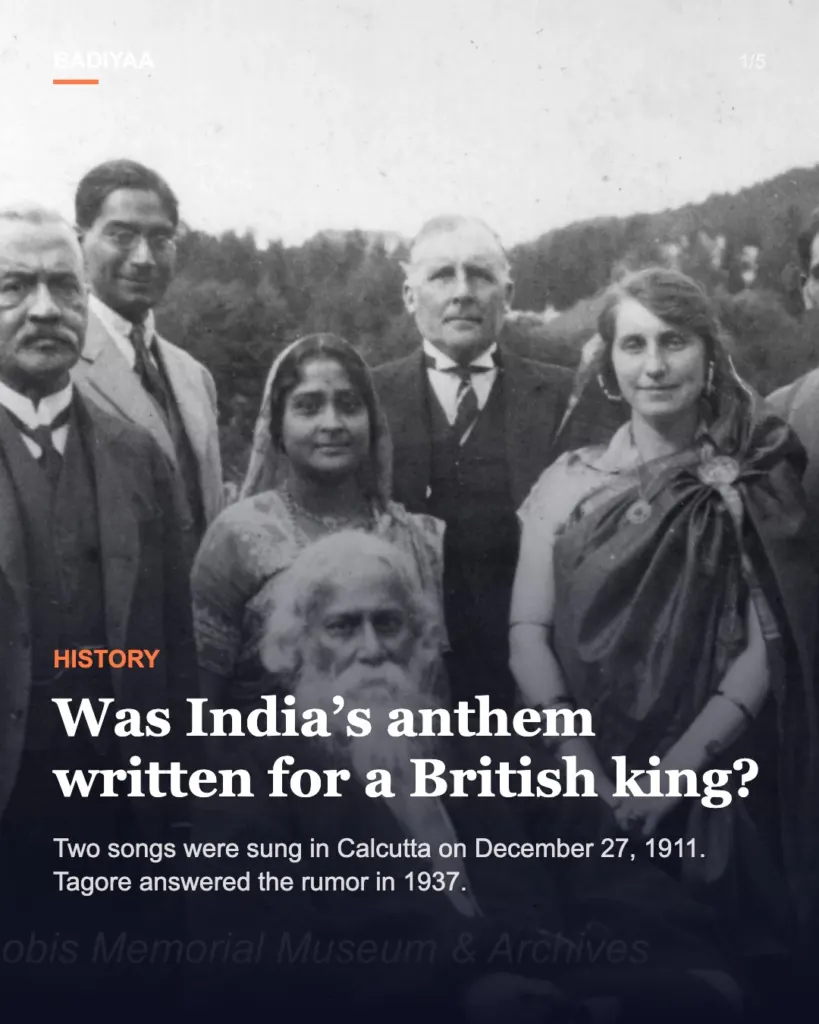
On November 10, 1937, Rabindranath Tagore wrote to a correspondent, Pulin Behari Sen, to deal with a rumor that had followed him for a quarter of a century. In the English translation usually cited, the Nobel-winning Bengali poet explained that the “Lord of Destiny” praised in his song “Jana Gana Mana” “could never be George V, George VI, or any other George.”
That song is now India’s national anthem. The claim that Tagore wrote it to flatter the British king is false, and the paper trail from December 1911 shows how the confusion started.
Two songs on one day in Calcutta
Tagore finished the Bengali song, then titled “Bharoto Bhagyo Bidhata,” on December 11, 1911. It has five stanzas and was written as a hymn for the monotheistic Brahmo Samaj movement. The timing was unlucky. King George V was in India that month for his imperial visit.
The annual session of the Indian National Congress opened in Calcutta (now Kolkata) on December 26. On the second day, December 27, the meeting began with Tagore’s song. Later the delegates passed a resolution of loyalty to the king, and a second piece, a Hindi song written specifically to welcome George V and Queen Mary, was performed.
Some British-run English-language papers reported on December 28 that Tagore had composed his song for the Emperor. Nationalist papers in the city described the order of events correctly, as did the Congress’s own report of the session, which called Tagore’s contribution “a patriotic song.” The official historical record of the 1911 imperial visit does not say that Tagore wrote anything for the royal family.
What the 1937 letter says
Tagore’s explanation came years later. He said a senior official in the king’s service, a friend, had asked him for a song of felicitation to the Emperor, and that the request “simply amazed” him. His answer, he wrote, was a song hailing the guide who “from age after age held steadfast the reins of India’s chariot.” The friend, Tagore added, understood the point.
He was blunter on March 19, 1939: “I should only insult myself if I cared to answer those who consider me capable of such unbounded stupidity as to sing in praise of George the Fourth or George the Fifth as the Eternal Charioteer.”
Two caveats matter for readers outside India. Tagore wrote these letters in Bengali, and the lines here are translations; the 1937 letter is printed in volume two of Prabhatkumar Mukherjee’s biography Rabindrajibani, page 339. Second, both letters came after George V had died in 1936. The 1911 records do not depend on the letters, though. They already separate the two songs.
Explainer: the Nobel and the knighthood
A related claim says Tagore’s 1913 Nobel Prize in Literature was a royal reward for the song. The Nobel is chosen in Sweden, and the chair of the Swedish Academy’s Nobel committee in 1913 was the historian Harald Hjärne, not the British king. The prize citation praises Tagore’s “profoundly sensitive, fresh and beautiful verse” expressed “in his own English words,” a reference to his English versions of his poems.
George V did knight Tagore in 1915. Four years later Tagore gave the title back in protest at the Jallianwala Bagh massacre in Amritsar, writing to the viceroy, Lord Chelmsford, that he wished to stand “shorn of all special distinctions, by the side of my country men.”
From hymn to anthem
- December 11, 1911: Tagore completes the song.
- December 27, 1911: First public performance, at the Congress session in Calcutta.
- January 1912: The full five-stanza poem appears in the Brahmo Samaj journal Tagore edited.
- February 28, 1919: At a college in Madanapalle, in southern India, Tagore sings it, helps set it down in Western notation and translates it as “The Morning Song of India.”
- November 10, 1937, and March 19, 1939: The two letters rejecting the George V story.
- January 24, 1950: India’s Constituent Assembly adopts the first stanza as the national anthem.
The rumor rests on a few newspaper lines from late December 1911. The anthem that came out of that week takes about 52 seconds to sing, and it names Punjab, Sindh, Gujarat, Maratha, Dravida, Utkala and Bengal, not a king.
Further reading
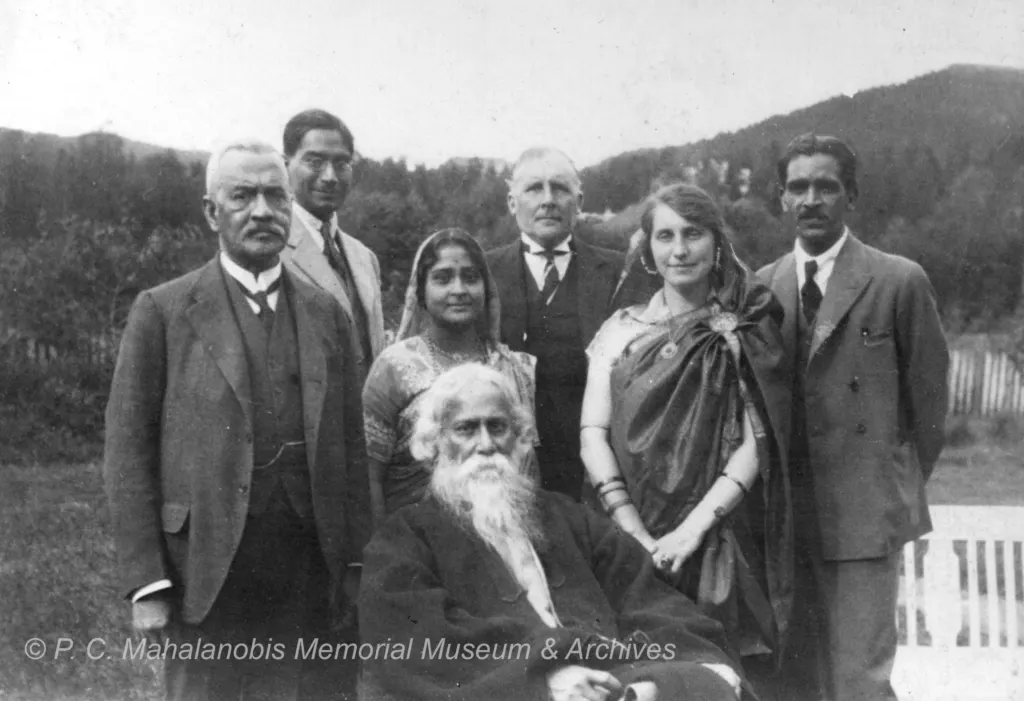
Image: P. C. Mahalanobis Memorial Museum & Archives, Public domain via Wikimedia Commons
This article was produced with AI assistance and reviewed by our Editorial Desk. How we work.
Spot an error? Help verify this story
The story in 5 slides