The only full account of Sojourner Truth’s Akron speech printed in 1851 never asks “Ain’t I a woman?” Marius Robinson, a minister who was one of the convention’s secretaries and who edited the Anti-Slavery Bugle, set down her words on page 4 of the paper’s June 21, 1851, issue, 23 days after she spoke. The famous refrain arrived almost 12 years later, in a retelling by Frances Dana Gage.
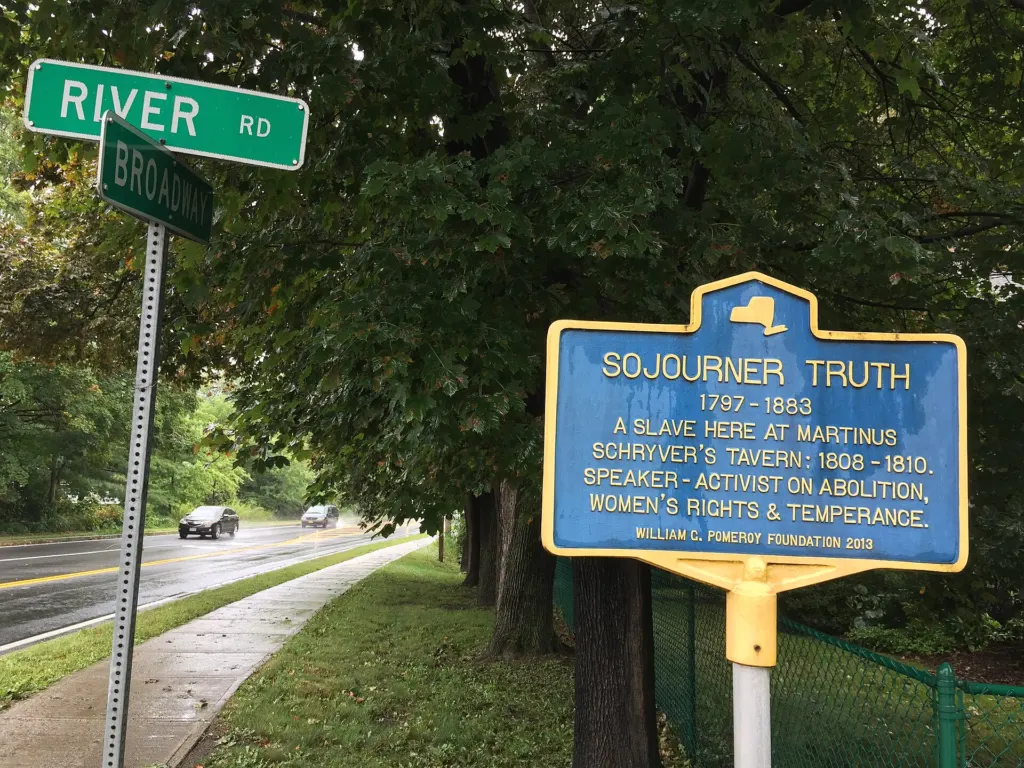
Truth was born into slavery in Ulster County, New York, around 1797, as Isabella Baumfree. In 1827 she left her enslaver, later telling him, “I did not run away, I walked away by daylight,” and in 1843 she took the name Sojourner Truth, preaching and lecturing against slavery and for women’s rights until her death in Battle Creek, Michigan, in 1883.
What the 1851 transcript records
The convention met in Akron, Ohio, and Truth took the floor on May 29, 1851, in the Old Stone Church, a building since torn down, according to the National Park Service. Robinson’s text opens with her asking the chair, “May I say a few words?” What follows is short and blunt. Its strongest claim is physical:
“I have as much muscle as any man, and can do as much work as any man. I have plowed and reaped and husked and chopped and mowed, and can any man do more than that?”
The nearest thing to a slogan is a single odd-sounding sentence, “I am a woman’s rights.” She argues from a pint and a quart, asks men to let women set the world “right side up again,” and closes on a farm image. Man, she says, “is in a tight place, the poor slave is on him, woman is coming on him, and he is surely between a hawk and a buzzard,” in the wording the Library of Congress quotes from the digitized page.
Robinson’s version has a good claim to be close to what she said. Truth stayed with Robinson and his wife, Emily, in Ohio that year, and he is believed to have read his transcript over with her before printing it.
What Gage published in 1863
Gage had presided over the Akron meeting. Her account appeared in the middle of the Civil War, first in a Congregationalist weekly in New York on April 23, 1863, and again in a New York abolitionist paper on May 2. She said she was moved to write by Harriet Beecher Stowe’s April 1863 profile, “Sojourner Truth, The Libyan Sibyl.” Gage was in Union-occupied South Carolina at the time, so Truth could not have checked this one.
Gage’s Truth speaks in an invented Southern plantation dialect (“Well, chillen, whar dar’s so much racket dar must be som’ting out o’kilter”) and puts the same question four times. In the 1863 printing it is spelled “ar’n’t I a woman?” The version Gage later supplied to the multivolume History of Woman Suffrage spells it “a’n’t.” The smooth modern “ain’t” belongs to neither.
The dialect is the plainest error. Truth never lived in the South, and her own Narrative says she spoke only Dutch until about the age of nine. The Library of Congress allows that she may have kept a Dutch accent, “but that would be nothing like the dialect Gage gave her.”
The two texts, line against line
- Time to print: 23 days for Robinson; 11 years and almost 11 months for Gage (May 29, 1851, to April 23, 1863).
- The refrain: absent from Robinson; four times in Gage.
- Children: Robinson’s Truth mentions none. Gage’s says “I have borne thirteen chillen, and seen ’em mos’ all sold off into slavery.” The Park Service records five children with her husband, Thomas, and she was never known to claim more.
- The crowd: Gage in 1863 describes a hissing, “mobbish” room. Other eyewitnesses reported a harmonious session, and Gage’s own 1851 report called Akron largely friendly to the convention.
- Shared ground: both keep the pint and the quart, Eve turning the world upside down, and Jesus coming from God and a woman.
How the later version won
Gage’s text was reprinted in 1875, 1881 and 1889 and was bound into the Narrative of Sojourner Truth from 1875. Truth never learned to read or write, and no record shows her objecting to it. In 1972 Miriam Schneir’s anthology Feminism: The Essential Historical Writings printed Gage’s speech with the dialect stripped out, and such versions are still printed today. The Park Service page still leads with a dialect-free copy of Gage’s text under Truth’s name, with a note below it pointing readers to Robinson.
Historian Nell Irvin Painter reopened the question in her 1996 biography, Sojourner Truth: A Life, a Symbol. “We cannot know exactly what Truth said at Akron in 1851,” she wrote, but she judged Robinson’s account the more reliable of the two. So the verdict is narrow and firm: the idea of the speech is Truth’s, the bare arm and the plowing are hers, and the refrain “Ain’t I a woman?” is Gage’s.
Truth died on November 26, 1883. An obituary that ran in several papers said her mind was “penetrating, clear, logical and original” and her “enunciation and pronunciation was faultless.” Robinson’s page, the Anti-Slavery Bugle of June 21, 1851, page 4, is digitized in the Library of Congress newspaper collection.
Further reading
- Wikipedia: Ain’t I a Woman?
- Library of Congress: Sojourner Truth’s Most Famous Speech
- National Park Service: Sojourner Truth: Ain’t I A Woman?
Image: HighAtop94, CC BY-SA 4.0 via Wikimedia Commons
This article was produced with AI assistance and reviewed by our Editorial Desk. How we work.