Benjamin Franklin did suggest that Paris could save millions of livres by using daylight, but he never asked anyone to touch a clock. His 1784 letter proposed taxing window shutters, rationing candles and firing cannon in every street at sunrise to drag sleepers out of bed.
That matters this weekend. Most of the United States falls back one hour at 2:00 a.m. on Sunday, November 1, and Franklin’s name will be attached to the switch again. The text he wrote tells a different story.
A lamp, a late night and a joke
The letter grew out of a Paris craze. In early 1784 a new oil lamp promoted by Quinquet and Lange, a copy of Ami Argand’s design, was lighting up the city’s salons. Franklin, then living in Passy as the American envoy, watched it demonstrated at an evening party where guests argued over whether it really burned less oil.
He drafted his reply around mid-March and signed it only as “An ABONNÉ,” a subscriber. A French translation ran on the front page of the Journal de Paris on April 26, 1784, under the heading “Economie.” The editor, Cadet de Vaux, quietly cut three of its sharpest passages.
The joke starts with Franklin going to bed three or four hours after midnight and being woken around six by light pouring through shutters his servant forgot to close. He reports, as shocking news, that our nearest star “gives light as soon as he rises,” then doubles down: “I am certain of my fact. One cannot be more certain of any fact. I saw it with my own eyes.”
What he actually proposed
Franklin’s plan was to change people, not time. His four “regulations” read like a police order:
- A tax of one louis, a gold coin, on every window “provided with shutters to keep out the light.”
- Guards in candle shops, with no family “permitted to be supplied with more than one pound of candles per week.”
- Guards stopping coaches after sunset, except for “physicians, surgeons, and midwives.”
- Church bells at sunrise, and if that failed, “let cannon be fired in every street, to wake the sluggards effectually.”
He even promised the habit would stick: “Oblige a man to rise at four in the morning, and it is more than probable he shall go willingly to bed at eight in the evening.”
Checking Franklin’s candle math
The satire rests on real arithmetic, and it holds up. Franklin assumed 100,000 Paris households burning half a pound of candles an hour. Our check of his figures: 183 nights from March 20 to September 20, times 7 wasted hours, gives 1,281 hours per household; times 100,000 households gives 128,100,000 candle hours; at half a pound each, that is 64,050,000 pounds of wax and tallow. Priced at 30 sols a pound, he reached 96,075,000 livres tournois, which he called “An immense sum!”
His mock-modest close asked for no reward at all: “I demand neither place, pension, exclusive privilege, or any other reward whatever. I expect only to have the honour of it.”
From candle joke to clock law: a short timeline
1784: The French version appears in Paris on April 26.
1788: Benjamin Vaughan first publishes the English text, in January.
1895: New Zealand entomologist George Hudson presents the idea of shifting clocks to gain evening daylight.
1916: Germany begins daylight saving time on May 1 to conserve fuel during World War I.
1918: The US Standard Time Act of March 19 starts American daylight saving time on March 31.
2026: Clocks fall back on Sunday, November 1, the first Sunday of the month.
The editors of Franklin’s papers, published by the National Archives, say readers have concluded “falsely” that he invented daylight saving time. Franklin wanted Parisians out of bed at dawn; the 2:00 a.m. clock change came 134 years later. Clocks spring forward again on March 14, 2027.
Further reading
- Founders Online: Aux Auteurs du Journal de Paris (1784)
- Wikipedia: Daylight saving time in the United States
- The Franklin Institute: Did Ben Franklin invent daylight saving time?
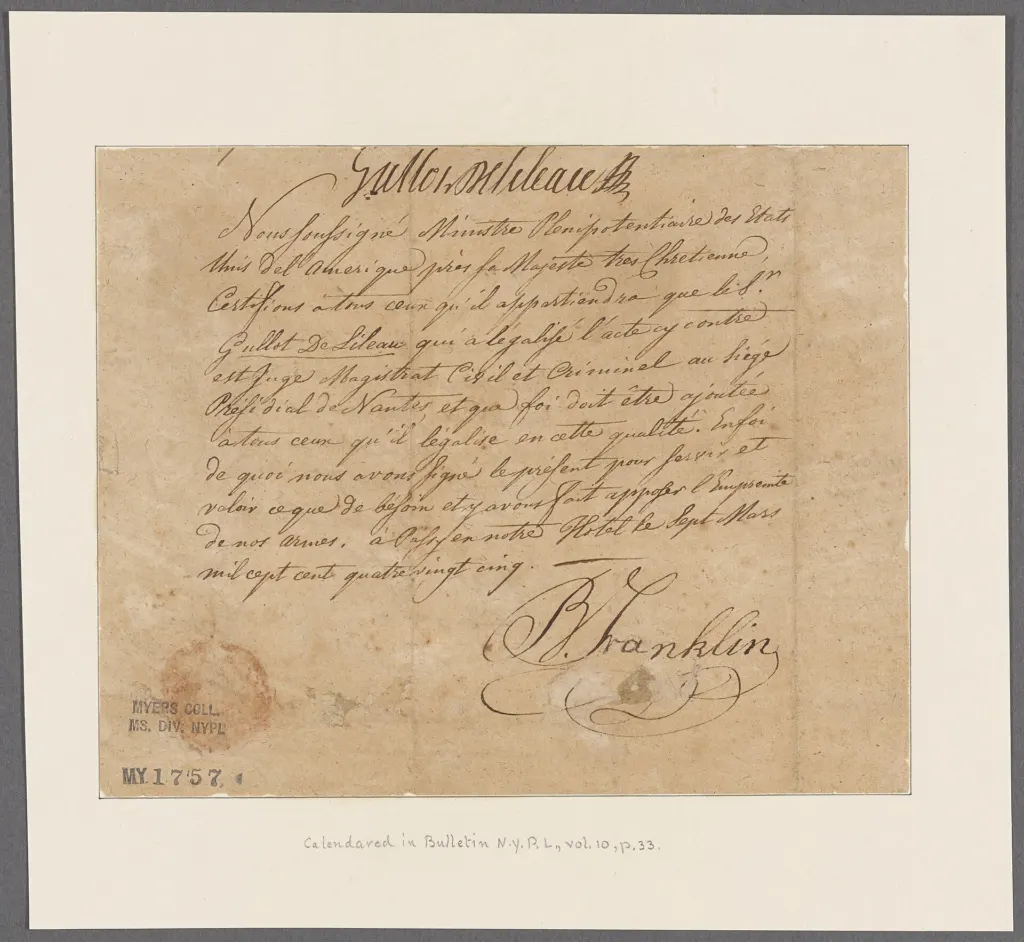
Image: Unknown artist (scan by New York Public Library), Public domain via Wikimedia Commons
This article was produced with AI assistance and reviewed by our Editorial Desk. How we work.