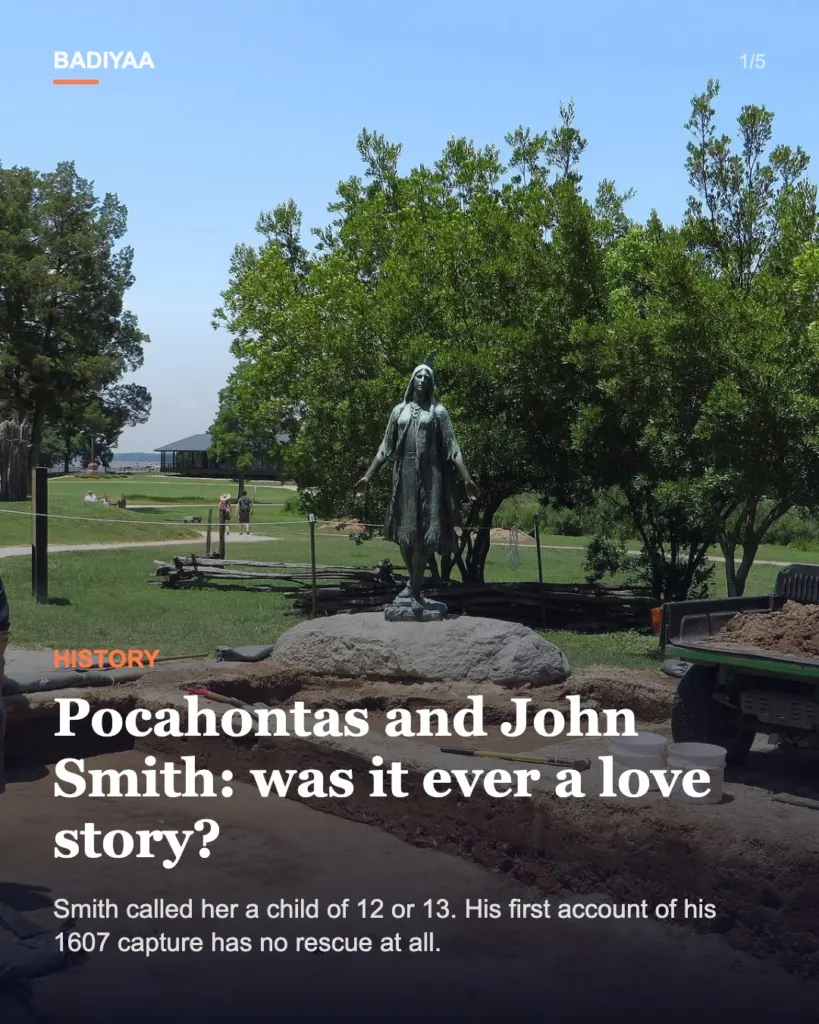
In a letter he said he sent to Queen Anne in 1616, John Smith described the girl at the heart of America’s most famous colonial love story as “a childe of twelve or thirteene yeeres of age” during his captivity in the winter of 1607. Historians at the National Park Service put her younger still: about 11 when English ships reached Jamestown that May. Smith wrote about her across 16 years. In the passages that survive, he calls her a child, a “tender Virgin” and the colony’s lifeline. He never calls her his sweetheart.
The woman known as Pocahontas was born around 1596 and given the names Amonute and Matoaka; “Pocahontas” was a nickname usually glossed as “playful one.” Her father, Powhatan, was paramount chief of Tsenacomoco, an alliance of more than 30 Algonquian-speaking tribes in what is now Tidewater Virginia, with roughly 25,000 people at its peak. She died at Gravesend, England, in March 1617, aged about 21.
One captivity, three versions
The love story grew out of a rescue, and the rescue changes depending on which of Smith’s books you open. Placed side by side, his accounts of the same visit to Powhatan’s capital at Werowocomoco read like this:
- 1608, A True Relation: a long letter from Virginia, published without his consent. Powhatan welcomes him with platters of food, questions him about why the English came and promises him “my liberty within four days.” Nobody raises a club, and no daughter steps in.
- 1616, the letter to Queen Anne: after “some six weeks fatting,” he writes, “at the minute of my execution, she hazarded the beating out of her owne brains to save mine.”
- 1624, The Generall Historie of Virginia: the full scene appears for the first time, with two great stones, men “ready with their clubs,” and Pocahontas who “got his head in her Arms, and laid her own upon his to save him from death.”
The version with the most detail is the one written last. By 1624 both Pocahontas and Powhatan were dead, so nobody else from that room could contradict him, and Virginia was again at war with the Powhatan peoples.
Whether anything like the rescue happened cannot be settled from the documents. Helen C. Rountree, author of Pocahontas, Powhatan, Opechancanough (2005), treats the 1608 letter as the more reliable account and argues that a girl of perhaps 11 was more likely helping with the food than sitting in on a chief’s interview. Another reading is that Smith went through a staged mock execution, an adoption rite that made him a weroance, or chief. The Mattaponi oral history, published in 2007, calls it a ceremony that children were barred from, so she would not have been there at all.
Where the word “love” actually turns up
The 1624 book does use the word once in this stretch. Smith says the colonists’ “dead spirits” revived when they heard about Powhatan’s wealth and, he adds, “the love of Pocahontas.” The surrounding sentences are about corn and venison: she and her attendants brought supplies every four or five days during the hungry winter of 1608. In the letter to the queen he wonders aloud whether those visits came from her father’s policy, from God, or from “her extraordinarie affection to our Nation.” He means goodwill toward a starving fort, not courtship.
The marriages the record does show
Her real married life left firmer traces. Around 1610, the colonist William Strachey recorded, she married a Powhatan man named Kocoum, whom he called a “private captain.” In April 1613 the English captain Samuel Argall lured her aboard his ship on the Potomac and held her for ransom. During her captivity she was baptized Rebecca, and on or about April 5, 1614, she married John Rolfe, a 28-year-old widower who was growing rich on tobacco. Powhatan sent one of her uncles to witness the wedding, which ended the First Anglo-Powhatan War. Their son, Thomas, was born sometime between 1615 and 1617.
When she met Smith again, at Brentford outside London after months in England, it was hardly a reunion of lovers. By Smith’s own telling she turned away from him, then reproached him over his treatment of her father. He records her parting judgment of the English: “your countrymen will lie much.”
How the romance was written in
Apart from her months in London, her contemporaries wrote almost nothing about her. She became a celebrity in the 1820s, when Southern writers wanted a colonial heroine to rival the Pilgrims, and they leaned on Smith’s 1624 book because it was still one of the only published accounts of early Jamestown. The romance came later still. Walt Disney’s 1995 animated film and Terrence Malick’s 2005 drama The New World both built their plots on it.
The National Park Service history at Historic Jamestowne sets the written record beside the Mattaponi account, and Hanover College’s history department prints all three of Smith’s versions in modernized spelling. Her own story ends in Kent. She was buried under the chancel of St. George’s Church, Gravesend, on March 21, 1617. A fire destroyed the church in 1727, and her remains now lie somewhere in a mass grave in the churchyard.
Further reading
- Wikipedia: Pocahontas
- National Park Service: Pocahontas, Her Life and Legend
- Documenting the American South: John Smith, The Generall Historie of Virginia (1624)
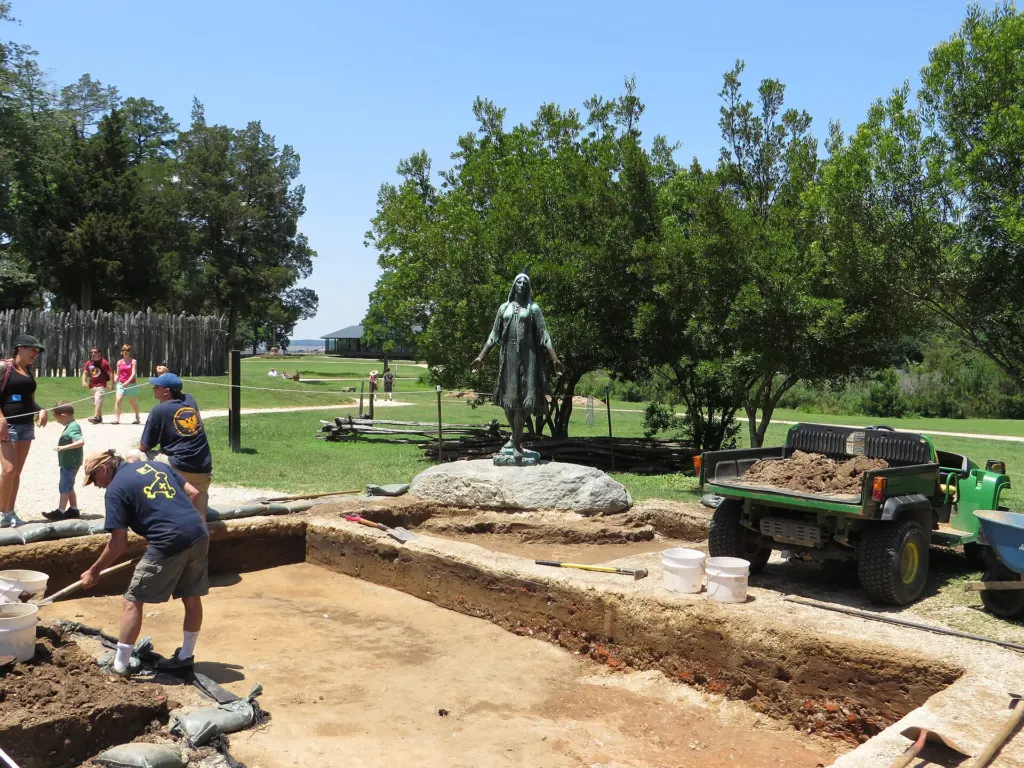
Image: Ken Lund, CC BY-SA 2.0 via Wikimedia Commons
This article was produced with AI assistance and reviewed by our Editorial Desk. How we work.
Spot an error? Help verify this story
The story in 5 slides