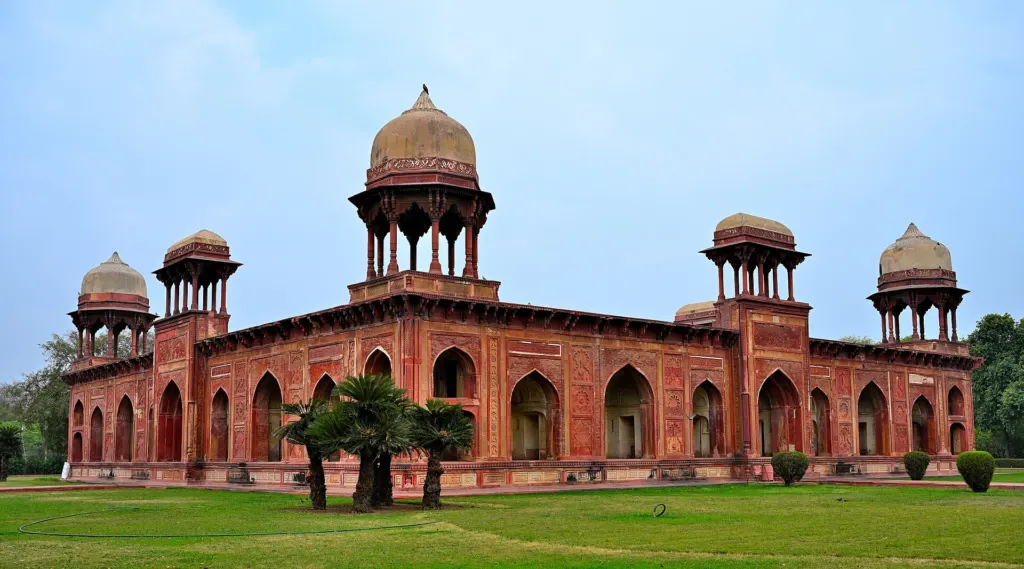
The Mughal emperor Akbar’s best-known wife, the Rajput princess sold to generations of moviegoers as “Jodha Bai,” is never called by that name in any Mughal-era record. Akbar’s official chronicle does not name her at all. The label first attaches to her in a book by a British colonial officer, James Tod, published in London in 1829, more than 200 years after she died.
What Akbar’s chronicle says
The marriage itself is well documented. In early 1562, as the young emperor returned toward Agra from the Sufi shrine at Ajmer, Raja Bihari Mal of Amber, a Kachhwaha Rajput ruler whose seat lay near present-day Jaipur, sought his protection against a hostile Mughal governor. The alliance he offered was a marriage. The Akbarnama, the court history written by Akbar’s minister Abu’l-Fazl, describes the raja’s plan to present “his eldest daughter, in whose forehead shone the lights of chastity and intellect,” and records that he brought her to the imperial camp at Sambhar, where the cavalcade halted a day for the wedding feast. The date usually given is February 6, 1562.
That is the whole of her identity in the chronicle: a daughter, a sister and a title. Court etiquette kept the personal names of imperial women out of public records, so she appears instead as Bihari Mal’s daughter and, after she gave birth to the heir, Prince Salim, in 1569, by the honorific Mariam-uz-Zamani, roughly “Mary of the Age.” Later family genealogies offer several personal names, among them Harkha Bai and Hira Kunwari, but none is contemporary.
Her son, who ruled as the emperor Jahangir, uses the title throughout his memoirs. In one passage he orders his son Khurram “to attend upon Hazrat Maryam-zamani and the other ladies,” then sails out to a village near Lahore “to meet my mother.” His birthday weighings, a court ritual in which the emperor was weighed against gold and other metals that were then given away, were held in her house. A surviving decree issued in her name carries a seal reading “From Wali Nimat Begam, mother of Nuruddin Jahangir, the King.”
Where “Jodha” comes from
“Jodh” points to Jodhpur, a different Rajput kingdom, not to Amber. And there was a Jodhpur princess in the story. Jahangir records that his son Khurram, the future emperor Shah Jahan, was born at Lahore in the Islamic year 999, or 1590-91, “to Jagat Gosa’in, daughter of the Mota Raja,” Raja Udai Singh of Jodhpur. Historians including Satish Chandra identify her as the woman properly called Jodh Bai.
Tod, who served as a British political agent in the Rajput states and drew heavily on court bards’ ballads, blurred the women together. In volume one of his Annals and Antiquities of Rajast’han (1829), a footnote reads: “The magnificent tomb of Jod Bae, the mother of Shah Jehan, is at Secundra, near Agra, and not far from that in which Akber’s remains are deposited.” The tomb near Akbar’s at Sikandra belongs to Mariam-uz-Zamani, the only one of his wives buried near him. Shah Jahan’s mother was Jagat Gosain. Tod’s second volume, which appeared in 1832, then has the Jodhpur ruler marrying his sister “Jod Bae” to Akber, and elsewhere names a “Joda Bae” from Bikaner as a wife of Jahangir.
Here is the chain in order:
- 1562: Akbar marries Bihari Mal’s eldest daughter at Sambhar; no personal name is recorded.
- 1569: Prince Salim is born; his mother becomes Mariam-uz-Zamani.
- 1590-91: Shah Jahan is born to Jagat Gosain, Jahangir’s wife from Jodhpur.
- 1623: Mariam-uz-Zamani dies; Jahangir builds her tomb at Sikandra between 1623 and 1627.
- 1829 to 1832: Tod’s volumes attach “Jod Bae” to the Sikandra tomb and to Akbar.
- 1960 and 2008: the films Mughal-e-Azam and Jodhaa Akbar carry the name to mass audiences.
What remains open
Not every question is closed. The historian Rana Safvi has pointed out that Jahangir never gives his mother’s name, which keeps a small debate alive about whether the title and the mother are the same woman. Most historians, citing the decree’s seal and the chronicles, accept her as his mother. On the name, though, the sources agree: Akbar’s chronicles, Jahangir’s memoir and the court records never call her Jodha. Her tomb still stands at Sikandra, outside Agra, about one kilometer from Akbar’s own.
Further reading
Image: Sharvarism, CC BY-SA 4.0 via Wikimedia Commons
This article was produced with AI assistance and reviewed by our Editorial Desk. How we work.