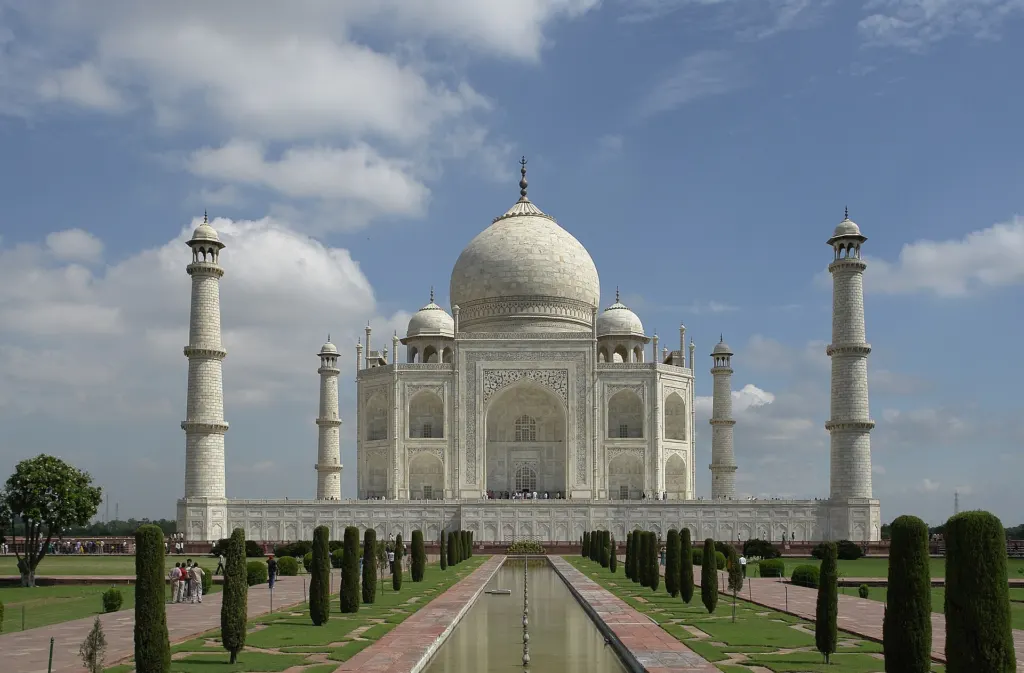
Jean-Baptiste Tavernier, a French gem merchant who visited Agra, wrote in his travel book of 1676: “I witnessed the commencement and accomplishment of this great work.” He gave the Taj Mahal 22 years of building and a workforce of 20,000. He noted the brick scaffolding, the cost and the eunuch who guarded the tomb with 2,000 men. He says nothing about anyone’s hands being cut off.
That silence is typical. The story that Emperor Shah Jahan had the builders of his wife’s tomb mutilated, so that nothing as beautiful could ever be built again, is one of the most repeated tales about the monument in Agra, in northern India. No 17th-century record supports it.
The legend and its variations
The tale comes in several versions. In some, the hands of all the workers are amputated; one widely shared figure is 40,000 hands. In others, the chief architect is blinded or killed. The standard reference account of the Taj Mahal groups these stories together and says no concrete evidence exists for any of them. A gentler variant holds that the craftsmen signed contracts promising never to work on a similar design, which may be how a story about lost work turned into a story about lost hands.
The Indian historian S. Irfan Habib has said the tale dates to roughly the 1960s and spread by word of mouth. “I can state that there is neither any evidence to back this story nor any credible historian has ever made this claim,” he said in an interview in 2021. By then it had reached American theaters too: Rajiv Joseph’s play Guards at the Taj, built around the legend, opened Off-Broadway in 2015 and won the 2016 Obie Award for Best New American Play.
What the Mughal court recorded
The emperor’s official chronicler, Abdul Hamid Lahori, began the Padshahnama (also spelled Badshahnama) in 1642 and covered the first two decades of the reign in close detail. He dates the start of work to six months after Mumtaz Mahal died on June 17, 1631, and says the complex took about twelve years “under the superintendence of Makramat Khan and Mir ‘Abd al-Karim.” Lahori also describes the emperor meeting his architects daily and altering their plans.
Like other Persian court writers, Lahori praised builders in general terms and rarely named them. Architects appear in the sources only now and then, and ordinary laborers barely at all. What the sources do show is that the people who ran the project kept working for the same emperor, on even larger commissions.
Where the Taj team went next
- Makramat Khan, a superintendent of the Taj, later supervised the building of the Red Fort in Delhi. Ground was broken on April 29, 1639, and Shah Jahan made his first state entry on April 18, 1648.
- Mir Abd al-Karim, the other superintendent Lahori names, served as superintendent of buildings at Agra from 1633 to 1646.
- Ustad Ahmad Lahori, credited with the tomb’s design in a poem by his son, is named in the official chronicle as one of two chief architects who drew up the Red Fort plan. Nothing in the record suggests he was harmed: he was planning a new capital seven years after the Taj’s foundations were dug, and died in 1649.
- His sons carried on the trade: Ataullah is named as architect on the gateway of the Bibi Ka Maqbara in Aurangabad (1660-61), and Nur Allah signed the facade inscription of Delhi’s Jama Masjid, begun in 1650.
The blinding variant is especially easy to test against this record. Art historian Ebba Koch cites the claim that Shah Jahan blinded his architect, alongside a newspaper’s confident naming of that architect, as examples of Taj stories passed off as historical fact. A whole district south of the tomb, first called Mumtazabad and now Taj Ganj, was laid out with caravanserais and bazaars to serve visitors and workers.
The European eyewitnesses
Tavernier is a useful test because he was no flatterer. In the same chapter he passes on court gossip that a French craftsman, Augustin de Bordeaux, was poisoned, and his remark that Shah Jahan began a second tomb across the river gave rise to the separate “Black Taj” legend. A man who recorded that much rumor would hardly have skipped mass amputations.
The French traveler François Bernier, who toured the complex around 1660, wrote mostly about its gardens and his own awe. He recalled bringing a newly arrived French merchant, who told him he “had seen nothing in Europe so bold and majestic.”
Badiyaa traced another Mughal-era myth, the name “Jodha Bai,” to an 1829 British book earlier this month; the same rule applies here. The sources behind all of this are gathered in English in Wayne Begley and Z. A. Desai’s 1989 anthology, Taj Mahal: The Illumined Tomb, which pairs the Mughal chronicles with the European travel accounts. Lahori’s line about the two superintendents is on page 75.
Further reading
Image: Yann, CC BY-SA 4.0 via Wikimedia Commons
This article was produced with AI assistance and reviewed by our Editorial Desk. How we work.