The document at the center of the George Washington teeth story is not a set of wooden dentures. It is a line of bookkeeping from May 1784, when Mount Vernon’s manager entered a payment of £6 2s with the words “To [cash] p[ai]d Negroes for 9 Teeth, on acc[oun]t of the French Dentis [sic] Doctr Lemay [sic].” The wooden teeth, meanwhile, never existed.
Washington, the Revolutionary War general who became the first US president, lost his teeth over four decades. At 24, in 1756, he paid 5 shillings to a “Doctr Watson” to pull one, an expense he noted in his diary. When he took the oath of office on April 30, 1789, a single natural tooth remained. His New York dentist, John Greenwood, extracted it in 1796 and kept it, set in a small glass case on his watch chain.
What the dentures were really made of
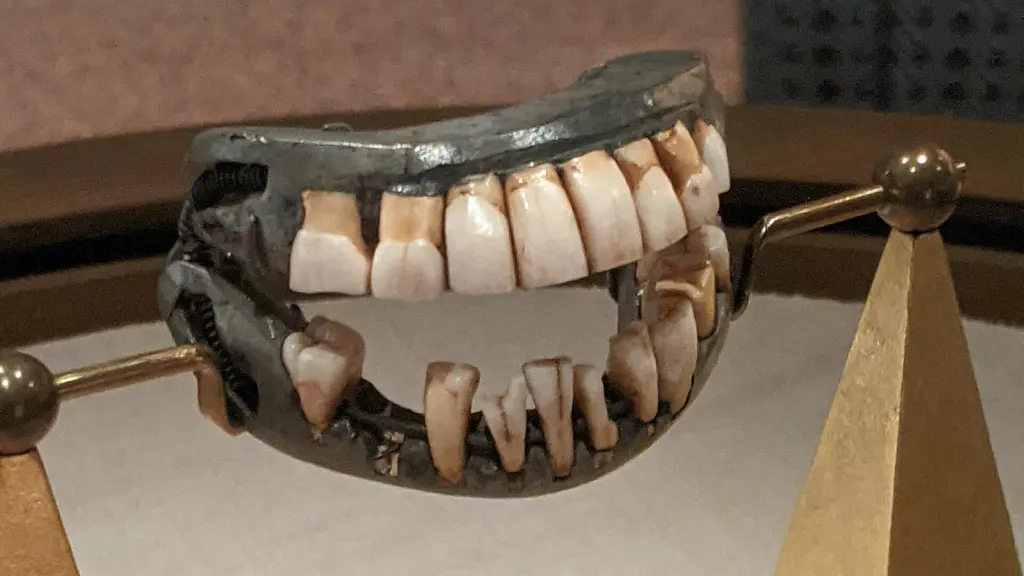
Four of Washington’s dentures survive in museum collections, and a fifth is believed to have been buried with him. According to the Mount Vernon Ladies’ Association, which owns the estate and the only complete surviving set, the four together combine metals (gold, silver, brass and lead) with teeth from cows, horses and humans and with ivory from hippopotamus, walrus and probably elephant. The estate’s own list also includes “tiny wood pegs,” the only wood in any of them. None of the teeth were wooden.
The most likely explanation for the myth, according to the estate’s encyclopedia, is staining: ivory and other materials darkened and took on a grain that later observers read as wood. Greenwood’s own letter from New York, dated December 28, 1798 and published in the Papers of George Washington, supports that. A set Washington mailed back to him had arrived “very black Ocationed either by your soaking them in port wine, or by your drinking it.” Greenwood added a technical aside: “Acid is Used in Couloring every kind of Ivory.” He charged fifteen dollars for the repairs. (The estate’s encyclopedia footnote dates this letter 1789; the letter itself is dated 1798.)
Washington also kept his own pulled teeth for reuse. On Christmas Day 1782, writing from Newburgh, New York, he asked his distant cousin Lund Washington to find “two small (fore) teeth” in his study desk and to “wrap up carefully, & send inclosed in your next Letter to me.”
The May 1784 entries, word for word
The transaction appears twice in Washington’s accounts. Lund Washington’s journal, kept under the heading “Cash p[ai]d on Acc[oun]t of Genrl. Washington,” has the line quoted at the top of this article. Washington’s double-entry ledger repeats it as a credit to Lund: “By Cash pd Negroes for 9 Teeth on Acc[oun]t of Dr Lemoin [sic].” Lemay and Lemoin are period spellings of Jean Pierre Le Mayeur, a French dentist who had treated British officers in occupied New York before crossing to the American side in 1781.
No date in May is given. Washington himself was away on a trip to Philadelphia from April 26 to May 23, 1784, while Lund kept the books. Le Mayeur was staying near Alexandria, Virginia, through that spring, visiting Mount Vernon and advertising in a local newspaper that he performed tooth transplants and would buy teeth.
The names of the enslaved people who gave up their teeth were not written down. What the money meant to them is also unrecorded. The arithmetic is simple: £6 2s is 122 shillings (6 x 20 + 2), and 122 divided by 9 comes to about 13.6 shillings a tooth. That is roughly 2.7 times the 5 shillings Washington paid in 1756 to have one of his own pulled, though prices 28 years apart are not strictly comparable.
Whose mouth did the teeth go into?
Nobody knows, and the two readings of the ledger differ. The entry has long been read as teeth for Washington himself, for transplants or dentures. Mount Vernon’s historians argue that the phrase “on acc[oun]t of” the dentist marks the teeth as Le Mayeur’s stock for his own patients, noting that “If Washington had been purchasing the teeth for himself, there would have been no need for this information.” Le Mayeur’s papers do not survive, so his patient list is lost.
The two surviving dentures with human teeth, both lower incisors, were made between 1789 and 1795, in New York or Philadelphia. Where those teeth came from is not recorded either. Art historian Jennifer Van Horn, in a 2016 study of the dentures, wrote that “The general would certainly not have been alone as a white southerner with African Americans’ teeth in his mouth.”
On whether the people at Mount Vernon were forced, the estate does not soften its answer. Washington regularly paid the people he enslaved for poultry, game and garden produce, and it treats the teeth as fitting that pattern of payment. It also states that the threat of punishment was always present, so they “could have felt compelled to provide teeth even if they were not physically forced to do so.”
The complete set is on display at Mount Vernon. Lund Washington’s account book, catalogued there as W-693, holds the journal entry, and the ledger version is on page 179 of Washington’s Ledger B, held by the Library of Congress.
Further reading
- Wikipedia: George Washington's teeth
- Founders Online: John Greenwood to George Washington, 28 December 1798
- Founders Online: George Washington to Lund Washington, 25 December 1782
Image: BakedintheHole, CC BY-SA 4.0 via Wikimedia Commons
This article was produced with AI assistance and reviewed by our Editorial Desk. How we work.