A brindle stray that wandered across the Yale campus in July 1917 ended up in a chamois coat covered in medals, with introductions to three presidents. He got to France because a corporal hid him on a troop ship.
Sergeant Stubby attached himself to the 102nd Infantry while the regiment drilled in New Haven, Connecticut. Corporal James Robert Conroy took to him, smuggled him aboard, and carried him off the ship under an overcoat. When a commanding officer found the dog, the story goes, Stubby raised a paw in the salute he had learned in camp and was allowed to stay.
What the record supports
Stubby reached the line at Chemin des Dames on February 5, 1918. In April, at Seicheprey, a German grenade wounded his foreleg. He was gassed, came back with a custom gas mask, and is credited after that with warning his unit of gas, finding wounded men in no man’s land and flagging incoming shells before the soldiers could hear them.
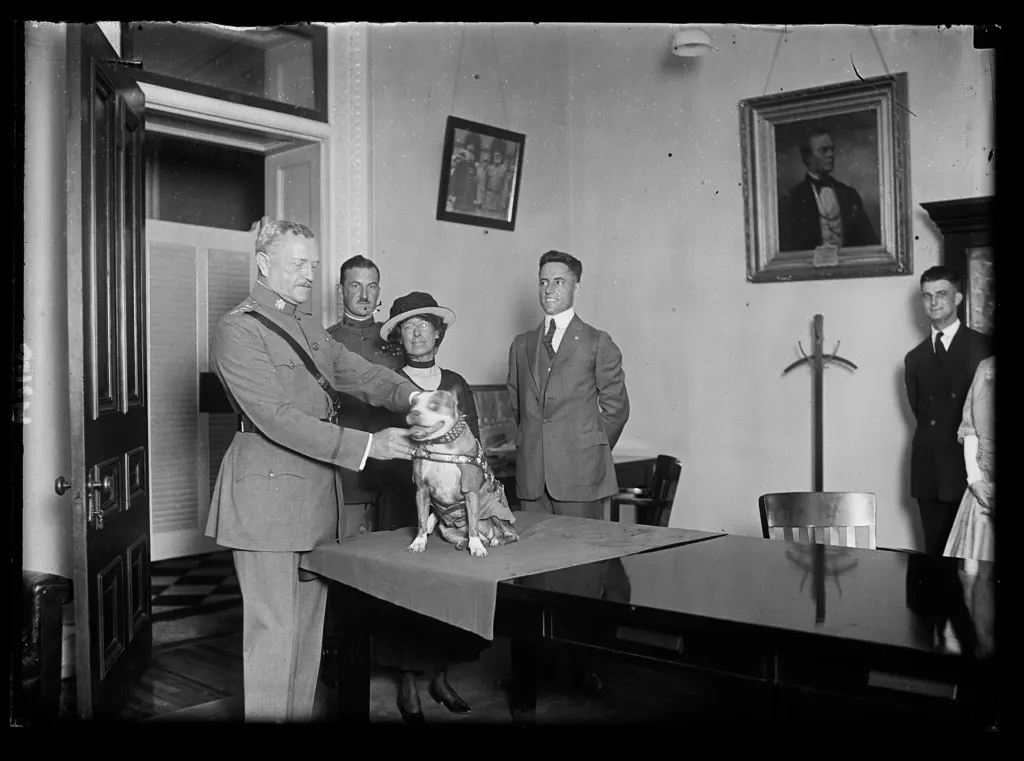
The women of Château-Thierry sewed him the coat. In 1921, General John J. Pershing presented him with a gold medal from the Humane Education Society, and the moment became a famous photograph.
Where the legend runs ahead
Some of the famous numbers deserve a second look. Stubby’s service is usually given as 18 months in the trenches and 17 battles. But his first combat came in February 1918 and the armistice in November, a span of about nine months. The 18 months fits better as his whole time with the regiment, from that first summer in New Haven until the trip home.
The medal count needs the same care. Modern retellings often credit him with two Purple Hearts. Stubby died in March 1926, and the medal he supposedly won twice did not exist in its modern form until February 22, 1932, six years later. The 1932 Army rules also excluded posthumous awards, so any such award would have had to be symbolic. The same accounts also give him two wound stripes, and wound chevrons were a real World War I distinction.
The German he is said to have caught is a similar case. One version has him seizing a spy by the seat of his pants in the Argonne and holding on until soldiers arrived; even the standard account marks the pants detail as alleged. His sergeant’s rank also has an asterisk. He was the regiment’s unofficial mascot, and the rank traces to his commander’s nomination.
The afterlife of a very good dog
Home in 1918, Stubby led parades, played vaudeville stages, and picked up lifetime memberships in the American Legion and the YMCA. He met Woodrow Wilson, Warren Harding and Calvin Coolidge. When Conroy enrolled at Georgetown’s law school, Stubby became the mascot of the Hoyas and nudged a football around the field at halftime.
He died in his sleep in March 1926. A national newspaper gave him a half-page obituary, longer than many famous people of the era received. His body was preserved, with his cremated remains sealed inside the mount, and Conroy gave it to the Smithsonian in 1956.
He is still on view at the National Museum of American History in Washington, in the exhibition “Price of Freedom: Americans at War.” Kansas City’s Liberty Memorial has carried a brick in his name since Armistice Day 2006.
Further reading
Image: Harris & Ewing, Public domain via Wikimedia Commons
This article was produced with AI assistance and reviewed by our Editorial Desk. How we work.