The pens touched paper in a railway carriage in a French forest at about 5 a.m. on November 11, 1918. The guns were told to stop at 11 a.m. For six more hours, the First World War carried on.
That gap is the strangest part of the day now marked as Armistice Day, Remembrance Day and Veterans Day. The deal that ended the fighting on the Western Front was already done before sunrise, yet the clock, not the signatures, decided when it ended.
A carriage in the Compiègne Forest
The German delegation, led by the civilian politician Matthias Erzberger, crossed the lines in five cars and reached the Allied train on the morning of November 8. The meeting place was Marshal Ferdinand Foch’s own carriage, parked on a siding in the woods near Compiègne, north of Paris.
There was little bargaining. The Germans were handed the Allied conditions and given 72 hours to accept them. Foch showed up only twice in three days: once to ask what the visitors wanted, and once to watch them sign. The final text ran to 34 clauses, from handing over 5,000 locomotives to pulling troops back across the Rhine. One clause set the tempo for the morning: hostilities had to end within six hours of signature.
Accounts differ by a few minutes, but the signatures went down somewhere between 5:00 and 5:45 a.m. Paris time. The ceasefire was fixed for 11 a.m. Paris time, which was noon in Berlin. That timing is why people still speak of “the eleventh hour of the eleventh day of the eleventh month.”
The six-hour timeline
Here is how the morning unfolded, using the times recorded in the official announcements:
- About 5:00 a.m.: The armistice is agreed and signed in Foch’s carriage.
- Around 9:00 a.m.: News of the signing is officially announced in Paris.
- 10:20 a.m.: In London, Prime Minister David Lloyd George tells Britain that “The armistice was signed at five o’clock this morning, and hostilities are to cease on all fronts at 11 a.m. to-day.”
- 10:50 a.m.: Foch issues a general order that the Allied armies must not advance past the line they hold at 11 o’clock.
- 10:57:30 a.m.: A US Navy 14-inch railway gun near Verdun fires its final round, timed to land just before the cutoff.
- 11:00 a.m.: A cannon at Fort Mont-Valérien fires the first peace shot over Paris, and church bells ring across the city.
Why the fighting did not stop at dawn
Word of the coming ceasefire reached most front-line units hours ahead, yet many sectors kept fighting until the appointed minute. Some artillery batteries fired off spare shells rather than haul them away, and commanders wanted the best possible ground in case the talks collapsed. The day’s toll was later put at 10,944 casualties, including 2,738 men killed.
The American private Henry Gunther is generally recognized as the last soldier killed in action, 60 seconds before the cutoff. After the war, the US Congress opened an inquiry into why so many men had been sent forward on the final morning.
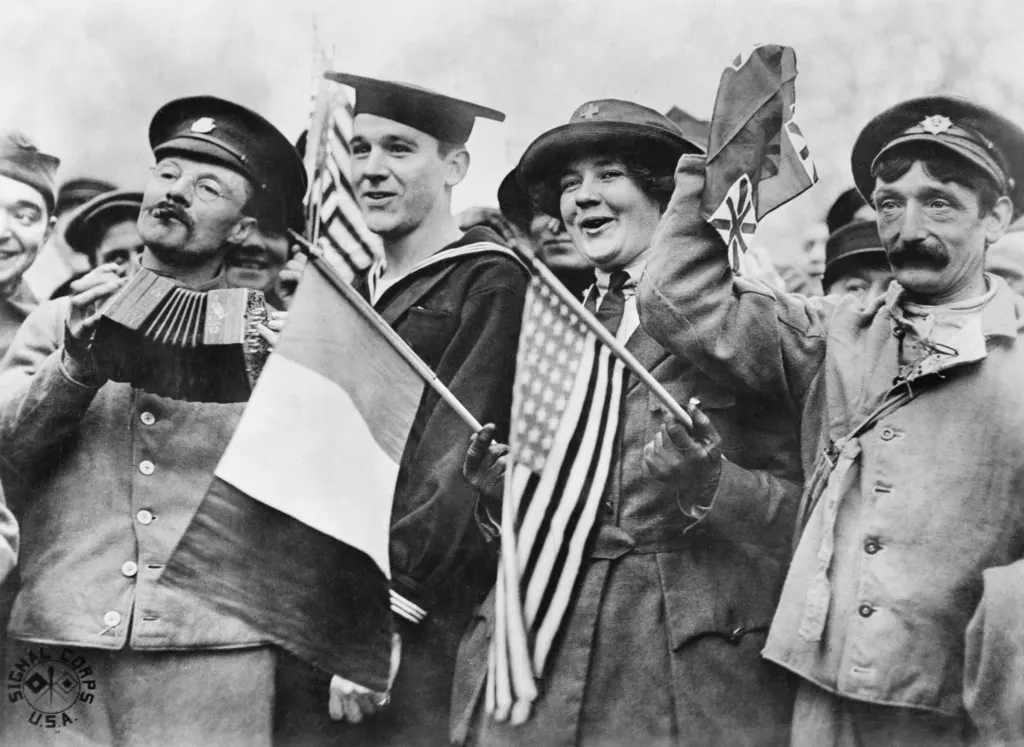
When 11 o’clock came, the mood was quieter than the newsreels suggest. One British corporal recalled that the Germans climbed out of their trenches, bowed and walked away, and that there was nothing to celebrate with “except biscuits.” In parts of the line, shelling went on until nightfall.
A ceasefire, not yet a peace
The 1918 agreement was only a pause. It was extended three times while diplomats worked on the Treaty of Versailles, and peace was formally ratified at 4:15 p.m. on January 10, 1920. Far from Europe, German forces fighting in what is now Zambia only heard the news about two weeks later.
Badiyaa has also told the stories of the Harlem Hellfighters, who spent 191 days in the trenches, and of how Remembrance Day’s two-minute silence began on a Cape Town street. For a lighter moment from the same war, read about Sergeant Stubby, the stray dog smuggled to France.
The carriage itself became a war prize. In June 1940, Adolf Hitler insisted that France sign its own armistice in the same railway car, at the same spot in the forest.
Further reading
Image: American official photographer, Public domain via Wikimedia Commons
This article was produced with AI assistance and reviewed by our Editorial Desk. How we work.