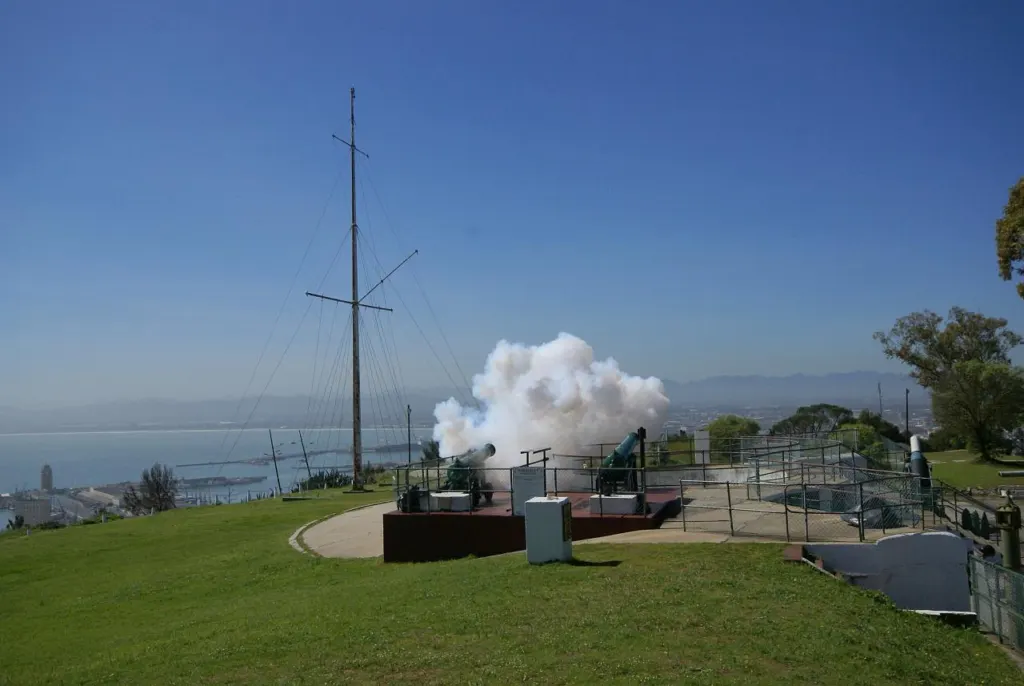
The silence that will settle over war memorials this Wednesday was first timed by a cannon. On May 14, 1918, the Noon Gun on Signal Hill fired over Cape Town, South Africa, and Adderley Street stopped dead for two minutes.
Trams halted. Taxis halted. Men on the sidewalk took off their hats. A bugler on a balcony at the corner of Adderley and Darling Streets played the Last Post, and Reveille closed the pause. The First World War still had six months to run.
The man behind the order had just lost a son. Mayor Sir Harry Hands learned that Reginald Hands had died after being gassed on April 20, and he acted on a suggestion from councillor Robert Rutherford Brydone. A small number of city churches had been pausing in this way since 1916, sporadically, after the casualty lists from the Somme reached the Cape. Hands turned a congregation’s habit into a whole city’s.
Three minutes was too long
The first attempt, on May 13, ran for three minutes. The mayor judged that excessive and published a notice cutting it to two. Each minute had a job: the first gave thanks for those who had come home, the second remembered those who had not.
The signal was already famous locally. The Noon Gun pair, smoothbore 18-pounders cast in 1794, had been marking time for the city since 1806, and the firing has been triggered from the observatory’s master clock since 1864.
A correspondent in Cape Town cabled a description to London. Within weeks, two English provincial towns had copied the ceremony, and places in Canada and Australia followed.
From Adderley Street to the King in 546 days
The route to the rest of the Empire ran through another bereaved father. Sir Percy FitzPatrick, whose son had been killed in France in December 1917, wrote to Lord Milner in 1919 proposing the pause for the annual Armistice service. He credited the source, writing that other towns had followed but “nothing was as dramatic as the Cape Town observation simply because of the midday gun.”
After that, things moved quickly:
- October 27, 1919: the proposal reaches George V through his private secretary, Lord Stamfordham, with a note calling it “a fine idea.”
- November 5: the War Cabinet approves it, with Lord Curzon the only dissenter.
- November 7: the Palace issues the King’s request.
- November 11: the first Armistice Day silence is held.
Count it out: 365 days from May 14, 1918, to May 14, 1919, plus 181 more to November 11, makes 546 days from a street corner in South Africa to a ceremony across the Empire. The last leg took four days. The King’s text asked that “all work, all sound, and all locomotion should cease.”
Where the record wobbles
Two loose ends are worth flagging. The account usually given says Cape Town repeated its pause daily for a full year, to May 14, 1919, yet the same record also gives January 17, 1919, as the last observance, so the length of the run is unsettled. And Australia’s government credits a different originator, Edward George Honey, who floated the idea in a letter to a London newspaper almost a year after Adderley Street had already gone quiet. No convincing trail links his letter to FitzPatrick or the King.
A plaque on Adderley Street now marks the spot, in front of the Standard Bank building. A centenary ceremony was held on Signal Hill at the firing of the gun on May 14, 2018.
This year November 11 falls on a Wednesday. The silence begins at 11:00 a.m. across the Commonwealth, and in Cape Town the same guns, 232 years old, are due to fire an hour later.
Further reading
Image: Flickr user DanieVDM, CC BY-SA 2.0 via Wikimedia Commons
This article was produced with AI assistance and reviewed by our Editorial Desk. How we work.