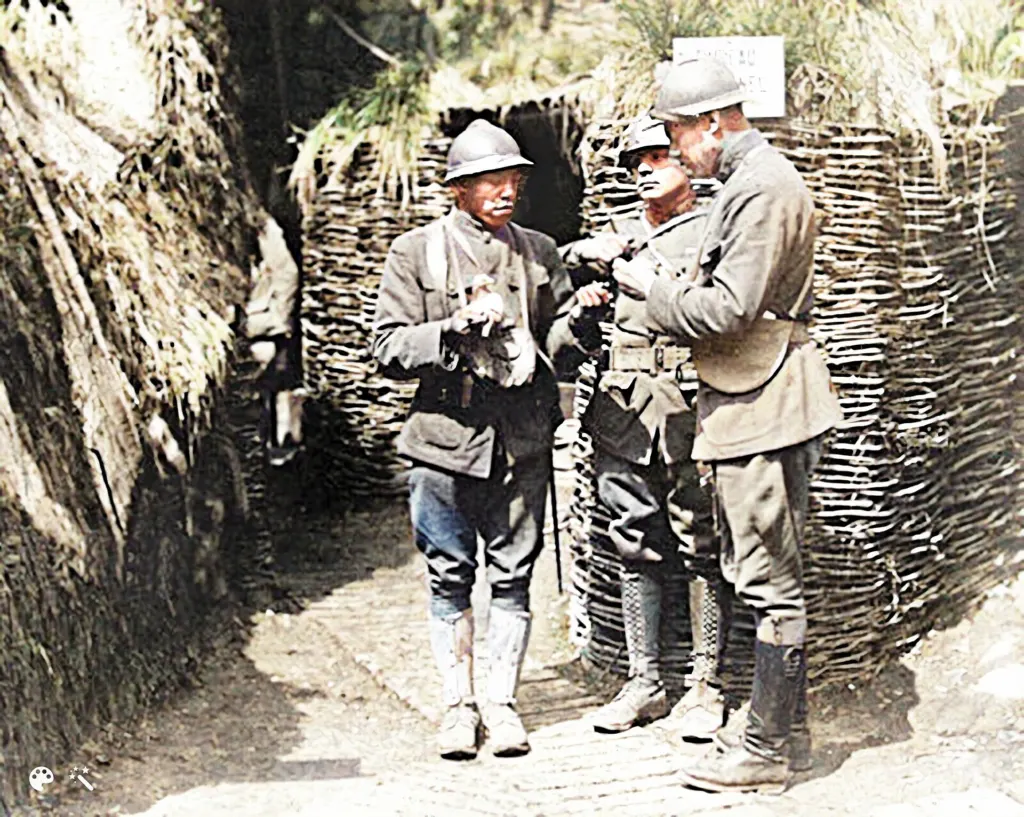
The Harlem Hellfighters spent 191 days in the front-line trenches of World War I, more than any other American unit, and they did it wearing French helmets because the US Army would not let them fight alongside white American troops. On Armistice Day, November 11, 1918, the Black regiment from New York was holding a quiet sector in the Vosges mountains of eastern France.
Its official name was the 369th Infantry Regiment. Its story starts as a New York National Guard unit, the 15th New York, organized in 1916 for Black Americans who wanted to serve in a segregated Army.
Sent to dig, then lent to France
The regiment sailed from New York on December 27, 1917. In France it was first put to work on labor duties rather than combat. On April 8, 1918, with segregation still Army policy, the unit was handed over to the French 16th Division. The men kept their US uniforms but carried French rifles, belts and helmets.
The French army, short of men and already used to colonial units from Morocco and Senegal, largely treated the Americans as it treated its own. The 369th went into the line on May 8, 1918, fought in the Second Battle of the Marne, and during the Meuse-Argonne offensive captured the village of Séchault, advancing about 14 kilometers (8.7 miles) against heavy resistance.
The nickname nobody can source
The name everyone knows is the shakiest part of the record. Army accounts say German troops called them “hellfighters”. The regiment’s encyclopedia history says there is no documentation that the Germans ever did, and that the label may have been coined by the American press. The French name is better attested: “Hommes de Bronze”, or Men of Bronze. Their own colonel, William Hayward, called them the Black Rattlers, after the rattlesnake on their insignia.
The 369th by the numbers
- Soldiers: about 4,000 served, according to the New York National Guard.
- Days in combat: 191.
- Casualties: about 1,400 in the Guard’s count and 1,500 in the regimental history, the highest of any US regiment.
- Croix de Guerre: France decorated 170 or 171 individual soldiers, depending on the count, plus a citation for the whole regiment on December 13, 1918.
- Medal of Honor: one, to Sgt. Henry Johnson of Albany, awarded long after his death.
What happened after November 11
The Armistice did not end the march. Six days after the guns fell silent, the 369th moved forward again, and on November 26, 1918, it reached the banks of the Rhine, the first Allied unit to get there. The men came home to a parade on February 17, 1919, marching up Fifth Avenue from 61st Street and into Harlem along Lenox Avenue, where Black New Yorkers packed the sidewalks.
The regiment’s band, led by Lt. James Reese Europe, is credited with bringing jazz to French and British audiences during the war. One of the war’s more unlikely veterans, the stray dog that became Sergeant Stubby and sailed to France hidden on a troop ship, reached the same front. Badiyaa has also traced how the Armistice two-minute silence began on a Cape Town street in 1918.
A medal a century late
A law signed in 2021 created a Congressional Gold Medal for the regiment, after a push that began with Debra Willett, granddaughter of Hellfighter Sgt. Leander Willett. It was presented in Emancipation Hall at the US Capitol on September 3, 2025. “My grandfather and the other brave men that fought alongside him never thought that their courage and their exploits would be celebrated in such a revered setting,” she said.
The regiment’s lineage lives on in the New York Army National Guard’s 369th Sustainment Brigade, and its armory still stands at 142nd Street and Fifth Avenue in Harlem.
Further reading
- Wikipedia: 369th Infantry Regiment (United States)
- US Army: New York Guard’s Harlem Hellfighters Honored by Congress
Image: US Army, Public domain via Wikimedia Commons
This article was produced with AI assistance and reviewed by our Editorial Desk. How we work.