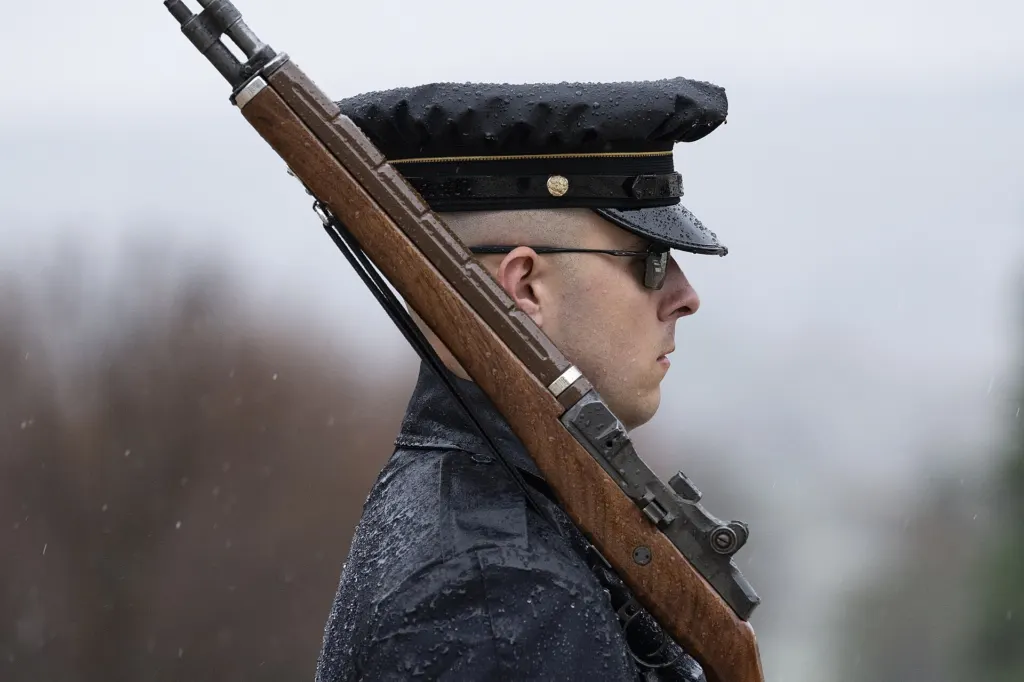
Every sentinel at the Tomb of the Unknown Soldier in Arlington, Virginia, takes exactly 21 steps down a black mat, turns, and waits 21 seconds before moving again. That routine has been repeated day and night, in snow and heat, since the first 24-hour guard was posted at midnight on July 2, 1937.
The number is no accident. Twenty-one echoes the 21-gun salute, the highest military honor the US armed forces can give. In the week of Veterans Day, when the monument draws its biggest crowds, here is how the watch works and how the tomb itself came to be.
The 21-step routine, move by move
The guards come from the US Army’s 3rd Infantry Regiment, known as The Old Guard, which has held the post since April 6, 1948. Their sequence never changes:
- March 21 steps south along the mat, which is 21 yards long.
- Turn east to face the tomb for 21 seconds.
- Turn north, shift the rifle to the outside shoulder, and wait another 21 seconds.
- March 21 steps back, then repeat the turns in the opposite direction.
Moving the rifle to the shoulder nearest the visitors is a signal that the soldier stands between the tomb and anyone who might threaten it. Guards on the mat wear no rank insignia, so they never outrank the Unknowns they protect, whatever rank those soldiers once held.
Do the arithmetic and every full lap holds 42 steps and four pauses of 21 seconds, which adds up to 84 seconds of standing still before any marching is counted. During winter visiting hours the guard changes once an hour, and every half-hour from April through September.
The shoes carry metal plates that give the famous heel click, and they wear the rubber mat down so fast that it is usually replaced twice a year, before Memorial Day and again before Veterans Day.
Who lies beneath the marble
Congress approved the burial on March 4, 1921, and an unidentified World War I soldier brought home from France was interred on November 11, 1921. The selection in France that October has its own story, told in our piece on how Sgt. Edward Younger chose America’s Unknown Soldier with a spray of white roses.
The sarcophagus visitors see today came later. Its biggest block of Yule marble was cut from a Colorado quarry in January 1931; it weighed 124 tons when freed from the mountain and was trimmed to 56 tons with a wire saw. The finished tomb was completed without ceremony on April 9, 1932. Its west face reads: “Here rests in honored glory an American soldier known but to God.”
Unknowns from World War II and the Korean War were buried in the plaza in 1958. A Vietnam-era Unknown followed in 1984, but DNA testing identified him in 1998 as Air Force First Lieutenant Michael Blassie, and his crypt has been left empty with a new inscription honoring missing servicemen.
A badge few soldiers earn
Fewer than one in five volunteers is accepted for Tomb Guard training. Candidates memorize 17 pages of cemetery history, including the locations of nearly 300 graves, and must pass a 100-question test and a uniform inspection measured to a sixty-fourth of an inch. As of May 18, 2026, only 890 Tomb Guard Identification Badges had been issued, making it the Army’s third least-awarded qualification badge.
For more on the soldiers remembered this week, read about the Harlem Hellfighters, who spent 191 days in World War I trenches, or how the Anthem Veterans Memorial in Arizona lines up sunlight at 11:11 a.m. on Veterans Day.
The story may not be finished. In September 2026 the Defense POW/MIA Accounting Agency said it intends to ask the Army to exhume and identify the Korean War Unknown, using DNA methods that can match relatives up to four generations removed.
Further reading
Image: Arlington National Cemetery, Public domain via Wikimedia Commons
This article was produced with AI assistance and reviewed by our Editorial Desk. How we work.