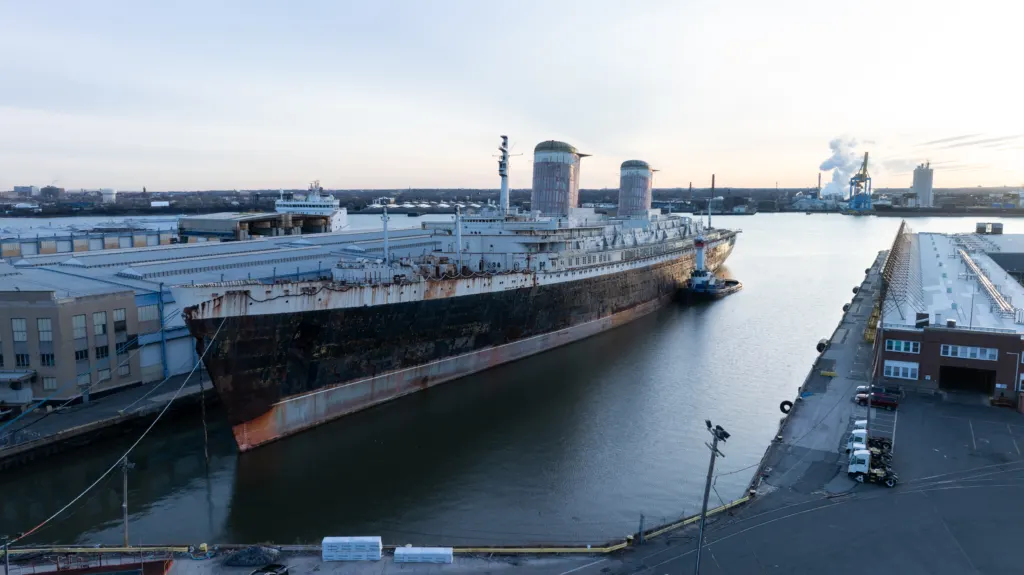
The SS United States, still the fastest ocean liner ever to cross the Atlantic, went to the bottom of the Gulf of Mexico off Destin, Florida, on November 11, 2026. Okaloosa County bought the 990-foot ship to turn her into an artificial reef, and she now outranks the aircraft carrier USS Oriskany as the largest one in the world.
That is why the “Big U” is trending this week. For anyone who never heard of her, the sinking closes a 74-year story that began with a speed record nobody has broken and ended with decades tied up at a Philadelphia pier.
A record set on the very first trip
Naval architect William Francis Gibbs had dreamed of a giant American liner since he watched a ship launch as an eight-year-old in 1894. His design was built at Newport News, Virginia, in the same dry dock where a canceled Navy supercarrier, also named United States, had been taken apart. She was launched on June 23, 1951.
On her maiden voyage in July 1952 she crossed from New York to Cornwall in three days, ten hours and 40 minutes, averaging 35.59 knots. That beat the eastbound record held by the Cunard liner Queen Mary by more than ten hours. She then set the westbound record on the way home and claimed the Blue Riband, a title she still holds. New York threw her crew a ticker-tape parade.
Her true top speed was treated as a military secret for years. It was later disclosed as 38.32 knots, reached in a full-power trial on June 10, 1952.
Built to carry a division
The Pentagon helped pay for the ship because she doubled as a troopship. With her furnishings removed she could take a 14,400-strong Army division anywhere in the world without stopping for fuel. Gibbs also banned wood almost entirely after deadly liner fires in earlier decades; the only exceptions were a butcher’s block in the galley and a mahogany grand piano that passed a gasoline fire test.
Her two red, white and blue funnels, 55 feet tall, were the largest ever fitted to a ship, and her aluminum superstructure was the biggest aluminum construction job of its day.
Timeline: from icon to reef
- 1952-1969: 400 round trips, about 1,025,691 passengers, and guests including Marilyn Monroe, Duke Ellington and Walt Disney.
- November 1969: withdrawn without warning after jet travel and strikes drained bookings; her funnels were left half-painted.
- 1984: her furniture and fittings were auctioned in Norfolk, Virginia, raising $1.65 million.
- 1993-1994: stripped to the bulkheads in Sevastopol to remove asbestos.
- 1996-2025: laid up in Philadelphia, owned in turn by Norwegian Cruise Line and the SS United States Conservancy.
- 2024: evicted from her pier after a rent dispute, opening the way for the Florida reef plan.
- November 11, 2026: sunk off Destin.
Put those numbers together and the ship’s working life lasted 17 years, while her time waiting for a second act stretched to 57. Every owner after 1969 promised a hotel, a casino or a cruise comeback, and none of the plans reached the water.
Old ships finding new lives underwater is a familiar idea in fisheries work; Kentucky has done something similar on a smaller scale, as in our story on how Kentucky sank 1,700 used Christmas trees to build fish habitat in Boltz Lake. For more Cold War-era naval history, read how an F-14 Tomcat fell off USS John F. Kennedy in 1976, or browse the rest of our history section.
The liner was added to the US National Register of Historic Places on June 3, 1999. Her Blue Riband, set on July 7, 1952, has now stood for 74 years.
Further reading
Image: WSRower, CC0 via Wikimedia Commons
This article was produced with AI assistance and reviewed by our Editorial Desk. How we work.