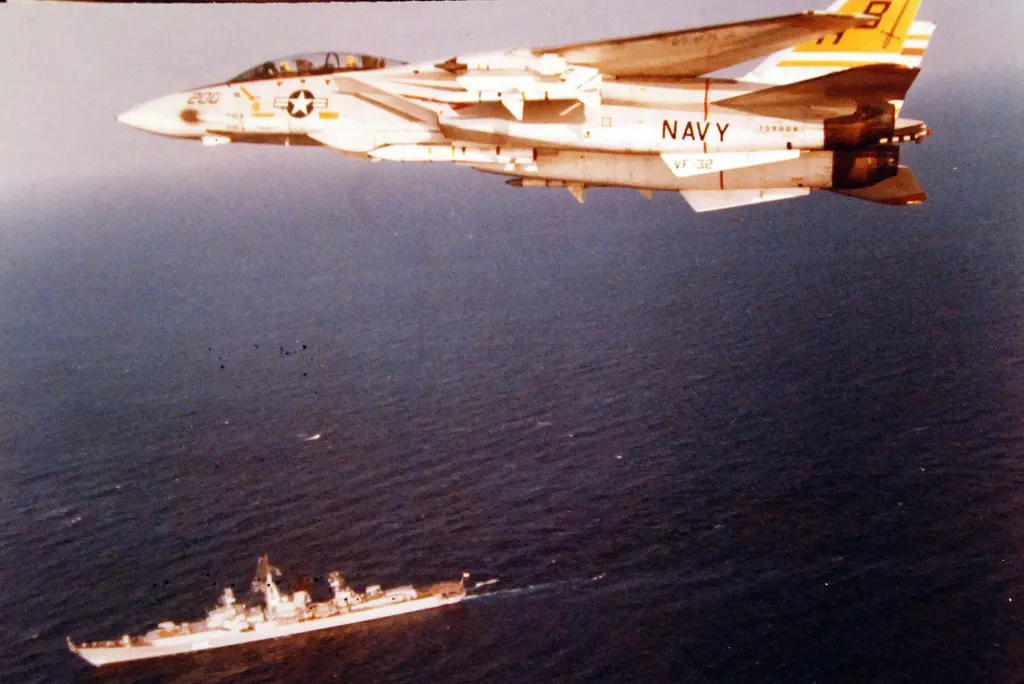
On September 14, 1976, a brand-new US Navy F-14 Tomcat slid off the flight deck of the aircraft carrier USS John F. Kennedy and sank in international waters off Scotland, still carrying AIM-54 Phoenix missiles. What followed was a quiet Cold War race: Soviet surface ships and submarines against the US Navy, each trying to reach the jet first.
The Navy won. It took a prolonged search, a tugboat, foreign salvage contractors and one of the strangest submarines the United States ever built.
A catapult problem and two ejections
The trouble began with the catapult that should have flung the fighter into the air. The F-14 went over the edge instead. Both crew members ejected and came down on the carrier’s own deck, injured but alive, according to the ship’s history.
It was an extraordinary day for the Kennedy even without the jet. That night, about 100 miles (160 kilometers) north of Scotland, the destroyer USS Bordelon lost control during an underway refueling and collided with the carrier. The damage was so severe that Bordelon was taken out of service the following year.
Why both navies wanted the wreck
In 1976 the F-14 was the Navy’s newest fleet defense fighter, and the Phoenix was its long-range air-to-air missile. A sunken example in open water was an intelligence prize. Anyone who could lift it would get a close look at the radar, the weapons system and the missile itself without stealing a single blueprint.
That is why the episode turned into a contest at sea. The Soviet Navy sent ships and submarines toward the area, and the US side mounted a prolonged search to keep the wreck out of their hands.
The tug and the tiny nuclear submarine
Two American vessels did much of the work. The first was USS Shakori (ATF-162), a fleet tug launched in August 1945 that had spent decades towing targets and dry docks across the Atlantic. In the fall of 1976 it helped recover the F-14 and a missile that had broken away, alongside contractors from the United Kingdom and West Germany. The tug received the Navy Unit Commendation for the mission.
The second was NR-1, a deep-diving research submarine nicknamed “Nerwin.” It was the smallest nuclear submarine ever put into operation, never officially named or commissioned, and built under the personal eye of Admiral Hyman Rickover. Its crew of about ten slept aboard for weeks with no kitchen, eating frozen TV dinners. NR-1 could crawl along the seabed on wheels and pick up objects with a claw. Most of its 1970s missions are still classified, but the 1976 recovery of F-14 parts and at least one Phoenix missile is one of the few the Navy has publicly acknowledged.
In the end, the US Navy brought up both the aircraft and its missiles.
How the day unfolded
Laid out in order, the Kennedy’s September 1976 shows how much went wrong in a single deployment:
- September 14, daytime: the F-14 falls off the deck after a catapult problem; both aviators survive.
- September 14, night: USS Bordelon collides with the carrier during refueling about 100 miles north of Scotland.
- Fall 1976: Soviet and US ships converge; Shakori, NR-1 and British and German contractors search the seabed.
- End of the search: the Navy recovers the jet and its missiles before the Soviets can.
The Kennedy herself went on to serve until 2007. For more naval history on Badiyaa, read how the World War II submarine USS Cobia was towed up Lake Michigan to dry dock, or how a storm-wrecked Navy blimp hangar in Oregon sold for one dollar.
The carrier’s own final voyage ended on February 2, 2025, when it arrived in Brownsville, Texas, to be scrapped, sold along with USS Kitty Hawk for one cent each.
Further reading
Illustrative image. Image: U.S. Navy, Public domain via Wikimedia Commons
This article was produced with AI assistance and reviewed by our Editorial Desk. How we work.