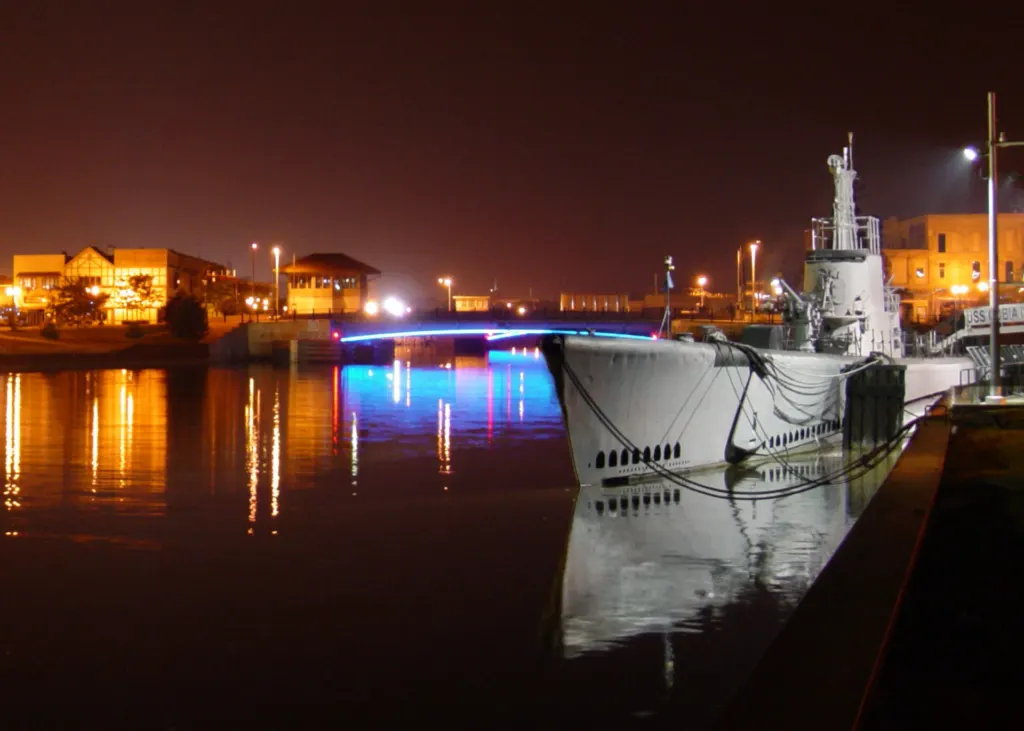
A World War II submarine that sent 28 Japanese tanks to the bottom of the Pacific spent five and a half weeks last fall being dragged around Lake Michigan by tugboats, and the clip of that tow is circulating again this week. The boat is USS Cobia, the Gato-class veteran parked at the mouth of the Manitowoc River in Wisconsin, and the trip was her first visit to a dry dock in nearly 30 years.
The facts are a year old, so here they are with their real dates. Cobia left her Manitowoc museum berth on September 8, 2025, towed by two tugs up the lake to Fincantieri Bay Shipbuilding in Sturgeon Bay. She came home on Wednesday, October 15, 2025, with a fresh coat of paint and, according to the museum, nearly three tons of invasive mussels scraped off her hull. Dozens of people lined the Sturgeon Bay ship canal to watch her leave.
Why a submarine needs a tow
Cobia cannot move herself. Museum staff keep two of her four General Motors diesels running for demonstrations, and her SJ-1 radar is believed to be the oldest working set in the world, but a museum boat is not a certified vessel and has not sailed under her own power since the Navy struck her from the register on July 1, 1970 and towed her to Manitowoc as a memorial to submariners.
The museum’s own explanation of the job is blunt. Ships in water rust from the outside and from the inside, so free-flood spaces around the torpedo tubes and the ballast and fuel tanks all have to be opened, cleaned and inspected, which is impossible while the hull sits in the river. The museum budgeted $1.5 million for the work, covering the tow, the dock time, the hull cleaning, metal repairs and an epoxy coating meant to protect the steel for at least 25 years.
Some arithmetic Badiyaa ran on the museum’s own numbers puts that bill in perspective. The museum says routine upkeep of Cobia costs more than $150,000 a year, so the dry docking equals roughly ten years of ordinary maintenance spent in 37 days. Spread over the 25-year life of the new coating, though, it works out to about $60,000 a year, less than half the annual upkeep figure.
The three tons of mussels sound dramatic until you set them against the boat. Cobia displaced 1,490 long tons on the surface when she was in service, so the shellfish added about a fifth of one percent to her weight. The real damage from mussels is to the steel and the coatings underneath them, not the load.
What this boat did in the war
Cobia was laid down at Electric Boat in Groton, Connecticut, on March 17, 1943, launched that November and commissioned on March 29, 1944. Her combat career lasted 13 months and six patrols, and the timeline is worth laying out in full:
- July 1944, first patrol: three Japanese freighters sunk off the Bonin Islands. The last, Nisshu Maru, was carrying the 26th Tank Regiment to Iwo Jima; all 28 of its tanks went down, and replacements did not arrive until December.
- July 20, 1944: a surface gun battle with three small armed ships, one of which rammed the submarine.
- January 14, 1945, third patrol: the minelayer Yurishima sunk off Malaya. Cobia surfaced to photograph the sinking and was chased under by a Japanese bomber. The next day her crew pulled two Japanese sailors off a raft after 40 days adrift.
- February 26, 1945, fourth patrol: machine-gun fire from a “sea truck” killed 20 mm gun loader Ralph Clark Huston Jr., the boat’s only wartime death.
- April 8, 1945: seven survivors of a downed Army bomber rescued in the Java Sea.
- June 8, 1945, fifth patrol: a tanker and the landing craft Hakusa sunk from a convoy in the Gulf of Siam.
Four of the six patrols were rated successful, earning four battle stars, and the Navy credited her with 16,835 tons of enemy shipping. After the war she trained reservists at New London, then spent eleven years as a training platform in Milwaukee before her final tow to Manitowoc. She was named a National Historic Landmark on January 14, 1986.
Back on the river
Cobia was built in Connecticut and never served from Wisconsin in wartime, but the museum calls her a priceless artifact and treats her as the memorial boat for everyone who built and crewed the diesel fleet. Kevin Cullen, the museum’s executive director, said after the return that the boat is now “as good as really when it rolled off the line, when it splashed into the water in 1943.”
The museum also hung a new detail on her while she was out of the water: hull numbers identifying Cobia as the 245th submarine of her type, painted on as a surprise for visitors watching the homecoming.
The museum lists Cobia for daily tours and overnight stays at its Manitowoc dock, and on its own schedule the next dry docking is not due for another 25 years, in 2050.
Further reading
Image: Andrew Dramm, CC BY-SA 3.0 via Wikimedia Commons
This article was produced with AI assistance and reviewed by our Editorial Desk. How we work.