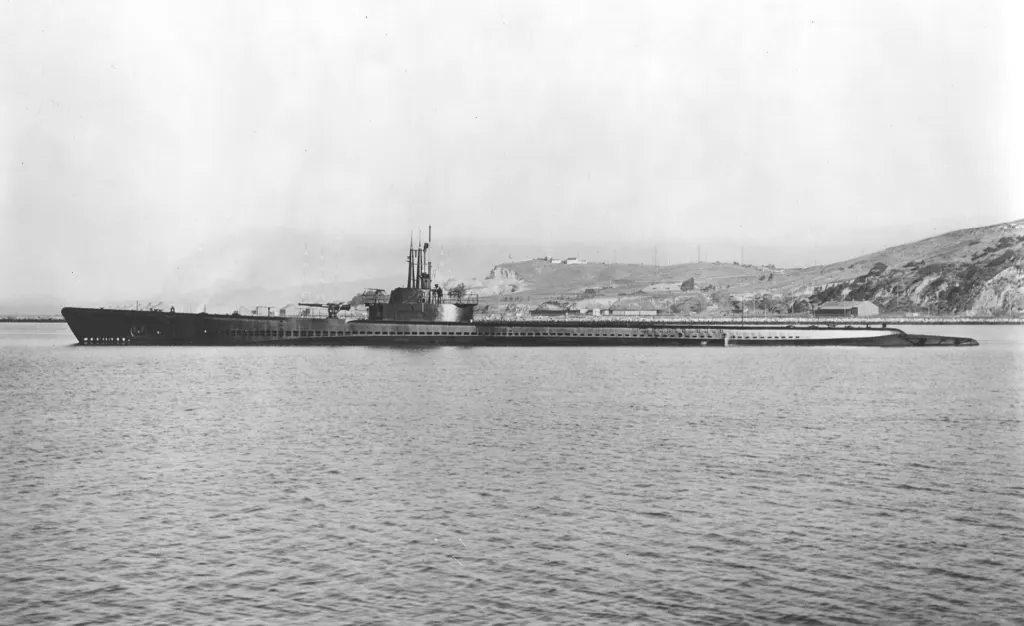
USS Tang spent barely nine months hunting in the Pacific, yet the US submarine is now credited with sinking 33 ships totaling 116,454 tons in 1944, more than any other American submarine of World War II by both count and tonnage. Her captain, Richard O’Kane, came home a prisoner of war and left with the Medal of Honor.
From Wahoo’s bridge to Tang’s
O’Kane, born in Dover, New Hampshire, in 1911, learned his trade as executive officer of USS Wahoo under Dudley “Mush” Morton. Morton reversed the usual roles, working the attack plot himself while O’Kane handled the periscope. When O’Kane took command of the new Tang at Mare Island, California, on October 15, 1943, he brought that hands-on approach with him.
He favored night surface attacks and extra daylight lookouts. More than once he steered Tang straight into the middle of an escorted convoy and fired at targets ahead and astern, trusting the boat’s low silhouette and speed to get her out again.
A record patrol and a rescue mission
Tang’s third patrol, into the East China Sea and Yellow Sea in June and July 1944, became the best single patrol of the war by ships sunk. O’Kane reported eight; postwar checks of Japanese records raised it to 10. In one attack he aimed six torpedoes at two ships,; four were hit.
Not every patrol was about sinking. On her second patrol, off Truk in the Caroline Islands, Tang served as a lifeguard for carrier aircraft and picked up 22 downed airmen, work that earned the crew a Presidential Unit Citation.
How the count kept changing
Wartime credit, postwar audit and later research gave three very different answers:
- During the war: 31 ships, about 227,800 tons, a total no other US boat matched.
- After the 1947 Joint Army-Navy Assessment Committee review: 24 ships and 93,824 tons, second to USS Tautog on ships and fourth on tonnage.
- Current figure: 33 ships and 116,454 tons, first on both lists, ahead of Tautog’s 26 ships and Flasher’s 100,231 tons.
Put simply, the committee’s audit cut Tang’s tonnage by roughly 59 percent, and the later revision restored about 22,600 tons and nine ships to her record.
The last torpedo
On her fifth patrol, in the Formosa (Taiwan) Strait, Tang chose to travel alone rather than with a group that included USS Silversides. Over October 23 and 24, 1944, O’Kane made two night attacks on convoys. At 2:30 a.m. on October 25, the 24th and final torpedo, a Mark 18, broke the surface and curved back in a circular run. It struck Tang near the stern, and the submarine sank in about 180 feet of water.
Seventy-eight men were lost. Nine survivors, O’Kane among them, were taken prisoner. Some of them had escaped from the sunken boat using the Momsen lung breathing device, the only known time it was used that way. O’Kane was held at Ōfuna and later the Omori camp until the war ended, weighing under 100 pounds at his release.
A medal, a destroyer and a cribbage board
President Harry S. Truman presented O’Kane with the Medal of Honor for the October 1944 attacks. He retired as a rear admiral in 1957, wrote Clear the Bridge! about Tang’s patrols, and died in 1994. The Navy named the destroyer USS O’Kane (DDG-77) for him in 1998.
His wartime cribbage board went down with Tang, but the crew of a later USS Tang gave him a replacement in 1957. Since his death it has passed to the oldest fast-attack submarine in the Pacific Fleet; USS Scranton received it in March 2025.
Two other Pacific veterans have had recent attention on Badiyaa: USS Silversides, out of the water for restoration, and USS Cobia’s tow up Lake Michigan to dry dock. For another 1944-45 Pacific story, read how the Navajo Code Talkers sent 800 error-free messages at Iwo Jima.
Tang was struck from the Naval Vessel Register on February 8, 1945. Like every US submarine lost at sea, she was never decommissioned and is listed as on “Eternal Patrol.”
Further reading
Image: Unknown photographer (U.S. Navy), Public domain via Wikimedia Commons
This article was produced with AI assistance and reviewed by our Editorial Desk. How we work.