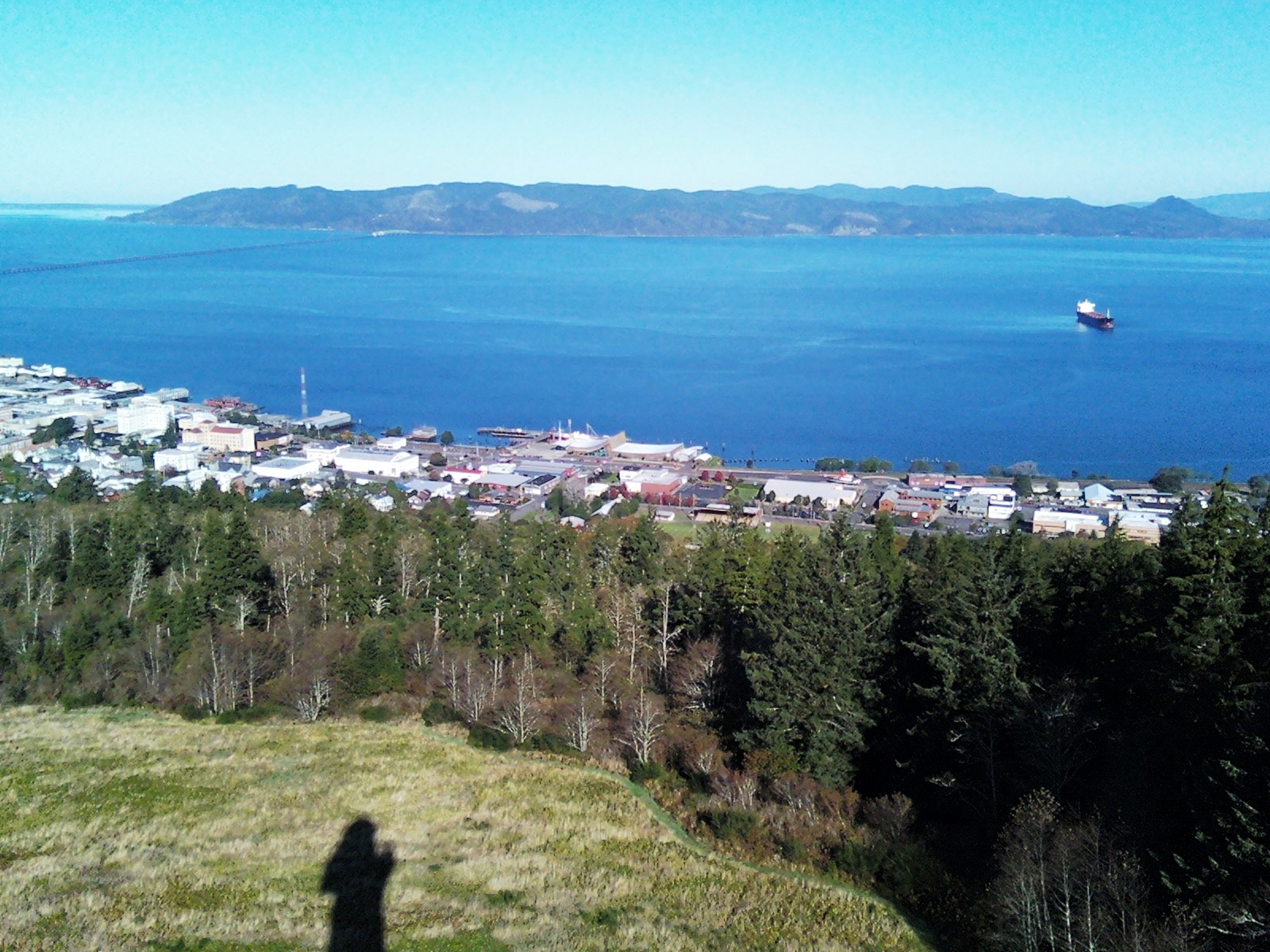
William Clark thought he had reached the Pacific on November 7, 1805. He had not. The spot where the Corps of Discovery camped that night, beside a tall basalt rock on the Washington shore of the Columbia River, was still more than 20 miles from the open ocean, and the men would need about two more weeks to get there.
That did not stop Clark from writing one of the most famous lines in American exploration. In his fuller journal entry for the day, as transcribed in the University of Nebraska–Lincoln edition of the Lewis and Clark journals, he wrote:
"Great joy in camp we are in View of the Ocian, this great Pacific Octean which we been So long anxious to See. and the roreing or noise made by the waves brakeing on the rockey Shores (as I Suppose) may be heard distictly"
His rougher field version, written the same day, is shorter: "we are in view of the opening of the Ocian, which Creates great joy." Neither entry, as printed in the Nebraska edition, uses the punchy wording "Ocian in view! O! the joy," the version that circulates most widely today. The spelling, though, is authentically Clark's, who wrote "Ocian" and then "Octean" in the space of a single sentence.
What Clark was really looking at
The National Park Service account of "O Joy Day" is blunt: the Pacific "was still well beyond the horizon," and the expedition was looking at the Columbia estuary, the zone where ocean tides push into the river and salt water mixes with fresh. The Nebraska edition's editors add a one-line footnote that says the same thing.
The camp sat opposite Pillar Rock in what is now Wahkiakum County, Washington. Clark measured the rock at about 50 feet high and 20 feet across. The editors note it may once have stood 70 to 100 feet above the water before its top was removed for navigation lights.
A soggy, foggy day of 34 miles
The day had started in thick fog and rain. The party lost one canoe in the murk for hours, found a local guide dressed in a sailor's outfit to steer them into the main channel, and traded fish hooks with Wahkiakum villagers for salmon, wapato roots and otter skins. Clark bought two beaver skins because his own robe was, in his words, "rotten and good for nothing." By nightfall the men had covered 34 miles and had to sleep on round stones, the only dry ground clear of the tide.
The trip in numbers
- May 14, 1804: the Corps leaves Camp Dubois in Illinois.
- November 7, 1805: Clark's "great joy" entry, 542 days later.
- November 24, 1805: the party votes on where to winter; Sacagawea and York, the Black man enslaved by Clark, both take part.
- September 23, 1806: the expedition returns to St. Louis, 862 days after setting out.
That November 24 vote, recorded in the Wikipedia history of the expedition, sent the men across the river to build Fort Clatsop near modern Astoria, Oregon. York's story ended far less happily: Clark refused to free him after the return, and he got none of the double pay and land the other men received.
The journals themselves took a long road to print. A heavily edited 1814 version left out much of the science, and the full text reached the public only with Reuben Gold Thwaites' 1904–1905 edition and Gary Moulton's later scholarly set, the basis of the Nebraska site.
The expedition was Thomas Jefferson's project, and Badiyaa has covered other Jefferson documents, including his 1802 letter on the wall of separation and the almanac Benjamin Banneker sent him in 1791. Clark's "great joy" came about two weeks early, but the ocean he heard that night was real enough, and the expedition reached it before November was out.
Sources
- November 7, 1805, Journals of the Lewis and Clark Expedition, University of Nebraska–Lincoln, 2026
- O Joy Day, November 7, 1805, US National Park Service, 2018
- Lewis and Clark Expedition, Wikipedia, 2026
Image: M.O. Stevens, CC BY-SA 3.0 via Wikimedia Commons
This article was produced with AI assistance and reviewed by our Editorial Desk. How we work.