Nikita Khrushchev’s most famous threat was delivered at a diplomatic party. On November 18, 1956, 70 years ago today, the Soviet leader turned to Western ambassadors at a reception in the Polish embassy in Moscow and told them: “Whether you like it or not, history is on our side. We will bury you!”
The room did not wait for a translation of his intent. Envoys from twelve NATO countries and Israel walked out. In the United States, many listeners heard the line as a promise of nuclear war, and “We will bury you” became one of the most quoted sentences of the Cold War.
The full remark
The burying line was the end of a longer jab at the capitalist states. Khrushchev began by telling the diplomats that “it doesn’t depend on you whether or not we exist,” and that if they did not like the Soviets, they need not accept or send invitations. Only then did he say history was on his side, followed by the four words that made headlines. Communist Polish leader Władysław Gomułka was in the room when he said it.
The English wording came from Viktor Sukhodrev, Khrushchev’s personal interpreter. The Russian original was “My vas pokhoronim!”
What he said he meant
Khrushchev spent years walking the phrase back. Speaking in Yugoslavia on August 24, 1963, he said: “I once said, ‘We will bury you,’ and I got into trouble with it. Of course we will not bury you with a shovel. Your own working class will bury you.”
That second sentence is the key. It points to a stock Marxist idea that the working class is capitalism’s undertaker, rooted in the first chapter of the Communist Manifesto, which says the bourgeoisie produces “above all, are its own grave-diggers.” Read that way, Khrushchev was forecasting that communism would outlive capitalism and be around for its funeral, not announcing an attack. In his memoirs he complained that “enemy propaganda picked up the slogan and blew it all out of proportion.”
Translators have since suggested gentler English renderings, the most common being “We shall be present at your funeral.” Some writers also blame a hand-clasp gesture he reportedly made over his head while speaking, which Western audiences may have misread.
How Americans answered
The phrase followed Khrushchev to the United States. During his 1959 visit, Los Angeles mayor Norris Poulson told him to his face: “We do not agree with your widely quoted phrase ‘We shall bury you.’ You shall not bury us and we shall not bury you.”
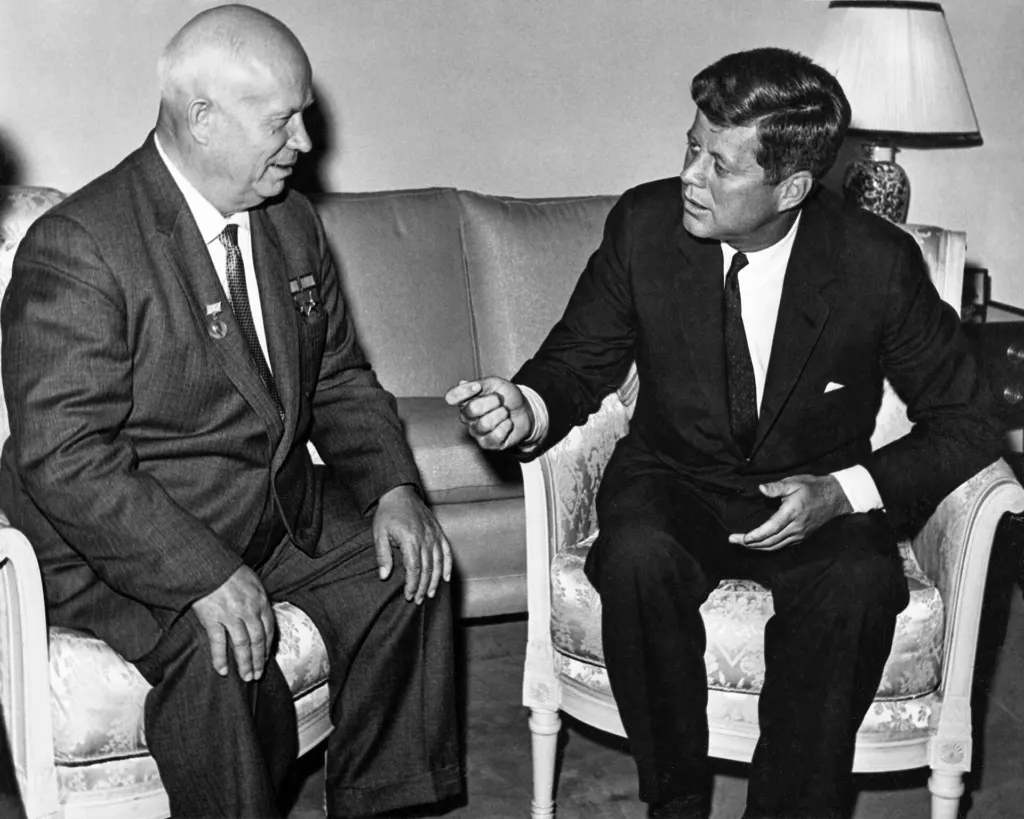
Khrushchev’s own manner did not help his case. He was known for interrupting, fist-banging and table-thumping, which made a menacing reading easy to believe. The same leader would later stand at the center of the 1962 Cuban missile standoff, and a year before that he met President John F. Kennedy in Vienna, the summit pictured above. The Cold War’s other famous speeches are worth reading side by side, from Kennedy’s ‘We choose to go to the moon’ address at Rice to the tensions behind the 1983 Able Archer NATO war game.
Timeline of a misunderstood line
- 1848: The Communist Manifesto calls the bourgeoisie the producer of its own grave-diggers.
- November 18, 1956: Khrushchev says “We will bury you!” at the Polish embassy in Moscow; Western envoys leave.
- 1959: Los Angeles mayor Norris Poulson rebuts the phrase to Khrushchev in person.
- August 24, 1963: In Yugoslavia, Khrushchev says the working class, not a shovel, would do the burying.
- 1985: The phrase turns up in Sting’s song “Russians”.
Superpower rivalry later moved into sport too, as when Ted Turner launched the Goodwill Games in Moscow in 1986. Khrushchev’s line has outlasted the state he led: the Soviet Union dissolved in 1991, 35 years after he promised to attend capitalism’s funeral.
Further reading
Image: U.S. Department of State (John F. Kennedy Presidential Library and Museum), Public domain via Wikimedia Commons
This article was produced with AI assistance and reviewed by our Editorial Desk. How we work.